 Society

Việt Nam, Switzerland to turn education, sci-tech, innovation into cooperation focus
1.
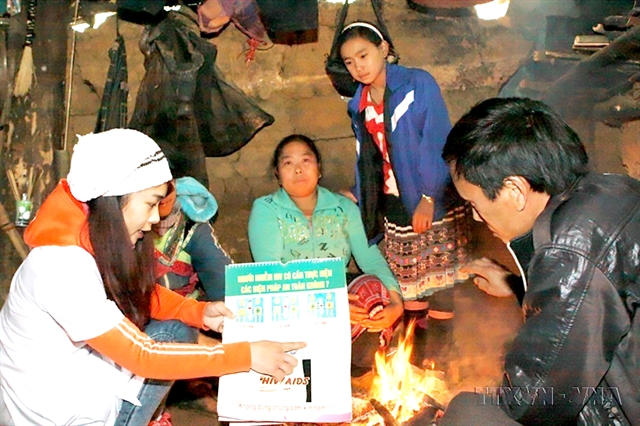 |
| A medical worker gives instruction on HIV/AIDS prevention to residents in Lai Châu Province. — VNA/VNS Photo Dương Ngọc |
HÀ NỘI — Marking a pivotal point in Việt Nam’s 35-year battle against HIV/AIDS, health officials said the country’s response has been defined by perseverance, sacrifice and progress that has earned international recognition.
Nguyễn Lương Tâm, Deputy Director of the Việt Nam Administration of Disease Prevention (VADP) under the Ministry of Health, told a conference on HIV/AIDS prevention and control organised by the VADP in Hà Nội on Tuesday that Việt Nam had transformed its approach since the earliest, most anxious days of the pandemic.
“From the initial days of facing the pandemic with anxiety and shortages to now, Việt Nam has built a strong, humane and effective HIV/AIDS prevention and control programme recognised by the international community,” said Tâm.
This year, the Ministry of Health chose "Unity is strength – Join hands to end the AIDS epidemic" as the theme for the National Action Month for HIV/AIDS prevention and control, which has run from November 10 to December 10.
“This is not just a slogan but a deep reminder of the core value behind all achievements over the past 35 years: the power of unity, of solidarity, shared responsibility and close cooperation among individuals, communities and society as a whole,” said Tâm
 |
| Nguyễn Lương Tâm, Deputy Director of the Việt Nam Administration of Disease Prevention, speaks at the conference. — VNS Photo Thu Trang |
However, the HIV/AIDS situation in Việt Nam remains complex, according to Tâm.
Last year, more than 68 per cent of new HIV cases were detected in the Mekong Delta, the southeast region and HCM City, with sexual transmission accounting for over 80 per cent of new infections, reflecting shifts in transmission pathways.
People aged 15–29 form a large proportion of new infections, with more than 80 per cent being men.
Notably, HIV rates among men who have sex with men and transgender individuals are rising significantly.
There is also an increasing trend of infections in non-key provinces, alongside risky behaviours such as synthetic drug use, chemsex and group sex.
Việt Nam has made notable efforts in prevention and control, conducting more than two million HIV tests, managing antiretroviral treatment for over 176,000 patients and maintaining effective methadone treatment for more than 46,500 people.
Initiatives such as extended methadone dispensing and expanded pre-exposure prophylaxis ensure diverse risk groups have access. Digital transformation in epidemic management through the nationwide HIV-INFO system has also shown positive results.
“Nevertheless, challenges remain, especially stigma, discrimination and difficulty accessing high-risk groups. This year’s action month aims to raise community awareness and promote specific actions to ensure equal access to HIV/AIDS prevention and control services,” said Tâm.
He expressed his hope that media agencies would actively promote the message "Unity is strength – Join hands to end the AIDS epidemic" to enhance public awareness and foster commitment.
Progress
 |
| Raman Hailevich, United Nations Programme on HIV/AIDS (UNAIDS) Country Director in Việt Nam, commends remarkable progress Việt Nam has achieved in HIV epidemic control. — VNS Photo Thu Trang |
Speaking at the conference, Raman Hailevich, United Nations Programme on HIV/AIDS (UNAIDS) Country Director in Việt Nam, said UNAIDS and WHO had worked with VADP last year to conduct a mid-term assessment of Việt Nam’s national strategy to end AIDS by 2030.
“Between 2004 and 2024, HIV prevention efforts in Việt Nam prevented more than 1.2 million infections and nearly 320,000 AIDS-related deaths,” he said.
Between 2021 and 2024, PEPFAR, the Global Fund, the UN and other development partners provided US$208.5 million to Việt Nam’s response.
“In a hypothetical – but not unrealistic – scenario where this support disappears and no domestic bridge is built, Việt Nam could face a resurgence of HIV infections to levels not seen since 2010, erasing more than a decade of hard-won progress. This is the challenge of the moment: how to sustain a strong, equitable HIV response with far less external support,” he said.
Việt Nam has been somewhat shielded from this shock, largely due to its existing and stable domestic financing for ART and MAT. However, several essential services still rely heavily on external funding, including HIV case-finding, PrEP and second-line ART.
“I commend the MoH and the VADP for their determination to integrate these costs into the National Target Programme on Health, Population and Development, the Disease Prevention Fund and other national mechanisms to achieve full self-reliance by 2029 and safeguard the national response well beyond 2030,” said Raman.
“Looking back at the 35-year journey of Việt Nam in the response to HIV, we can also see how critical strong political leadership and embracement of evidence-informed, inclusive and people-centred approaches have been in making possible all the remarkable progress Việt Nam has achieved in HIV epidemic control.”
These approaches, he added, must be further strengthened and fully embraced, particularly as Việt Nam faces an evolving HIV epidemic and shifting transmission patterns.
“Doing so will enable Việt Nam to stay on the right track to achieve national HIV goals and end AIDS as a public health threat by 2030,” said Raman. — VNS
Society
 Society
 Society
 Society
 Society
 Society
 Society
 Society
 Society
 Society
 Society
 Society
 Society
 Society
 Society