 Politics & Law
84 individuals investigated for transnational online frauds
1.
|
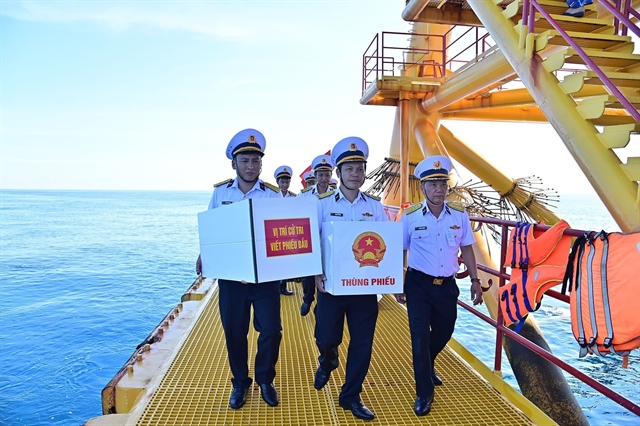
| Election officials carry the ballot box and essential materials to DK1/9 offshore platform to facilitate early voting. — VNA/VNS Photo |
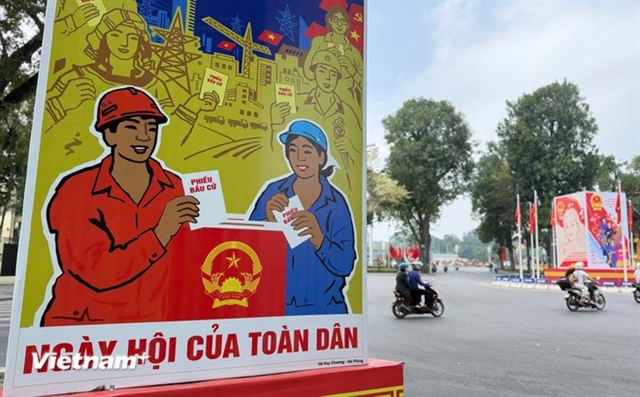
HÀ NỘI — With just half a month remaining until March 15, voters across Việt Nam will head to the polls to elect outstanding representatives to the 16th National Assembly and People’s Councils at all levels for the 2026–2031 tenure, in what authorities describe as a significant political event during a period of extensive reform and administrative restructuring.
As the country enters a new era marked by sweeping institutional reforms and administrative reorganisation, the upcoming election represents not only a nationwide democratic exercise conducted in accordance with the Constitution and law but also a major political milestone underscoring national unity.
The election takes place at a particularly important juncture as the Party, people and armed forces continue implementing the Resolution of the 14th National Party Congress while, for the first time, operating a two-tier local government model nationwide.
Speaking at a national conference on election preparations on November 15, 2025, Party General Secretary Tô Lâm said the election provides an opportunity to demonstrate the Party’s leadership capacity, the State’s governance effectiveness and the operational efficiency of the political system following the streamlining of organisational structures, mergers of administrative units and restructuring of local governments under the new model.
The election has therefore been identified as a central political task for 2026. The entire political system has been tasked with ensuring thorough preparations so that the vote is conducted democratically, in accordance with the law, safely and efficiently, and in a manner that reflects a nationwide civic occasion.
Following the third consultative conference, the National Election Council issued Resolution No. 151 on February 14, announcing a final list of 864 candidates for the 16th National Assembly across 182 electoral constituencies.
Of these, 217 candidates were nominated by central agencies and 647 by localities, ensuring an average ratio of 1.73 candidates per seat. Four candidates are self-nominated, accounting for 0.46 per cent of the total. Authorities said the overall composition meets regulatory requirements and structural orientation.
“The preparation of personnel for candidacy in the 16th NA and People’s Councils for the 2026–2031 tenure has been implemented in a synchronised, rigorous and lawful manner, fully complying with procedures, authority, standards and eligibility requirements,” said NA Secretary General and Chairman of the NA Office Lê Quang Mạnh, who also serves as Chief of Office of the National Election Council, at a nationwide online conference held on February 26.
Digital transformation reshapes election management
The 2026 election introduces several unprecedented reforms, including the implementation of the two-tier local government model, shortened electoral procedures and expanded application of information technology and digital transformation. These measures amount to a comprehensive technical overhaul aimed at optimising electoral processes.
According to the Ministry of Public Security, integration of the National Population Database and the VNeID digital identification platform marks a significant step forward in compiling voter lists. To date, 3,320 out of 3,321 commune-level administrative units nationwide, excluding the Hoàng Sa Special Administrative Zone, have adopted digital management software. Authorities said this has enabled the allocation of more than 78.5 million voters to polling stations, achieving a reported accuracy rate of 99.48 per cent.
|
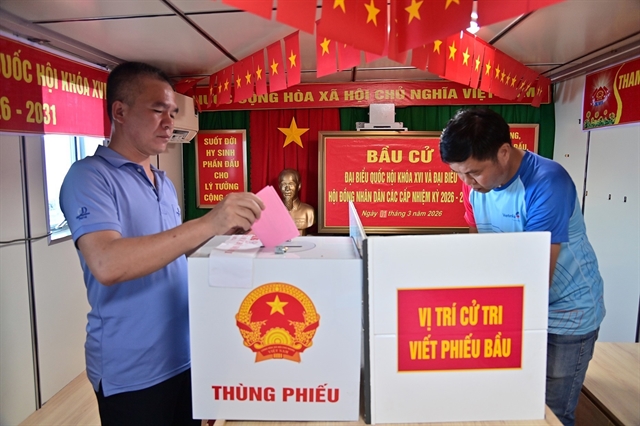
| Crew members of Hải An 68 cast their ballots in the election aboard the Trường Sa 04 vessel while on duty at sea. — VNA/VNS Photo |
Artificial intelligence has also been applied in editing and producing election communication materials, making information more accessible, engaging and easier for voters to understand. In previous elections, localities such as Hà Tĩnh Province relied primarily on traditional channels, including loudspeaker systems, posters, banners and community meetings. This year, alongside those conventional methods, many communes and wards, including in mountainous and remote areas, have actively adopted digital tools, using social media and online platforms to bring election information closer to citizens.
These digital transformation efforts have strengthened election preparations by improving efficiency and accuracy while making public access to information easier. In turn, this has enhanced voter awareness and reinforced citizens’ understanding of their rights and responsibilities.
In Hà Nội, a comprehensive system of directives has been established from the municipal Party Committee to grassroots authorities, with responsibilities clearly assigned to members of election committees and subcommittees. Key milestones have been met on or ahead of schedule.
The capital has also proactively deployed election information management software at the commune level and coordinated with telecommunications providers to issue user accounts and provide professional training. The use of the National Population Database and VNeID has further improved accuracy and transparency in voter registration and population statistics.
Election supervision and inspection have been strengthened, alongside improvements in receiving citizens and resolving complaints and denunciations in accordance with the law. Measures to safeguard security, public order and safety have been prioritised, with contingency plans in place to address potential risks.
Strengthening trust
Politburo member and Permanent member of the Secretariat Trần Cẩm Tú recently signed Conclusion No. 03-KL/TW on February 23, reaffirming the continued implementation of Directive No 46-CT/TW on leadership of the election.
The Politburo has called on Party committees and organisations at all levels to ensure high-quality personnel preparation while promoting democracy under the Party’s unified leadership in cadre work. Candidate composition must reflect balanced representation from Party and State agencies, the armed forces and the Việt Nam Fatherland Front, while ensuring appropriate proportions of women, ethnic minorities, religious representatives, young candidates, scientists, intellectuals, artists, workers, farmers, entrepreneurs and professional associations.
|
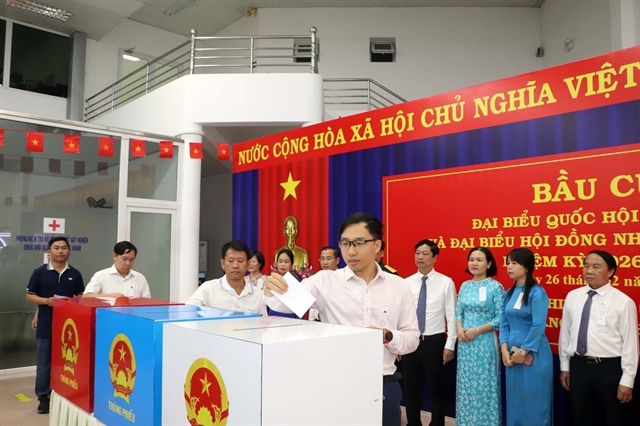
| Voters cast their ballots at the Vũng Tàu Airport polling station. VNA/VNS Photo |
The election also aims to fill all National Assembly and People’s Council seats while improving the quality of elected representatives and increasing the number of full-time National Assembly deputies, with projections of 145 full-time deputies at the central level and 55 at the local level.
Early voting has already been conducted in several special areas. On the morning of February 26, early voting took place at four polling stations in Tam Thắng Ward, Phước Thắng Ward and Long Sơn Commune in HCM City. These voters, primarily offshore oil rig workers and personnel on maritime duty, exercised their voting rights ahead of the official polling day due to work commitments at sea.
By noon on March 1, all voters stationed at DK1/9 offshore platform in Bombay Castle under Naval Region 2 had completed early voting in what authorities described as a safe and solemn process, ensuring the electoral rights of citizens serving on the nation’s frontline.
According to the National Election Council, supervision has been conducted rigorously at both central and local levels, with two rounds of inspection completed in 24 key cities and provinces. Additional inspection delegations are continuing their work nationwide throughout early March.
Nguyễn Thị Việt Nga, Deputy Head of the Hải Phòng National Assembly delegation, said the ongoing restructuring of administrative units and local governance is intended to improve national governance effectiveness, placing higher demands on the quality of elected representatives.
“The reforms introduced in this election are directed toward three overarching goals: political synchronisation, modern and transparent electoral processes and substantive improvements in the quality of elected representatives,” she said.
With comprehensive preparations and the full engagement of the political system, each ballot cast on March 15 will represent not only a citizen’s right and duty but also a vote of confidence in a streamlined and effective State apparatus, guiding Việt Nam into a new stage of development. — VNS
Politics & Law
 Politics & Law
 Politics & Law
 Politics & Law
 Politics & Law
 Politics & Law
 Politics & Law
 Politics & Law
 Politics & Law
 Politics & Law
 Politics & Law
 Politics & Law
 Politics & Law
 Politics & Law
 Politics & Law