 Politics & Law

84 individuals investigated for transnational online frauds
1.
|
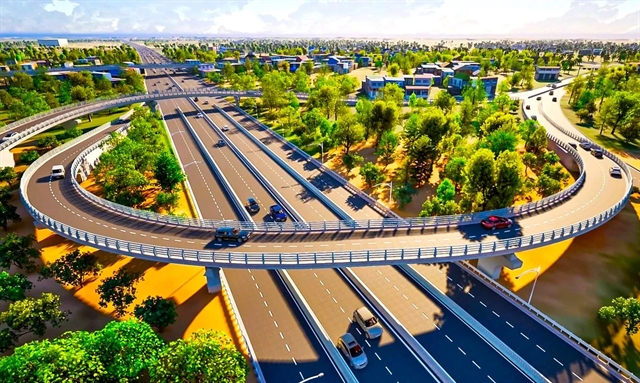
| Artist’s impression of the HCM City-Mộc Bài Expressway, proposed for connection with Cambodia’s Phnom Penh-Bavet Expressway. — Photo courtesy of the Ministry of Construction |
HCM CITY — Việt Nam's Ministry of Construction has proposed a plan to connect the planned HCM City-Mộc Bài Expressway with Cambodia’s Phnom Penh-Bavet Expressway, aiming to improve cross-border transport links and boost regional trade between Việt Nam and Cambodia.
Under the proposal submitted to the Government, the two highways would be linked in phases via the existing Mộc Bài-Bavet International Border Gate, which currently handles most road traffic between the two countries.
Officials say the approach would allow early use of infrastructure already in place while longer-term technical and diplomatic arrangements are finalised.
Road connectivity between the neighbours currently relies on national highways leading to the border crossing (National Highway 22 on the Vietnamese side and National Road 1 on the Cambodian side).
The ministry said new expressway links could significantly reduce travel time and logistics costs once completed.
Việt Nam is developing the nearly 51km HCM City-Mộc Bài Expressway under a public-private partnership (PPP) model, with construction authority assigned to the HCM City People's Committee.
The project will run from Ring Road 3 in HCM City to an area roughly 5km from the border gate, connecting to existing national highways.
On the Cambodian side, the roughly 135km Phnom Penh-Bavet Expressway, linking Phnom Penh with the border city of Bavet, broke ground in June 2023 under a PPP arrangement.
Cambodian authorities have left the final 15km segment near the border open pending agreement with Việt Nam on the exact connection point.
Officials said the current proposal builds on earlier bilateral studies. In 2017, transport agencies from both countries signed a memorandum noting research, supported by the Japan International Cooperation Agency (JICA), that outlined potential connection points near border markers 164 and 170.
Final alignment decisions were left to both governments.
According to the ministry, an inter-agency working group set up during 2023-25 reviewed technical options and conducted field surveys before recommending a two-phase approach.
The first phase would route traffic through the existing border gate to maximise immediate benefits from the HCM City-Mộc Bài Expressway once operational and ensure stable international freight flows.
The second phase would involve a direct expressway-to-expressway connection near border marker 170, aligned with a dedicated cargo clearance route at the border crossing.
Authorities say this option is consistent with current transport planning frameworks and has received initial backing from relevant ministries and local governments.
The ministry has asked the Government to approve the phased connection plan and instruct relevant agencies to complete technical, legal and diplomatic procedures required for implementation.
With an estimated investment of more than VNĐ19.6 trillion (US$780 million), including roughly VNĐ9.67 trillion in State funding, the HCM City-Mộc Bài Expressway is expected to become a key transport corridor linking southern Việt Nam’s economic hub with Cambodia and the broader Mekong sub-region.
Analysts say improved cross-border infrastructure could enhance trade efficiency, logistics competitiveness and regional integration, although timelines will depend on financing, construction progress and bilateral coordination. — VNS
Politics & Law
 Politics & Law
 Politics & Law
 Politics & Law
 Politics & Law
 Politics & Law
 Politics & Law
 Politics & Law
 Politics & Law
 Politics & Law
 Politics & Law
 Politics & Law
 Politics & Law
 Politics & Law
 Politics & Law