 Politics & Law
Vietnamese, Panamanian first ladies bond over ethnic textiles at Hà Nội cultural event
1.
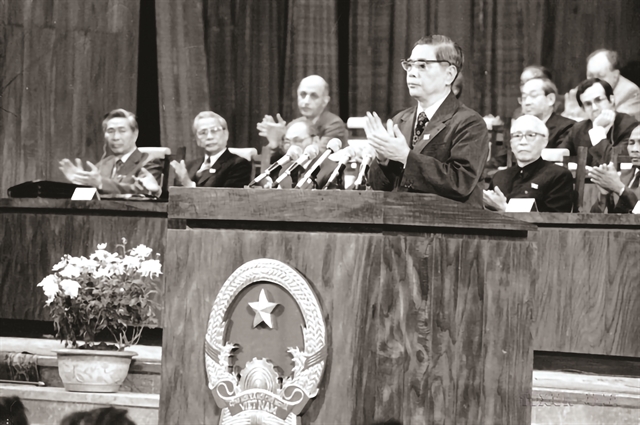 |
| Party General Secretary Nguyễn Văn Linh addresses the sixth National Congress of the Communist Party of Việt Nam in 1986. — VNA/VNS Photo |
HÀ NỘI — Nearly four decades after Đổi mới (Renewal) was launched at the sixth National Congress of the Communist Party of Việt Nam in 1986, the reform spirit that reshaped the nation continues to define its economic resilience, social transformation and rising international stature.
Looking back over the four decades since that decision, the country has not only emerged from crisis but advanced with renewed momentum. Living standards have steadily improved and Việt Nam has secured an international standing unmatched at any other point in its history.
At the start of 2026, as the 14th National Party Congress convened to chart strategic decisions for the years ahead, the enduring values and vitality of Đổi mới stand out more clearly than ever. They continue to provide both confidence and a firm foundation for the vision of a prosperous and powerful Việt Nam by 2045.
Years of hardship
In the early 1980s, despite national reunification, peace was fragile and daily life was harsh. For many households, ration coupons for essentials such as rice, cooking oil, cloth and soap were indispensable.
Family aspirations were modest and immediate: a meal that was filling, a roof that did not leak in the rainy season and a lamp bright enough for children to study at night.
Hà Nội and other major cities endured prolonged shortages of electricity, water and food. Scarcity meant demand outstripped supply, pushing up prices and weighing heavily on daily life.
Former vice chairman of the National Assembly Đặng Quân Thụy, then commander of the Chemical Corps and living on Trần Phú Street in Hà Nội, personally shared those hardships.
He recalled his family's meals disrupted by rain leaking through the roof, sending the whole family scrambling to fix it and children queuing to buy food and lamp oil, no different from any other household.
Phùng Huy Thịnh, now 73, a former official of the Bureau of Political Affairs of Army Corps 2, said rice was scarce while people were stretched across two frontlines – fighting the Khmer Rouge in Cambodia and defending the northern borders.
“We also had to save resources to support Laos and Cambodia. Hardships piled upon hardships,” he said.
In his recollection, Thịnh’s family of six siblings in Gia Lâm District on the outskirts of Hà Nội, survived through farming.
At the time, he was a junior officer transitioning to civilian life, earning a meager salary to support the entire family.
“Cloth was so scarce that we were allocated only four metres a person a year. I had to wear my old military uniform throughout my university years,” he recalled.
Former minister of foreign affairs Nguyễn Dy Niên said that during overseas trips, diplomats had to borrow clothing such as suits, shirts and even socks and shoes from the Ministry of Finance’s storage.
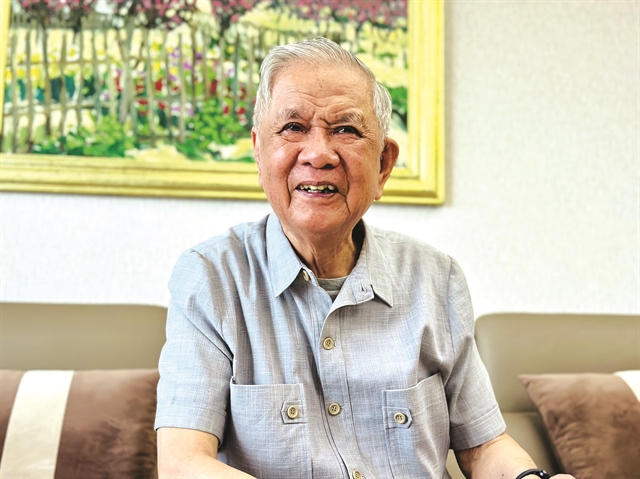 |
| Former minister for foreign affairs Nguyễn Dy Niên. — VNA/VNS Photo |
He said that staff members of the Vietnamese delegations to the United Nations in New York had to make use of cramped office space at the permanent mission, with two people sharing a small bed to save costs.
“Our delegations could not afford to be large. Each member had to do many tasks on their own. On the outside we wore suits and ties, but in reality life was extremely austere,” Niên said.
Breaking the deadlock
The sixth National Party Congress in 1986 marked a historic turning point, when the Party candidly acknowledged weaknesses and mistakes in economic management, resolved to untie entrenched constraints in thinking, shifted from a subsidy-based system to a socialist-oriented market economy and mobilised all social resources for national development.
This was followed by major policies on pricing, wages, currency, finance and legal frameworks.
The bold renewal of thinking and departure from rigid planning quickly helped Việt Nam overcome crisis and achieve strong socio-economic development.
GDP grew by 4.4 per cent, the agricultural sector recorded growth of 4 per cent and export turnover rose by an average of 28 per cent annually.
From chronic food shortages, Việt Nam rose to become one of the world’s leading exporters of rice, coffee and seafood. Public confidence, once eroded, gradually returned.
Over the following two decades, Việt Nam maintained annual growth rates of 7–8 per cent, even amid regional financial crises and successive natural disasters.
This period laid the foundation for industrialisation and modernisation, opening new and lasting development space for the country.
Former vice chairman of the National Assembly Đặng Quân Thụy, said, “Now we can see even more clearly the correctness of the Đổi mới decision. It was truly a historic turning point that opened a way out for the nation.”
These achievements have been recognised by the international community.
The United Nations has assessed Việt Nam as one of the countries that achieved many Millennium Development Goals ahead of schedule, particularly in poverty reduction, education and health care, describing it as a “model for sustainable poverty reduction”.
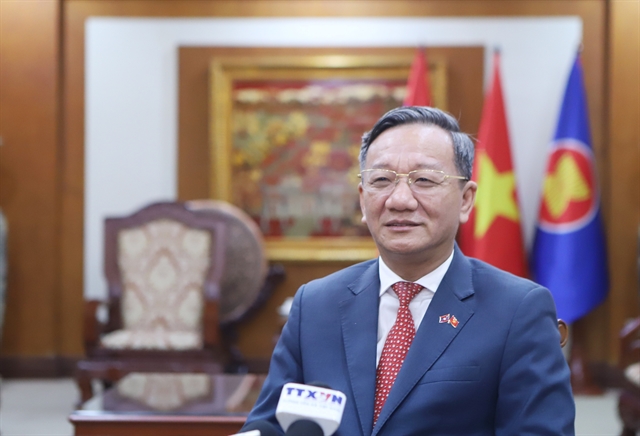
According to Professor V.G. Kolotov, director of the Việt Nam–ASEAN Research Centre at St Petersburg State University in Russia, today’s Việt Nam is vivid proof of the power of Đổi mới.
The country’s future, he noted, would depend on whether future generations continue to inherit that spirit so that the aspiration for national strength and prosperity becomes a reality.
Renewal as liberation
"Renewal" was not merely a change in the economic model but, first and foremost, a profound and courageous liberation of thinking. From dismantling the subsidy system, liberalising prices and reforming monetary and financial policies to building a legal framework for the private sector and opening up to international integration, these landmark decisions unleashed social resources and enabled Việt Nam to emerge from crisis.
Through these policies, the trust of the people and the business community was gradually restored, becoming a fundamental foundation for sustainable development.
Following the Law on Foreign Investment passed by the National Assembly shortly after the sixth National Party Congress, the Government issued a decree on foreign investment in 1977.
These pioneering steps laid the foundation for policies to attract foreign direct investment and promote international integration, even while the country remained under blockade and sanctions.
The real breakthrough that built confidence, however, came from agriculture.
The Politburo of the CPV adopted Resolution 10 in 1988 granting farmers long-term land-use rights and recognising them as autonomous producers.
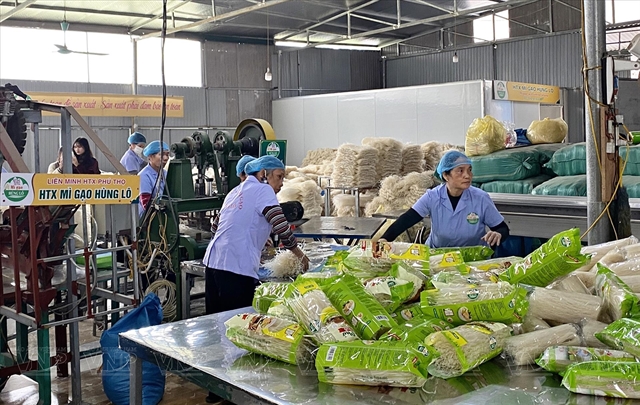
Once constraints were lifted, agricultural productivity surged and food output rose sharply. From shortage to surplus, Việt Nam had become one of the world’s leading rice exporters.
This foundation paved the way for the most comprehensive and decisive reform phase between 1990 and 1992.
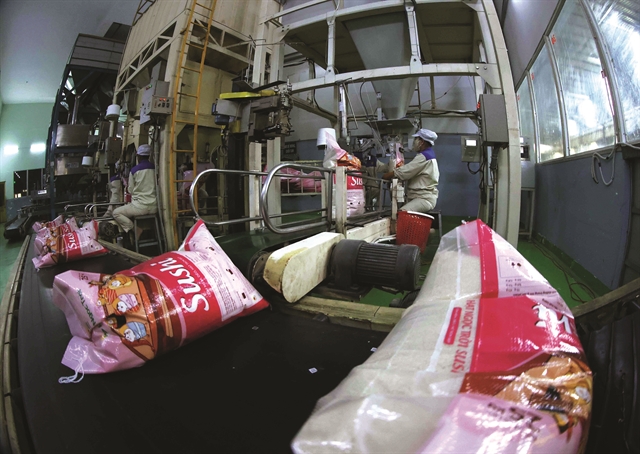 |
| Packaging rice in An Giang Province. Việt Nam has become one of the world’s leading rice exporters. — VNA/VNS Photo Vũ Sinh |
Within a short period, a series of key policies were introduced, including the Company Law and the Law on Private Enterprises, as well as the Law on Foreign Investment.
The 1992 Constitution formally recognised a multi-sector economy operating under market mechanisms with State management, marking a decisive and irreversible shift towards a socialist-oriented market economy.
Economist Nguyễn Đình Cung, former director of the Central Institute for Economic Management, said the early 1990s represented “the most thorough reform in the history of modern Việt Nam’s economy”.
The central bottleneck at the time was not a lack of capital or goods, but a non-market mechanism for allocating resources that suppressed production incentives. The State fixed prices, subsidised inputs and outputs and directly intervened in enterprises, leading to stagnation, depleted public finances and people seeking ways to leave the formal sector, he said.
The year 1994 marked another important shift in Party and State thinking with the introduction of the Law on the Promotion of Domestic Investment, followed by the Law on State-Owned Enterprises and the Law on Cooperatives.
These legal frameworks created space for Vietnamese citizens to conduct business freely and accumulate wealth, further consolidating a multi-sector economy.
The "two wings” of reform – the domestic market and international integration – were now moving in the same direction.
In particular, Việt Nam’s normalisation of relations with the United States, accession to ASEAN and the signing of the Việt Nam–US Bilateral Trade Agreement in 2000 opened up new development opportunities.
Exports grew rapidly and became a key driver of the economy.
Opening to the world
The peak of institutional reform came with the Enterprise Law and the Investment Law in 2005, which established a unified legal framework for all economic sectors.
This paved the way for Việt Nam’s accession to the World Trade Organization in 2007 and a record inflow of foreign direct investment in 2008, with total registered capital exceeding US$64 billion.
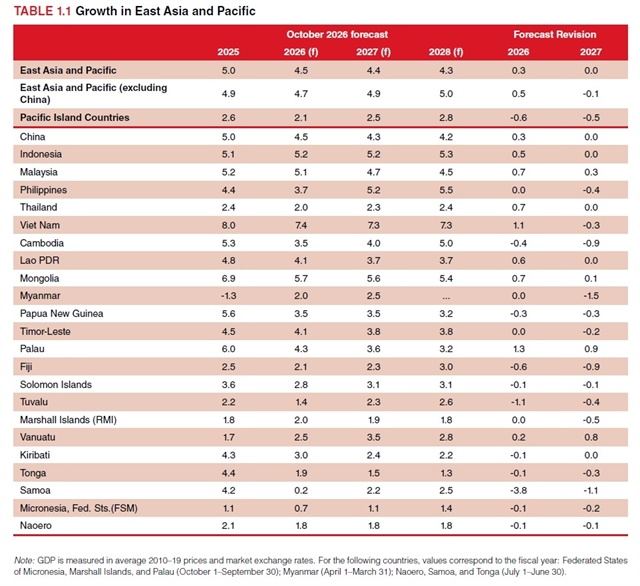
Reflecting on these landmark decisions, Manuela V. Ferro, World Bank vice president for East Asia and the Pacific, said the bold move to open the economy and prioritise exports from the late 1980s was among the key factors behind Việt Nam’s success today.
Economist Cung also stressed that the greatest achievement of Đổi mới was not merely GDP growth, but the establishment of an economic order based on market principles and the rule of law.
When the State shifted from doing everything itself to playing a facilitating role and when enterprises and citizens were trusted, the economy could function effectively, he said.
This shift was reflected in daily life: markets became more vibrant, goods more abundant, jobs more plentiful and people began to save and invest for the long term. Society moved from worrying about daily meals to focusing on education, employment and the future of the next generation, he said.
Diplomacy as a catalyst
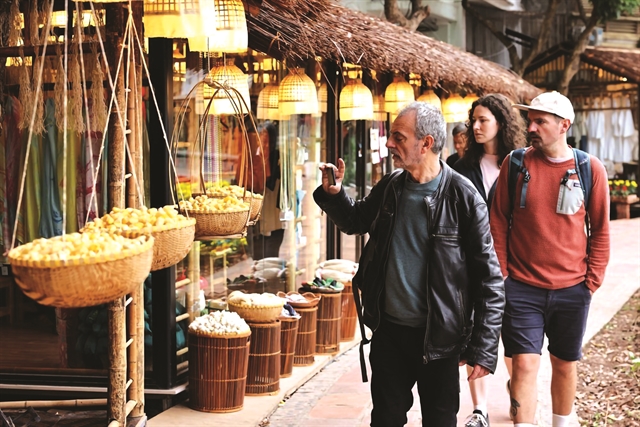 |
| Foreign tourists visit the Temple of Literature in Hà Nội during Lunar New Year 2026 holiday. — VNA/VNS Photo |
During her visit to Việt Nam in 2025, Australian Governor-General Sam Mostyn said the country’s rise over the past 40 years was astonishing.
Recalling her trip to Việt Nam in the early 1990s, she said foreign visitors were rare and the economy was struggling, yet the hospitality and sincerity of the Vietnamese people left a deep impression.
One or two decades later, on her return to Hà Nội, Mostyn witnessed “one of the most dynamic and successful economies in the region,” describing it as “a lesson for the whole world on how to develop a nation.”
Entering the 1990s, a historic milestone was Việt Nam’s decision to join ASEAN in 1995. This was not merely a diplomatic move but a proactive and confident strategic choice that placed Việt Nam firmly within regional and global cooperation frameworks.
From a once isolated country, Việt Nam now maintains diplomatic relations with 194 nations and has established a network of 37 comprehensive partnerships or higher, including all permanent members of the United Nations Security Council, all ASEAN countries and most of the world’s major economies.
Việt Nam is an active member of more than 70 international organisations, has twice served as a non-permanent member of the UN Security Council and twice as a member of the UN Human Rights Council.
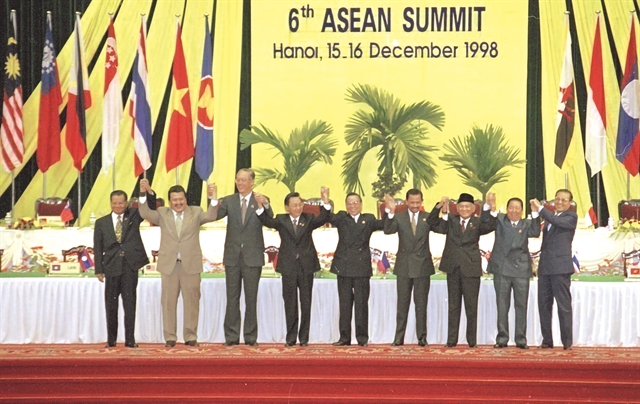 |
| Việt Nam hosts the sixth ASEAN Summit in 1998. — VNA/VNS Photo |
According to Deputy Prime Minister Bùi Thanh Sơn, throughout the Đổi mới process, diplomacy has played a pioneering role in building peace and safeguarding the country from early on and from afar, creating the most favourable external environment to date for national construction and defence.
The current foreign policy of independence, self-reliance, peace, cooperation and development, multilateralisation and diversification and active international integration in the service of national and ethnic interests is the crystallisation of the renewal and opening-up process.
Enduring value of renewal
Manuela V. Ferro of the World Bank said "Việt Nam is a textbook success story of economic development". Over the past four decades, household incomes have increased sixfold and extreme poverty has been nearly eradicated.
She said a key highlight was the bold decision in the 1980s to open the economy and prioritise exports.
Australian Ambassador to Việt Nam Gillian Bird observed that alongside impressive economic growth, Việt Nam’s external relations had been particularly noteworthy.
The country’s extensive diplomatic network, comprehensive strategic partnerships and free trade agreements demonstrate that today’s Việt Nam has an outward-looking vision and is proactively integrating deeply into the world, according to the ambassador.
New Zealand Ambassador Caroline Beresford also expressed admiration for Việt Nam’s pace of growth and the scale of its reforms, describing the lifting of tens of millions of people out of poverty since 1990 as a truly remarkable and internationally recognised achievement.
Looking ahead, the spirit of Đổi mới remains not only a historical legacy but a living force shaping Việt Nam’s present and future.
As the country advances towards its centenary milestones in 2030 and 2045, the enduring lesson of renewal — daring to confront reality, liberate thinking and place trust in the people — continues to guide Việt Nam’s path towards prosperity, resilience and national strength. — VNS
Politics & Law
 Politics & Law
 Politics & Law
 Politics & Law
 Politics & Law
 Politics & Law
 Politics & Law
 Politics & Law
 Politics & Law
 Politics & Law
 Politics & Law
 Politics & Law
 Politics & Law
 Politics & Law
 Politics & Law