 Politics & Law
Việt Nam, Singapore promote cooperation through Party-to-Party channel
1.
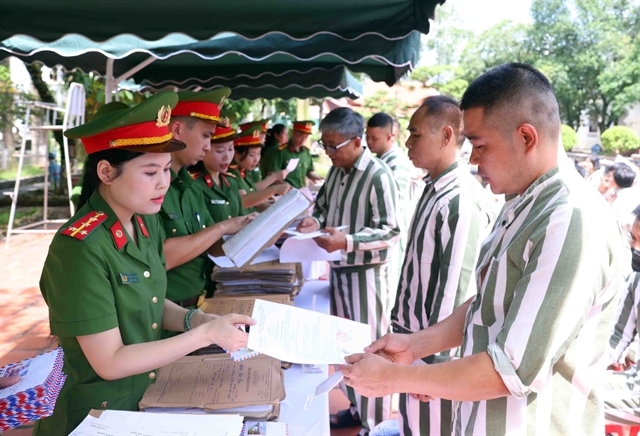 |
| Officials of the Phú Sơn 4 Prison in Thái Nguyên Province present amnesty certificates to the amnestied individuals. — VNA/VNS Photo Phạm Kiên |
HÀ NỘI — Amnesty is a major policy showing a lenient and humanitarian approach deeply imbued with the cultural identity and noble traditions of the Vietnamese nation, reflecting both the strictness of the law and profound humanity.
Deputy Prime Minister and also Chairman of the Amnesty Advisory Council Nguyễn Hòa Bình stated on Thursday while attending a conference held by the Ministry of Public Security (MPS) to review the amnesty work and community reintegration of those granted amnesty this year.
The Amnesty Advisory Council this year submitted to the State President to grant early release to nearly 22,100 people, allowing them to return to society and reunite with their families for the April 30 and September 2 anniversaries.
According to monitoring by relevant agencies and reports from the MPS, security and order related to the amnesty work have been well maintained.
Deputy PM Bình acknowledged and praised ministries, agencies and localities for well implementing the amnesty policy; proactively coordinating to carry out community reintegration for those granted amnesty as they return to families and society.
Building on the nation’s humanitarian tradition, over the past 80 years the Party and State have granted early amnesty to hundreds of thousands of inmates.
Since 2009, the State President has granted early amnesty to over 100,000 people. Those released have been welcomed by families, various agencies, organisations and social groups that create conditions to help them stabilise life step by step and reintegrate into the community.
This year, State President Lương Cường issued two amnesty decisions. Despite the short timeframe from policy reporting to implementation, the members of the Amnesty Advisory Council along with ministries, especially prisons, detention centres and criminal enforcement agencies nationwide completed strictly, ensuring transparency, democracy and legality.
These results demonstrate the efforts of agencies, especially detention and criminal enforcement facilities, who with compassion and responsibility overcame many difficulties to manage, educate and reform inmates so that they could abandon past wrongs, comply with laws and prison regulations and actively study to become honest citizens. This also shows the accuracy and legality of the amnesty appraisal process.
Highlighting successes from the amnesty work, the Deputy PM said that the policy of leniency by the Party has been effectively implemented and the amnesty policy would continue to be well carried out in the future.
Along with other activities during recent holidays, the amnesty work has boosted public spirit during important celebrations and strengthened people's trust in the Party’s leadership.
Amnesty encourages inmates to strive for leniency.
Amnesty contributes to spreading goodwill, forgiveness and support to those who have made mistakes but want to reform and return to family and society.
Through these amnesties, the Party, State and Government’s humanitarian policies – such as vocational training, loans and job introduction for reformed inmates – have been well executed.
Valuable lessons have been learned to improve the management and education of inmates and the amnesty appraisal process, helping the police better fulfil their duties.
Under the leadership of the Party, Government and State President, all forces coordinated effectively, resulting in successful amnesty rounds.
Supporting amnestied individuals
To continue successfully implementing amnesty and community reintegration, Deputy PM Bình urged ministries, agencies and localities to review and build on previous amnesty results.
It is essential to regularly communicate and widely educate humanitarian and lenient policies on amnesty and relevant legal provisions.
Local governments, organisations and businesses should actively plan and create conditions to support amnestied individuals in returning and settling down quickly.
Public Security forces, especially local police, must advise Party committees and local authorities to manage, monitor, educate and assist those granted amnesty to find the right path.
“I hope all sectors will open their arms wide, create the best conditions for amnestied people to quickly reintegrate, participate in productive labour and become good citizens contributing to the community and society,” said the Deputy PM.
He also reminded the MPS, as the standing agency for amnesty work, to proactively advise the Party, State and Government on policies on amnesty. Based on practice, the MPS should lead coordination with related ministries to revise the Amnesty Law to align with other laws such as the Criminal Code, Criminal Procedure Code and Law on Criminal Enforcement.
Recently, the National Assembly passed several laws related to criminal enforcement and amnesty including laws on judicial assistance in criminal matters, prisoner transfer, temporary detention and prohibition from leaving residence and criminal enforcement law.
Deputy PM Bình requested the MPS and relevant agencies to urgently advise the Government and PM on directing implementation, focusing on drafting and rolling out decrees and circulars to guide enforcement and reintegration practices.
Additionally, the MPS and Ministry of National Defence should closely coordinate with other agencies to ensure absolute security and safety in detention facilities; fully implement policies and regimes for inmates to actively work and strive for early amnesty.
They should promote technology application, digital transformation, build smart detention facilities and modern and fair inmate management and education systems to facilitate regular inmate assessment and accurate amnesty appraisal when required. — VNS
Politics & Law
 Politics & Law
 Politics & Law
 Politics & Law
 Politics & Law
 Politics & Law
.jpg) Politics & Law
Politics & Law
 Politics & Law
 Politics & Law
 Politics & Law
.jpg) Politics & Law
Politics & Law
 Politics & Law
 Politics & Law
 Politics & Law
 Politics & Law