 Politics & Law

Huawei Commits to Advancing an Intelligent, Green Europe with Customers and Partners
1.

|
| Deputy Prime Minister Bùi Thanh Sơn delivers his speech at the conference on Thursday morning. — VNA/VNS Photo An Đăng |
HÀ NỘI — A total of 379 foreign non-governmental organisations (NGOs) were operating regularly in Việt Nam, with total aid commitments for the 2020-24 period reaching nearly US$1.14 billion as of November 30, 2025.
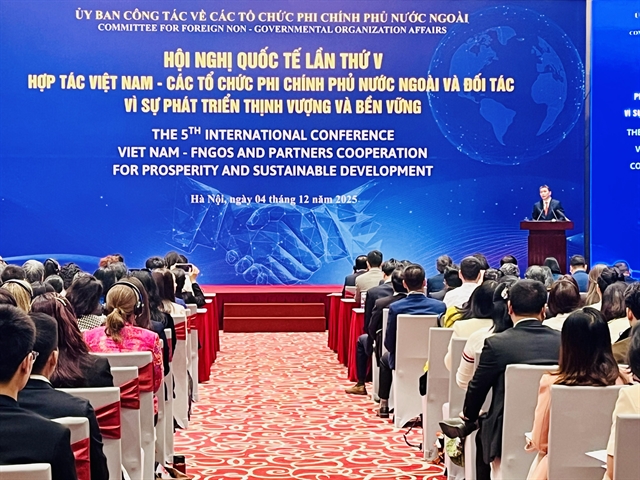
The figures were released on Thursday morning at the Fifth International Conference on Cooperation between Việt Nam and Foreign NGOs and Partners for Prosperity and Sustainable Development, organised by the Committee for Foreign NGO Affairs and the Việt Nam Union of Friendship Organisations (VUFO).
Presenting the conference report, Nguyễn Ngọc Hùng, VUFO Vice President, said foreign NGO projects are being implemented nationwide, focusing on essential areas such as health care, socio-economic development, social issues, education and training, natural resources and the environment, institutional capacity-building, and judicial support.
He said the achievements were made possible in large part thanks to Việt Nam’s enabling policies, most notably the National Programme on Strengthening Cooperation and Mobilising Foreign NGO Aid for 2019-25.
Despite complex and rapidly evolving global developments in recent years, cooperation between Việt Nam and foreign NGOs has remained stable, flexible and productive, he added.
Continued supports
Speaking at the conference, Deputy Prime Minister Bùi Thanh Sơn said that Việt Nam consistently supports and facilitates the operations of foreign NGOs, thereby helping to strengthen people-to-people relations, expand international cooperation, and mobilise resources for national poverty reduction and sustainable development.
He also said that cooperation between Việt Nam and foreign NGOs has proven to be an important diplomatic channel, complementing Party diplomacy, State diplomacy and people-to-people diplomacy.
He added that the Government would continue to introduce favourable policies for NGOs, encouraging the expansion of multi-stakeholder partnerships involving the public sector, private sector, as well as enterprises, research institutes, universities, international experts and local communities.
Sơn said that the contributions of foreign NGOs extend far beyond financial resources.
Their international expertise, creativity, humanitarian values and innovative approaches to community development are assets not easily found in other forms of cooperation.
“Cooperation between Việt Nam and foreign NGOs is therefore not merely supplementary, but an indispensable component of Việt Nam’s national development strategy,” he said.
Looking ahead, he expressed hope that NGOs would continue accompanying Việt Nam in priority areas such as human development, social welfare enhancement, climate change response, digital transformation, innovation, gender equality, and sustainable community development.
He also encouraged NGOs to keep sharing knowledge, technologies and international networks, helping Việt Nam participate more deeply in global initiatives.
He called on ministries, agencies and localities to renew their thinking and administrative methods, prioritising service to citizens and community development, proactively seeking aid sources, accelerating administrative reforms, promoting technological applications, and ensuring the long-term sustainability of projects.
“Cooperation involves not only sharing resources but also sharing vision, responsibility and trust,” Sơn said. "The Government’s commitment to listening, accompanying and providing the best possible conditions for NGOs to contribute effectively in Việt Nam.”
|
| VUFO President Phan Anh Sơn at the conference on Thursday morning in Hà Nội.— VNS Photo Nguyễn Hằng |
Vital component
Also at the event, VUFO President Phan Anh Sơn said that cooperation with foreign NGOs is an integral part of Việt Nam’s diplomacy in general and people-to-people diplomacy in particular.
The significant progress Việt Nam has achieved in poverty reduction and socio-economic development over the years has benefited from the support and solidarity of international friends, including foreign NGOs.
These outcomes demonstrate the trust, closeness and importance of the partnership between Việt Nam and foreign NGOs in the country’s development journey.
Entering a new development phase, Việt Nam encourages NGOs not only to maintain their strong performance in traditional areas but to expand into emerging priorities such as green and circular economy development, climate change adaptation, digital transformation at the community level, sustainable agriculture, social security system development, local-level capacity-building and innovation promotion.
Alongside the NGO community, Việt Nam also seeks broader collaboration with development partners, international organisations, financial institutions and domestic and foreign enterprises to establish multi-stakeholder cooperation models that meet new requirements, broaden resource mobilisation, and replicate successful practices.
To enhance cooperation effectiveness, VUFO proposed three key directions. The first direction is strengthening linkages within the development ecosystem, requiring closer coordination among NGOs, local authorities, businesses, research institutions and people’s organisations to maximise resources and avoid overlap.
The second direction is expanding effective cooperation models to create long-term impact, improve community capacity and promote sustainable development.
The third direction is consolidating trust and transparency, with Việt Nam committed to maintaining an open, responsible and legally compliant cooperation environment.
As the standing agency of the Committee, VUFO will continue listening to proposals and working with relevant authorities to identify effective solutions.
International partners’ perspectives
Speaking to the media on the sidelines of the conference, Christie Getman, country director of SNV Netherlands Development Organisation, said they appreciate the partnership and cooperation with the Government of Việt Nam, both with VUFO, which enables them to operate across the country, and with provincial authorities, the ministries of agriculture and environment, of industry and trade, as well as other ministries such as the Ministry of Finance.
They value the support that enables them to work closely with communities, farmers, cooperatives, emerging businesses and SMEs, all contributing to Việt Nam’s 2030 development strategy.
Naomi Cook, development counsellor at the Australian Embassy in Việt Nam, added they see “huge value in what NGOs bring to Việt Nam’s development.”
They are integral to how Australia delivers its development programme, and they are essential to Việt Nam’s own development efforts, she said.
"NGOs also reflect shared Australian and Vietnamese values. They strengthen the enduring ties between our two countries and enhance the two countries' people-to-people connections." — VNS
Politics & Law
 Politics & Law
 Politics & Law
 Politics & Law
 Politics & Law
 Politics & Law
 Politics & Law
 Politics & Law
.jpg) Politics & Law
Politics & Law
 Politics & Law
 Politics & Law
 Politics & Law
 Politics & Law
 Politics & Law
 Politics & Law