.jpg) Opinion
Opinion

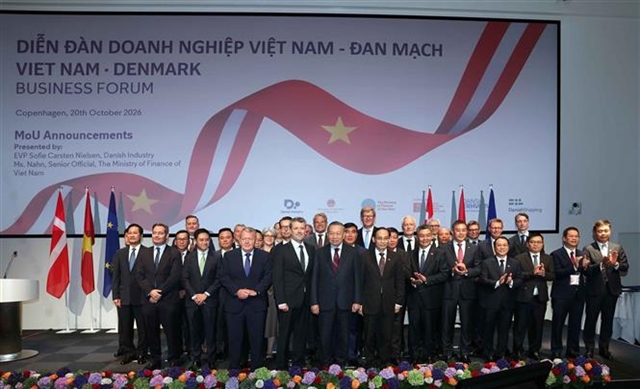
General Secretary and President Tô Lâm witnesses exchange of Việt Nam-Denmark cooperation agreements
1.
|
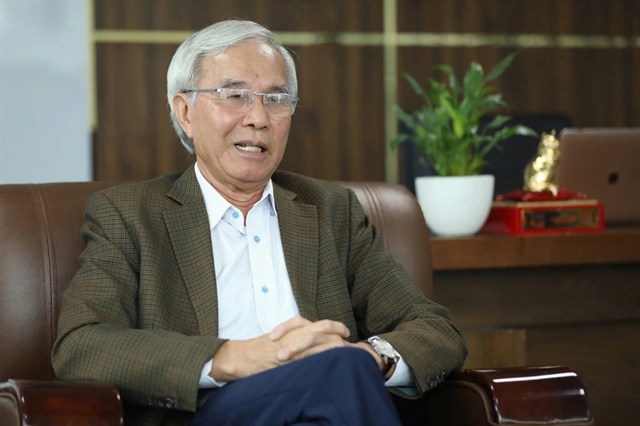
| Associate Professor Dr Trần Chủng, chairman of the Việt Nam Association of Road System Investors (VARSI). — VNA/VNS Photo |
How do you assess the role of infrastructure, especially major construction work and key projects, in the country’s socio-economic development?
From the 11th and 12th Party Congresses through to the 13th, Party resolutions have consistently identified three strategic breakthroughs for socio-economic development, one of which is infrastructure development, including transport infrastructure.
When transport is regarded as the ‘lifeblood’ of the economy, its role becomes indispensable to economic growth. Developing the expressway network is therefore a core objective in realising this strategic breakthrough. The planned 3,000km of expressways, expected to be completed soon, will lay the groundwork for achieving the target of 5,000km of expressways by 2030.
This reflects the tremendous efforts of the entire transport sector, local authorities and especially the attentive direction of the Government and the Prime Minister. Localities have also been proactive in land clearance and in supplying construction materials for projects.
Equally important is the engagement of private investors and enterprises through public-private partnership (PPP) models. They have contributed significantly to breakthroughs in the development of Việt Nam’s road transport infrastructure by accelerating construction progress, ensuring quality and achieving higher performance and efficiency with lower investment costs.
|
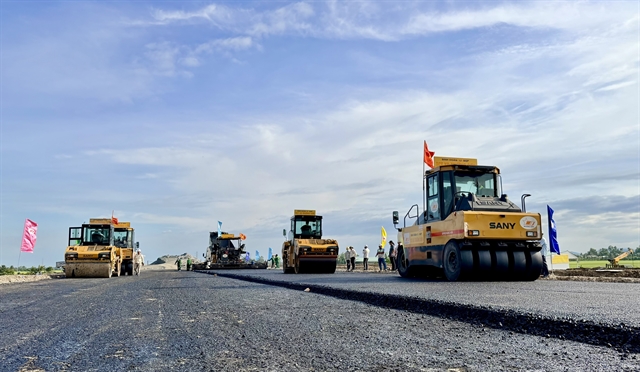
| Asphalt paving underway on a section of the Châu Đốc-Cần Thơ-Sóc Trăng Expressway in the southern province of An Giang. — VNA/VNS Photo Thanh Sang |
How have private investors and enterprises contributed to project progress and quality in recent years?
Projects brought into operation in recent years have largely met progress targets, while construction quality has generally complied with technical standards and design requirements. This is first and foremost due to the growing strength of Việt Nam’s expressway contractors.
On expressway construction sites nationwide, the predominantly manual labour seen many years ago has been replaced with mechanisation. Beyond earthworks, embankment, site grading and compaction, many other tasks such as monitoring and supervision have adopted advanced techniques, equipment and digital technologies, from the survey and design stages through to construction.
Companies’ willingness to adopt new technical advances, modern equipment and new technologies has resulted in very high construction productivity, while also playing a crucial role in managing quality and work volumes. Moreover, the application of advanced building information modelling and laser scanning devices allows for accurate assessment of construction quality against design specifications.
These techniques also improve post-construction operation and maintenance management. Scientific and technological advances have driven higher productivity, which in turn has accelerated project completion while ensuring quality.
Private investors and enterprises have also been very proactive and innovative in project management. Investors such as the Đèo Cả Group have pioneered the PPP++ model to mobilise funding for projects, going beyond securing bank credit to invite other investors to join when they see the project’s potential profitability, thereby expanding capital contributions and jointly developing projects.
About 20 years ago, Việt Nam’s road network had fewer than 1,000km of expressways, but in 2025 alone, approximately 1,000km of expressways have been put into operation. With the engagement of the private sector and the aforementioned approaches, the target of 5,000km of expressways by 2030 is well within reach, meeting the expectations of the Party, the State and the public’s travel needs.
Clearly, the collective effort to build a nationwide, seamless transport system with thousands of kilometres of expressways is creating powerful momentum for national economic development, facilitating the flow of goods and connecting regions. At the same time, it is unlocking the development potential of many localities, especially mountainous provinces such as Cao Bằng and remote areas like Cà Mau and the Central Highlands.
As a representative of enterprises and contractors, what are your recommendations to further develop transport projects and attract greater participation from the private sector in the next few years?
The quality, progress and investment efficiency of a transport project depend on many factors, foremost among them land clearance. Transport construction cannot be carried out in a piecemeal manner, clearing land and building section by section like civil works. It must have sufficient available lengths for uninterrupted construction.
In recent years, the Government and local authorities have shown a strong commitment to land clearance for transport projects. However, this remains a major challenge, as it involves compensation and resettlement for residents, in addition to issues related to forest land and agricultural land. Contractors cannot complete one segment and then simply move on to another.
Following the nation's administrative restructuring, provinces are now much larger, both in terms of administrative boundaries and workload. Project contractors hope that challenges arising from administrative changes will not affect land clearance progress.
As for material supplies, the Prime Minister has directed southern provinces to allocate resources promptly and assign them directly to contractors without intermediaries. Local authorities therefore need to act decisively to resolve these issues, enabling enterprises to carry out construction simultaneously with determination, thereby reinforcing investor confidence. — VNS
Opinion
 Opinion
 Opinion
 Opinion
 Opinion
 Opinion
 Opinion
 Opinion
 Opinion
.jpg) Opinion
Opinion
 Opinion
 Opinion
 Opinion
 Opinion
 Opinion
.jpg)