 Opinion

Digital transformation opens new prospects for sports medicine in HCM City
1.
|
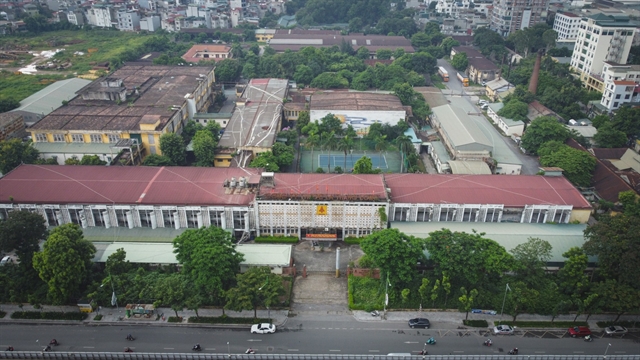
| Thăng Long Tobacco Company Limited located on Nguyễn Trãi Street has been relocated to Quốc Oai-Thạch Thất Industrial Park. — Photo tienphong.vn |
Architect Trần Huy Ánh, permanent member of the Hà Nội Association of Architects, speaks to Kinh Tế & Đô Thị (Economic & Urban Affairs) newspaper about the relocation of 42 production facilities and 15 agency headquarters out of the inner city.
How do you assess the significance of relocating 42 production facilities and 15 agency headquarters for relieving pressure in the inner city and restructuring Hà Nội’s urban space?
Relocation is not a new issue. Over the past decades, from the 1998 master plan to the 2011 Hà Nội master plan and, more recently, the adjustments to the master plan and the capital planning, the goals have consistently emphasised moving production facilities out of the inner city to ease congestion and restructure urban space.
In other words, the objectives have long been in place, but implementation has not been aligned.
In the past, some facilities were moved out, but the land they left behind was turned into commercial real estate projects rather than public facilities as intended.
This undermined the goal of easing pressure and reorganising urban space, even steering it off course.
Nearly 20 years have passed since 1998, and this task continues to be repeated.
This relocation effort serves as a firm reminder that Hà Nội must implement the policy correctly so that the goal of restructuring urban space becomes a substantive task rather than just a policy statement.
The expectation this time is that the city must follow through as originally intended.
With the requirement that relocated facilities must modernise equipment and technology, save energy and meet environmental standards to avoid simply shifting pollution from one place to another, what do you see as the biggest challenges in enforcing this principle effectively?
The requirements this time are more stringent than in previous phases.
Over the past two decades, many factories have left the inner city but brought with them outdated production lines and obsolete technologies.
Some industrial zones were formed from imported used machinery or clusters of small-scale facilities lacking proper control of emissions and wastewater.
Independent studies show that several industrial zones, particularly those in western and southwestern Hà Nội, contribute to fine dust pollution and a decline in environmental quality.
This shows that relocation without clear criteria on technology, equipment and energy use becomes superficial and fails to address core problems.
What level of technological upgrade is required? What types of equipment? What energy standards? Which environmental indicators must be met?
If these requirements remain general, without a defined standards framework, implementation could become perfunctory, leading to pollution spreading from old locations to new ones and potentially becoming worse.
Hà Nội needs to issue a detailed set of criteria covering planning, design and operations.
Even a basic requirement, such as ensuring that the volume of soil excavated equals the volume of fill in industrial or new urban areas, helps maintain drainage balance and preserve natural water absorption.
In reality, many industrial zones are built on filled-in low-lying farmland, reducing drainage capacity, eliminating natural ecosystems and increasing flood risks.
To minimise pollution and prevent wasteful land use, relocation must be tied to specific standards for equipment, technology, energy and environmental protection.
Otherwise, a well-intentioned policy could inadvertently create long-term consequences that the city may no longer have the resilience space to fix.
The post-relocation land fund is expected to be prioritised for public spaces, green areas and social infrastructure. From a land-use planning perspective, what is the most important principle to ensure this land truly serves public interests and is not converted for other purposes?
Public land must be preserved and remain public property.
It must not be transferred to private entities under any form, whether through socialisation, investment partnerships or long- and short-term contracts, that effectively privatise public assets.
Relocation must adhere to a core principle: State-owned land resources must be used for public purposes and must not be disguised in ways that allow public land to become private.
Given the city’s many existing residential areas interwoven with former industrial sites, what approach and model should be applied to post-relocation spatial transformation to avoid conflicts between new urban development and preservation of existing urban structures?
In reality, existing residential areas are often surrounded by industrial or commercial real estate projects that fragment traditional urban structures.
Older neighbourhoods, once the foundations of modern urban formation, now face disadvantages: technical infrastructure is not upgraded, social infrastructure is narrowed, while new industrial zones are not connected to local labour or improved living conditions.
This represents an imbalanced development pattern. New projects must take responsibility for reinvesting in and improving conditions for existing communities rather than focusing solely on land exploitation.
Spatial transformation must be guided by principles that safeguard the rights of long-time residents, upgrade infrastructure and maintain the continuity of urban structure, avoiding any segregation between new and old neighbourhoods.
Relocation may affect long-standing industries and enterprises in the inner city. What support policies are needed for enterprises and workers to ensure stable operations and prevent production disruptions?
Support policies must be based on comprehensive labour-transition data. For many years, agricultural land has been converted to industrial use without adequate evaluation of retraining effectiveness, occupational transitions or impacts on workers’ health. This is a major gap.
As Hà Nội moves toward industries such as creative industries, biotechnology and the knowledge economy, industrial transformation must align with upgrading labour quality rather than maintaining outdated, polluting and labour-intensive production models.
It is essential to assess the labour situation thoroughly: training levels, adaptability, health impacts and working conditions. Only then can authorities identify which groups require support, what form it should take and how enterprises should fulfil social responsibilities in a sustainable development framework where environmental protection and human health are prioritised.
To ensure relocation aligns closely with the master plan and the capital planning vision, what criteria and monitoring mechanisms should the city establish for both relocation and post-relocation land use?
Localities today are adopting highly flexible approaches. Many agencies have proactively repurposed redundant facilities for cultural, tourism or historical functions, fields with strong development potential.
This approach delivers multiple benefits: public assets are preserved, the strengths of each locality are leveraged and investment directions for cultural industries are realised in practice.
These experiences show that scaling up this approach aligns well with current management requirements, ensuring public assets are both preserved and utilised more effectively. — VNS
Opinion
.jpeg) Opinion
Opinion
 Opinion
 Opinion
 Opinion
 Opinion
 Opinion
 Opinion
 Opinion
 Opinion
 Opinion
 Opinion
 Opinion
 Opinion
 Opinion