 Opinion
Project lays foundation for digital greenhouse gas emissions data management
1.
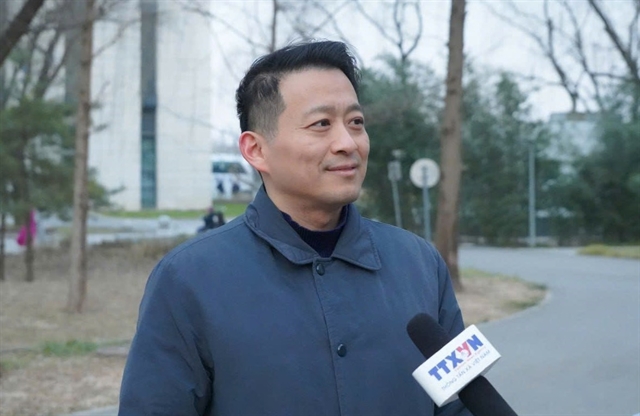 |
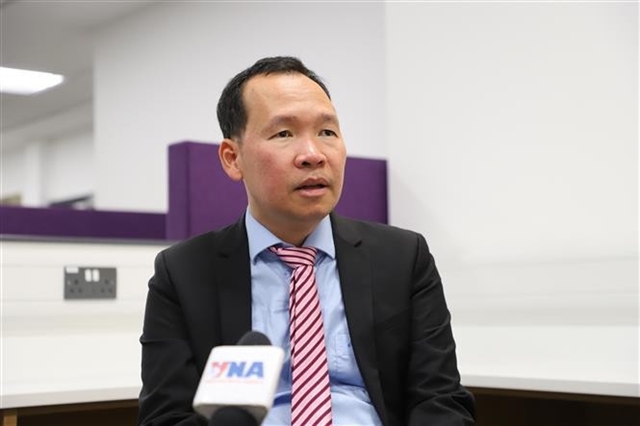
| Professor Qu Qiang of Minzu University of China. — VNA/VNS Photo |
BEIJING — The 14th National Congress of the Communist Party of Việt Nam (CPV) is set to mark a milestone of special significance, ushering the country into a new stage of “strategic breakthrough” development, with science – technology, innovation, and institutional reform playing a pivotal role, according to a Chinese professor.
In an interview granted to the Vietnam News Agency correspondents in Beijing, Professor Qu Qiang of Minzu University of China said that considering both international and domestic backdrops, Việt Nam has emerged as a country with an increasingly prominent position in Southeast Asia. With a population of around 100 million, a youthful demographic structure, rapid urbanisation, and a stable socio-political environment, it enjoys favourable conditions for medium- and long-term development.
He noted that during the period from the 12th to the 13th National Party Congress, Việt Nam stood out as one of the region’s most dynamically growing economies, with deepened international integration and steadily improved national competitiveness.
However, the current development context differs markedly from the past. The global economy is facing complex fluctuations, supply chains are disrupted, strategic competition among major powers is intensifying, and regional conflicts and geopolitical instability remain unpredictable. In this context, Qu emphasised that Việt Nam – an important emerging economy and a key link in ASEAN’s supply chains – needs to make appropriate strategic choices to sustain growth momentum and enhance development quality.
A central issue he highlighted is the need to transform the growth model. To move beyond reliance on scale expansion and low-cost labour, and to avoid the “middle-income trap”, Việt Nam must raise the technological content and value-added of its economy, he opined.
The professor also pointed to Việt Nam's strong development fundamentals. Internet penetration has reached about 80 per cent of the population, creating a critical “take-off point” for the digital and platform economies. Drawing on China’s experience, he noted that once Internet usage surpasses 70 per cent, the Internet economy typically enters a phase of rapid growth. Việt Nam, he observed, is currently at this pivotal juncture.
In addition, Việt Nam's higher education system is expanding fast, helping to form a young workforce capable of engaging with advanced technologies. Educational reforms are increasingly geared toward training talent for future-oriented sectors such as semiconductors, artificial intelligence (AI), green energy, and the digital economy. Notably, Việt Nam has introduced innovative training models, including two-year master’s programmes linked to enterprise internships, alongside policies to attract talent, particularly overseas Vietnamese professionals, through a long-term visa mechanism.
These measures, he said, reflect long-term vision and careful preparation for the next development phase.
From a regional perspective, the professor noted that a large East Asian common market is gradually taking shape in reality. Historically, advanced economies have been closely associated with expansive regional markets, such as the North American Free Trade Agreement (NAFTA) or the EU market. Today, the integrated economic space encompassing China, ASEAN, Việt Nam, Japan, and the Republic of Korea is already operational and increasingly effective. Against the backdrop of the “China +1” strategy, Việt Nam is well positioned to capitalise on global investment shifts and supply chain restructuring, assessed Qu.
Besides, he went on, the enhancement of bilateral cooperation, along with ties within the frameworks of ASEAN and East Asia, will help regional economies strengthen resilience to external shocks.
Regarding the high growth targets discussed ahead of the 14th Congress, Qu described the goal of around 10 per cent growth as ambitious yet grounded. Vietnam’s GDP growth of approximately 7.5 per cent in the first three quarters was an encouraging result amid global volatility. More importantly, he stressed, are the structural policy shifts, particularly the decision to raise spending on science, technology, and innovation from about 0.5 per cent of GDP to 1.5 per cent and enshrine it in law.
He also called Việt Nam's promotion of apparatus streamlining, administrative reform, and organisational restructuring as a strategic step, helping cut expenses, improve governance capacity, and create more room for development in the next phase.
Qu concluded by expressing confidence that the 14th National Party Congress will be a landmark event, shaping Việt Nam's development strategy for years to come, with positive spillover effects not only domestically but also across the region and beyond in an increasingly complex global landscape. — VNA/VNS
Opinion
.jpg) Opinion
Opinion
 Opinion
 Opinion
 Opinion
 Opinion
 Opinion
 Opinion
 Opinion
 Opinion
 Opinion
 Opinion
 Opinion
 Opinion
 Opinion