 Politics & Law
Mutual funds get back losses and more as stock market rebounds
1.
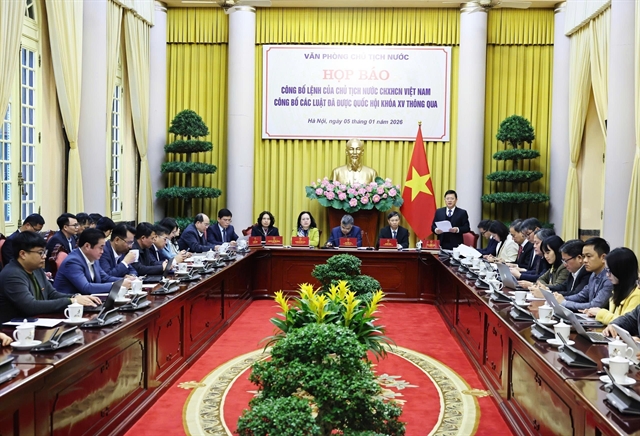 |
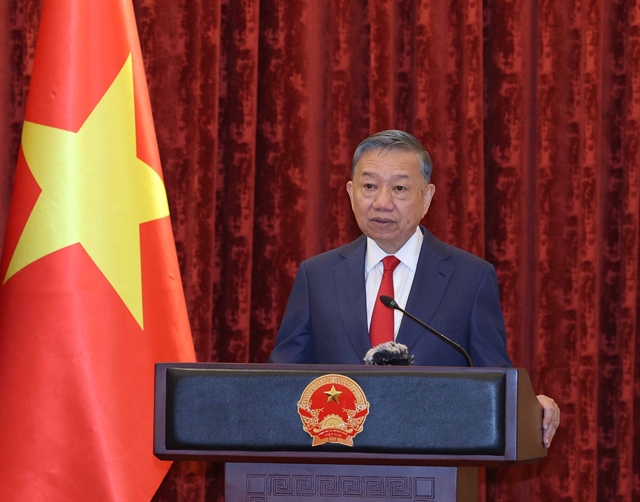
| The Presidential Office holds a press conference on Monday to announce the State President's orders on 13 laws coming into force this year. — VNA/VNS Photo Minh Đức |
HÀ NỘI — The State President has issued orders promulgating 13 laws adopted at the 10th session of the 15th-tenure National Assembly (NA), the President’s Office announced in a press conference held on Monday.
These include the Law on Mutual Judicial Assistance in Civil Matters, the Law on Judicial Expertise, the Law on Enforcement of Civil Judgments, the Population Law, the Law on Disease Prevention, the amended Law on Technology Transfer, the Law on Artificial Intelligence, the amended Intellectual Property Law, the Law on High Technology, the Law on Digital Transformation, the Construction Law, the Civil Aviation Law and the amended Law on Urban and Rural Planning.
The revised Law on Urban and Rural Planning took effect on January 1. It clarifies responsibilities and authority in line with the new two-tier local government model, promotes decentralisation and simplification of administrative procedures to help improve the investment and business environment while addressing practical challenges.
Coming into force on March 1, the Law on Artificial Intelligence establishes a unified legal framework for the safe, responsible and human-centred development and application of AI.
The amended Law on Intellectual Property focuses on administrative reform, digital transformation, commercialisation of intellectual property rights and improved enforcement. Meanwhile, the revised Law on Technology Transfer aims to enhance the legal framework for effective and coordinated technology transfer, strengthen governance, foster domestic innovation and develop a transparent, professional science and technology market. Both laws will take effect from April 1.
The Law on High Technology and the Law on Digital Transformation will both take effect from July 1, as the 2006 Law on Information Technology expires. The high technology law creates a comprehensive legal framework to concentrate national resources on breakthrough technologies and enhance technological self-reliance, while the digital transformation law addresses core issues in this process.
The Law on Mutual Judicial Assistance in Civil Matters aims to further improve legislation in this area, supporting the timely and accurate settlement of civil and administrative cases involving foreign elements. It seeks to protect the lawful rights and interests of the parties involved and improve the effectiveness of Việt Nam’s international judicial cooperation.
The Law on Enforcement of Civil Judgments continues to concretise the Party’s guidelines and the State’s policies on reforming the organisation and operation of civil judgment enforcement, addressing shortcomings, strengthening legal discipline and contributing to the building of a socialist rule-of-law state.
Both laws will take effect on July 1.
On the same date, the new Population Law will come into force, shifting population strategies from family planning to population and development. It introduces measures to maintain replacement fertility rates while also addressing adaptation to population ageing.
Meanwhile, the Law on Disease Prevention emphasises proactive disease prevention measures, promoting people-centred and life-course approaches to health care.
Accordingly, a national disease prevention fund will be established to provide sustainable financing for the strategy. Preferential policies are also set out for disadvantaged areas and communities.
The disease prevention law will also take effect on July 1.
The Construction Law aims to create a more transparent, streamlined and cost-efficient legal framework, improve the investment and business environment, simplify administrative procedures and address practical shortcomings in construction investment.
The Civil Aviation Law is designed to improve State management, address current bottlenecks and create new momentum for socio-economic development, international integration and national defence and security.
These two laws will also enter into force on July 1, this year — VNS
Politics & Law
 Politics & Law
 Politics & Law
 Politics & Law
 Politics & Law
 Politics & Law
 Politics & Law
 Politics & Law
 Politics & Law
 Politics & Law
 Politics & Law
 Politics & Law
 Politics & Law
 Politics & Law
 Politics & Law