 Politics & Law

Lotte, Phát Đạt combine strengths in Thu Thiem project
1.
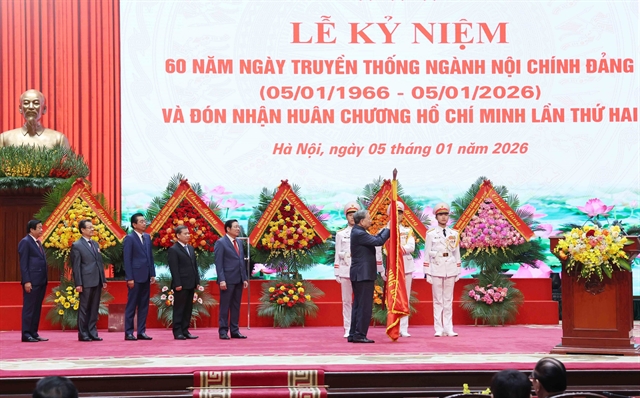 |
| Party General Secretary Tô Lâm pins the Hồ Chí Minh Order to the ceremonial flag of the Central Commission for Internal Affairs on Monday. — VNA/VNS Photo |
HÀ NỘI — The Communist Party of Việt Nam on Monday marked the 60th anniversary of its internal affairs apparatus, using the milestone to reaffirm anti-corruption as a central pillar of governance as the country enters a new phase of development.
At a ceremony in Hà Nội, the Central Commission for Internal Affairs was awarded the Hồ Chí Minh Order for the second time, one of the State’s highest honours.
Party General Secretary Tô Lâm attended and delivered a keynote address setting out priorities for Party oversight, judicial reform and anti-corruption work.
In a commemorative speech, Politburo member and commission head Phan Đình Trạc reviewed the evolution of the Party’s internal affairs system since its formal establishment in 1966, noting that despite periods of merger and reorganisation, the apparatus has consistently served as a core advisory body tasked with safeguarding Party discipline and legal order.
The commission was re-established in its current form in 2012 amid a renewed institutional drive to strengthen anti-corruption mechanisms.
The following year, internal affairs commissions were formed in all 63 provinces and centrally governed cities, while the Central Steering Committee for Anti-Corruption was consolidated under the Politburo, with the General Secretary as its head and the commission acting as its standing body.
Its remit was further expanded in 2017 when the Office of the Central Steering Committee for Judicial Reform was transferred to the commission, adding strategic advice on judicial reform to its responsibilities alongside internal affairs and anti-corruption policy.
Speaking at the anniversary event, Party General Secretary Tô Lâm described the internal affairs sector as one of the Party’s “particularly important pillars,” crediting it with helping to uphold Party discipline, enforce State law and maintain public confidence.
He said internal affairs work has long been regarded as a key instrument for protecting the political system and safeguarding the lawful rights and interests of citizens.
The General Secretary noted that since its re-establishment, the commission has played an increasingly prominent role in supporting the Party’s anti-corruption drive, oversight of misconduct and institutional reform.
He linked these efforts to broader moves to strengthen Party discipline and advance what the leadership describes as a socialist rule-of-law state.
Looking ahead, he said Việt Nam is entering a new stage of development while facing a complex array of challenges that place heavier demands on internal affairs institutions.
He called on the sector to sharpen its strategic advisory capacity, stressing that internal affairs work must be both rigorous and humane. Anti-corruption efforts, he added, should be sustained and systematic rather than episodic and conducted on the principle that everyone is subject to the law, without exception.
The commission, he said, should continue to serve as a coordinating hub linking Party bodies and State agencies, while paying greater attention to combating waste and improving the use of public resources. Strengthening early warning, policy forecasting and legal oversight were identified as key priorities.
Party chief Tô Lâm also urged closer monitoring of national security and social stability issues, including border areas, ethnic minority regions, religious affairs and rural governance. He called for more effective handling of citizen complaints at the local level to prevent prolonged disputes.
In concluding remarks, he emphasised the need to build a disciplined and professional internal affairs workforce, describing integrity, ideological steadiness and legal expertise as essential attributes.
He expressed confidence that the sector would continue to play a central role in the Party’s governance framework as Việt Nam moves into its next phase of development. — VNS
Politics & Law
 Politics & Law
 Politics & Law
 Politics & Law
 Politics & Law
 Politics & Law
 Politics & Law
 Politics & Law
 Politics & Law
 Politics & Law
 Politics & Law
 Politics & Law
 Politics & Law
 Politics & Law
 Politics & Law