.jpeg) Opinion
Opinion

Ping An Digital Bank Completes HKMA’s Second GenA.I. Sandbox Cohort
1.
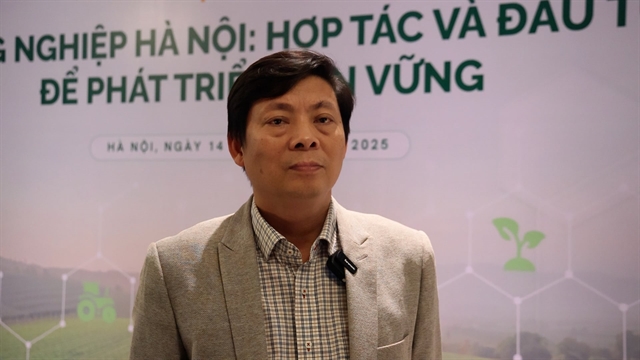 |
| Mai Văn Trịnh, director of the Institute of Agricultural Environment. VNS Photo Minh Phương |
Mai Văn Trịnh, Director of the Institute of Agricultural Environment, spoke to Việt Nam News about Hà Nội’s push for greener agriculture, noting key gains while warning that pollution, unstable markets and environmental risks still hinder sustainable production.
How would you assess the current state of sustainable agriculture in Hà Nội?
Hà Nội has made progress across all three pillars of sustainable agriculture – economic, social and environmental.
On the economic front, the city continues to ensure food security, maintain stable yields and improve the quality of its agricultural products. Resources such as land, water, fertilisers and labour are being used more efficiently, helping increase farmers’ incomes and reduce production risks.
In terms of social sustainability, rural livelihoods have become more stable, poverty reduction has been strengthened and equity has improved. The role of farmers, especially women and young people, has been reinforced while rural cultural values and community cohesion are preserved.
However, the environmental pillar remains a significant weakness. Natural resources are not always used efficiently; many production areas fail to meet required standards, and in some places, polluted river water is still used for irrigation. Industrial and urban zones continue to exert pressure on nearby farming areas.
For organic agriculture, which requires strict conditions regarding production space and inputs, Hà Nội must adhere closely to established standards to minimise risks and avoid wasting farmers’ time, labour and investment.
What are the challenges Hà Nội faces in implementing sustainable agriculture? What should be done to address them?
Under Action Plan No 156/KH-UBND, Hà Nội aims to maintain about 55,000 hectares of rice land by 2030, ensuring an annual output of at least 660,000 tonnes. This target is essential for stabilising rural economies and doubling farmers’ income compared with 2020 while bolstering the capital city’s resilience amid volatile global food markets.
At the same time, Action Plan No. 149/KH-UBND on green growth identifies agriculture as a key sector for reducing greenhouse gas emissions. The city plans to expand ecological, organic, circular and low-emission agriculture, increase the share of organic fertilisers and biological pesticides to over 30 per cent, and raise organic farming acreage to more than 2 per cent of total cropland.
To meet these goals, however, Hà Nội must navigate several challenges. Large population fluctuations affect the balance of supply and demand. Local agricultural products remain less competitive, with unstable prices, inconsistent supply and uneven quality.
Environmental pollution continues to hinder organic and ecological farming as well as low-emission models. Fertile alluvial lands along the Red River, for example, are not fully utilised, and yields of certain speciality crops have declined. Several geographical indication areas are being degraded or encroached upon.
Climate change poses growing risks for production. Typhoon Bualoi in September, for instance, wiped out nearly all vegetable-growing areas in its path.
 |
| A high-tech grape farming model in Đan Phượng Commune, Hà Nội. VNA/VNS Photo Vũ Sinh |
Agricultural land is also shrinking and must be conserved for future generations. Despite these challenges, Hà Nội’s advantages as a centre of science, technology and consumer markets mean the city can generate substantial added value if it meets sustainability standards.
The city also has strong potential to develop ecological agriculture integrated with tourism – an appealing model for nearly 10 million residents seeking leisure and learning experiences. Linking these initiatives with the education system could help urban students better understand agriculture, similar to well-established models in Taiwan and South Korea.
What barriers do enterprises and cooperatives face when adopting sustainable agricultural models?
A major challenge lies in farmers’ limited capacity and lack of confidence in transitioning to new production models. But the most critical barrier is market access. Certified products such as VietGAP require specialised distribution channels because of higher production costs. Only when stable markets are guaranteed will farmers fully comply with strict production standards.
Some green-transition models also require substantial upfront investment. For example, alternate wetting and drying irrigation methods, which are used to reduce methane emissions from rice, depend on modern water-management infrastructure, which individual small-scale farmers cannot finance.
Similarly, ecological agriculture and agritourism models demand community-wide participation. A single farmer cannot build and maintain such systems on their own.
Circular agriculture offers promising opportunities, as recycling farm waste can reduce fertiliser costs by 50–80 per cent while mitigating pollution. But clear regulations and strong coordination are needed for these models to be implemented effectively.
What policies does Hà Nội currently have to support enterprises and cooperatives in developing sustainable agriculture?
The Department of Finance and the Hanoi Support Centre for Enterprise and Investment Promotion (SCE) are consulting experts, scientists, businesses and farmers to refine support policies.
Hà Nội already has a large number of agricultural extension models, from economic production and green growth to low-emission and ecological farm models. The challenge now is scaling them up, ensuring they grow sustainably and generate meaningful impact.
Without such expansion, many models will remain small-scale pilots that lack long-term value and fail to drive substantive change in the city’s agricultural sector. — VNS
Opinion
 Opinion
 Opinion
 Opinion
 Opinion
 Opinion
 Opinion
 Opinion
 Opinion
 Opinion
 Opinion
 Opinion
 Opinion
 Opinion
 Opinion