.jpeg) Opinion
Opinion

Ping An Digital Bank Completes HKMA’s Second GenA.I. Sandbox Cohort
1.
Trưng Vương Middle School in Hà Nội is among the pioneers in integrating STEM (Science, Technology, Engineering and Mathematics) education into the official curriculum. Its Robotics Club has won numerous domestic and international awards, including the Gold Award in the Secondary 2 category at Hong Kong International Science Olympiad in June 2022 and the Sportsmanship Award at the VEX World Robotics Championship held in May 2023 in Texas, US. Việt Nam News reporter Lê Hương spoke to school principal Meritorious Teacher Nguyễn Thị Thu Hà about their achievements.
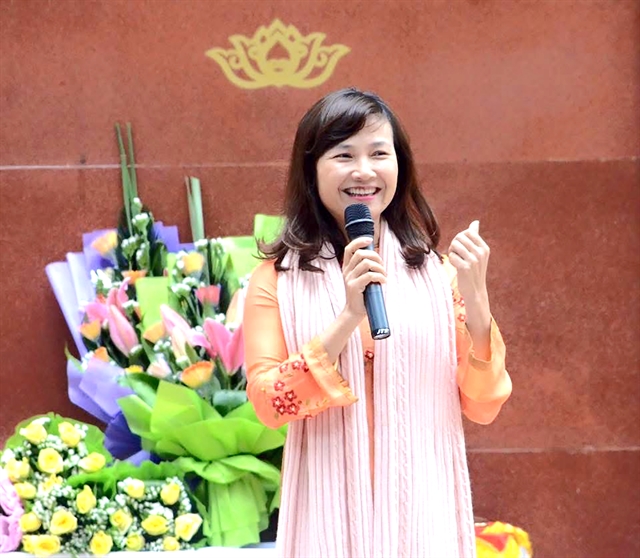 |
| Meritorious Teacher Nguyễn Thị Thu Hà, Principal of Trưng Vương Middle School in Hà Nội. Photos courtesy of Trưng Vương Middle School |
Could you briefly outline the STEM education activities at your school?
STEM education activities at Trưng Vương Secondary School have been implemented over many years in various forms. STEM lessons can be integrated into Natural Sciences classes, delivered through experiential learning clubs or organised as themed events and festivals. Students participate in projects and create electronic products as part of their learning.
Why has your school placed such strong emphasis on STEM education?
We are living in a century where it is difficult to develop and thrive without technology. We aim to equip lower secondary students with fundamental knowledge so that, at higher levels of education such as upper secondary school and university, they can nurture aspirations to contribute, innovate, conduct research, and serve the community using what they have learned.
For this reason, we place great importance on STEM and natural sciences education.
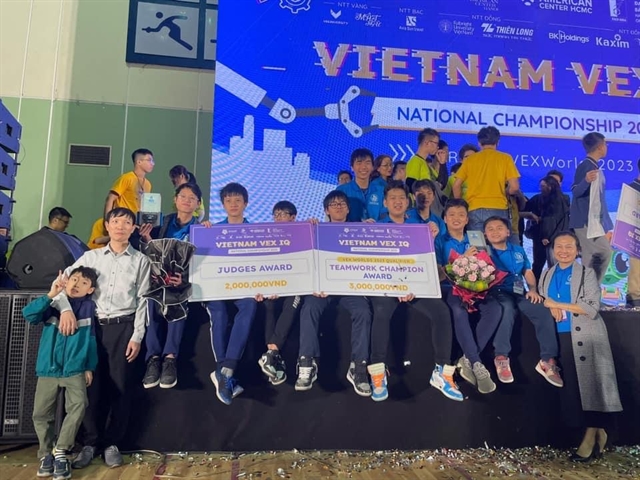 |
| Principal Hà (first right) poses for a photo with her pupils after winning the Judges Award and Teamwork Champion Award at the Vietnam Vex IQ Robotics National Championship in Hà Nội in February 2023. |
What benefits do students gain from STEM education?
Through STEM activities, students gain a great deal. They are able to review what they have learned and discover new aspects of seemingly familiar knowledge. They can practise and apply theory to create products and experience real-world applications.
These activities also help students develop a wide range of skills, including inquiry, observation and data analysis. They are introduced to interdisciplinary and multidisciplinary thinking, which is extremely important. Through STEM lessons, students learn to connect knowledge across fields such as economics, technology and the environment.
As a result, they develop a sense of citizenship and civic responsibility. STEM education encourages them to observe real-life issues, recognise problems that need improvement, and think about solutions to make life better. Gradually, they begin to consider creating products that contribute positively to society.
This is precisely what we aim to instil in students: a strong sense of civic awareness and responsibility.
STEM education also nurtures a spirit of inquiry and creativity, while fostering an understanding that learning and practising STEM should be grounded in sustainable development.
Do you think STEM education can only be implemented in schools with sufficient resources? As far as I know, not many schools, even in the capital, have introduced STEM into their curricula.
STEM education is not limited to well-resourced schools. The materials required for STEM learning can often be simple and readily available in students’ everyday lives. If schools are genuinely committed and have dedicated teachers, any school can implement STEM effectively.
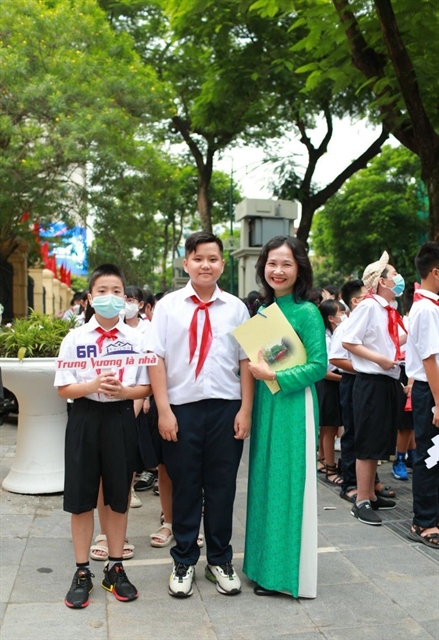 |
| Principal Hà is known for acting in the best interests of her pupils. |
How has your school sustained STEM education? Have you mobilised funding from different sources?
For STEM lessons integrated into the official curriculum and related educational activities, we do not rely on social contributions or parental funding.
However, for STEM clubs, where participation is voluntary and driven by students’ interest, we do mobilise social resources. This may include funding for equipment and tools that support hands-on learning and experimentation.
Importantly, social mobilisation is not limited to financial or material contributions. One effective approach we have adopted is drawing on the expertise of parents. Many parents are lecturers at universities, researchers at institutes, or professionals in businesses. We invite them, through outreach and communication efforts, to voluntarily teach and share their knowledge with students free of charge.
We consider this a valuable and sustainable form of social resource mobilisation. VNS
Opinion
 Opinion
 Opinion
 Opinion
 Opinion
 Opinion
 Opinion
 Opinion
 Opinion
 Opinion
 Opinion
 Opinion
 Opinion
 Opinion
 Opinion