.jpg) Opinion
Opinion
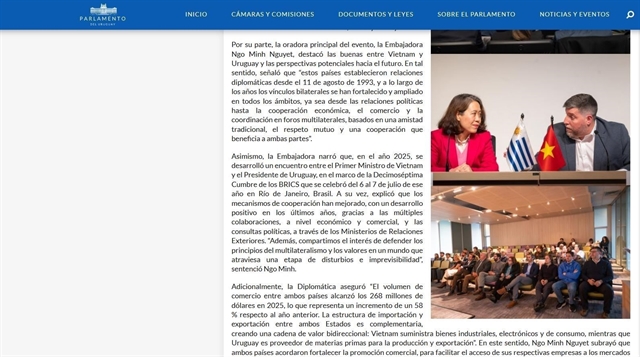
Uruguayan parliament highlights Việt Nam’s role, bilateral cooperation prospects
1.
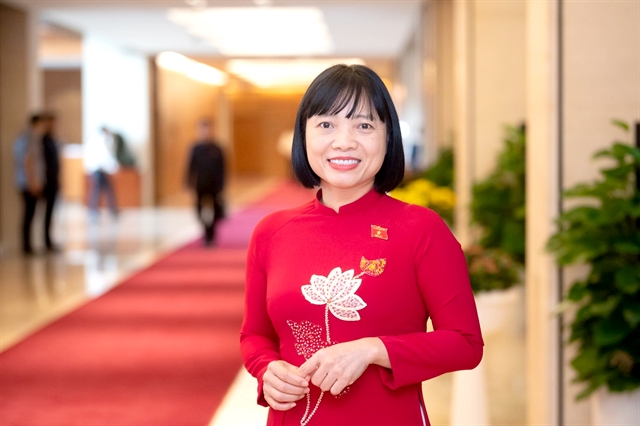 |
| Nguyễn Thị Việt Nga. — VNA/VNS Photo |
Nguyễn Thị Việt Nga, deputy head of Hải Phòng City’s National Assembly (NA) delegation, speaks to the Vietnam News Agency about NA deputies’ resolve, responsibility and commitment.
What qualities are essential, and what difficulties and challenges does a NA deputy face?
A NA deputy represents the people in exercising state power at the highest authority. Therefore, in my view, a deputy must first possess solid political resolve and a firm stance, while also maintaining independent, objective thinking when considering specific issues.
Alongside political resolve, I believe a particularly important quality is a sense of responsibility and commitment. Deputies do not merely attend sessions; they must regularly visit the grassroots level and listen to people's thoughts and aspirations.
As for challenges, I think the greatest difficulty for NA deputies is balancing multiple demands simultaneously: safeguarding the nation's common interests while accurately reflecting the voice of their electoral locality; upholding principles while being flexible in approach.
In the context of the country entering a new development phase with rapid changes, deputies must continuously update their knowledge and renew themselves to keep pace with practical requirements.
What advantages and difficulties did you face upon becoming a NA deputy?
I entered the NA with a background in literature, later pursuing law studies. Many people think that literature and the parliamentary arena are two distinct realms, but in reality, I realised they share a profound common ground: people.
My greatest strength as a NA deputy is the sensitivity of a literary practitioner. Literature has honed my ability to listen and perceive even the subtlest vibrations in social life. When engaging with voters, I do not just hear numbers or specific proposals; I sense the underlying worries, expectations and sometimes deeply personal concerns. This allows me to approach policies from a more humane perspective.
However, when I first entered the NA, I faced no shortage of difficulties. Parliamentary work demands broad knowledge of economics, finance and state governance – fields which I had to strive hard to learn. I proactively delved into draft laws, attended training courses, listened to experts and colleagues, and gradually perfected myself.
Over two terms, I have come to realise that what matters is not one's starting point, but whether one is willing to learn and commit. For me, literature does not distance me from reality; on the contrary, it enables me to enter the world of policy with an empathetic heart and a mindset that places people at the centre.
What tasks lie ahead for the next NA term? And what requirements must deputies of the 16th term meet?
The country is entering a new development phase with great opportunities but also significant challenges. The context of digital transformation, deep integration, demands for rapid and sustainable growth and global volatility impose very demanding tasks on the next NA term.
In my view, the primary task is to continue perfecting a synchronous, unified and feasible legal system, creating a solid legal framework for socio-economic development. Laws must not only be technically sound but also aligned with reality, anticipate future trends and promote innovation and creativity. Especially amid administrative reforms, unit restructuring and economic reorganisation, the NA must ensure stability while remaining flexible enough to adapt.
Additionally, the NA's supreme supervisory role will face even greater expectations. Supervision is not just about identifying issues; more importantly, it must drive substantive changes in policy implementation, ensuring laws are put into practice.
To meet these demands, deputies of the 16th NA must satisfy higher standards of capability and responsibility. Whereas previously deputies focused mainly on legislation and conveying voter opinions, they now also need modern governance thinking, data-based policy analysis skills and the ability to address emerging issues like the digital economy, artificial intelligence and climate change.
How do you evaluate the new aspects in this year's election work?
This year's election work features many innovations that clearly embody the spirit of democracy, openness, transparency and strong application of information technology in organisation and execution. The consultation process, candidate nomination and voter opinion solicitation have been conducted more rigorously; publicising biographies and action programmes provides voters with full information for informed choices.
In my view, a notable point is the increasingly high requirements for deputy quality. Candidates must not only meet general legal standards but also possess practical capabilities, social prestige and concrete action potential. This creates positive pressure on candidates: they must truly prove themselves through their work history, clear commitments and serious preparation.
Enhancing openness, transparency and voter participation from the nomination stage is of great importance. It curbs formalism, ensuring those selected are not only 'procedurally correct' but also 'aligned with the people's will'. When voters have full access to information and can directly express their views, the NA's representativeness is more firmly consolidated.
Do you have any recommendations or proposals to make the NA's operations even more effective?
I believe we must continue advancing three key areas.
First, improve the quality of legislative work, especially policy impact assessment. Each draft law needs more thorough preparation to avoid frequent short-term amendments or supplements.
Second, strengthen supervisory effectiveness. Supervision must pursue issues to their root, with clear conclusions and follow-up on recommendation implementation. Only when recommendations are seriously acted upon, will the people's trust in the NA be consolidated.
Third, continue innovating operational methods towards greater modernity and professionalism: robustly apply digital technology, enhance interaction with voters and increase transparency in parliamentary activities so people can follow and oversee them.
For me personally, in whatever position, I always remind myself: the greatest honour for a deputy is not the position, but the trust of the people. And that trust is the motivation for me to keep striving every day. — VNS
Opinion
 Opinion
 Opinion
 Opinion
.jpg) Opinion
Opinion
 Opinion
 Opinion
 Opinion
 Opinion
 Opinion
 Opinion
 Opinion
 Opinion
 Opinion
 Opinion