.jpeg) Opinion
Opinion

Ping An Digital Bank Completes HKMA’s Second GenA.I. Sandbox Cohort
1.
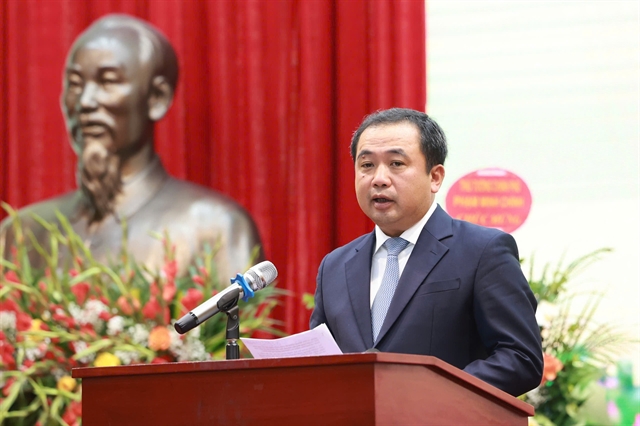 |
| Minister of Agriculture and Environment Trần Đức Thắng. VNA/VNS Photo |
As global market standards grow increasingly stringent and competition intensifies, the agriculture sector’s development focus is no longer merely on expanding output but on improving quality, sustainability and value addition.
In an interview with VietnamPlus, Minister of Agriculture and Environment, Trần Đức Thắng, stressed that by strengthening quality and ensuring transparency throughout production chains, Vietnamese agricultural products would be able to go further and compete more sustainably in international markets.
The year 2025 marked many important milestones for the agriculture and environment sector. Alongside growth, the industry has also accelerated its transition towards greener and more sustainable development models. Could you outline the concrete progress in green agriculture and the circular economy?
The transformation can be broadly summarised in three dimensions: shifts in mindset and institutions; innovation in production models and value chains; and the promotion of science, technology and digital transformation.
Requirements related to ecological agriculture, emissions reduction and the circular economy have been increasingly integrated into sectoral strategies, planning frameworks and standards. A notable example is the project on developing one million hectares of high-quality, low-emission rice in the Mekong Delta, which has so far been implemented across more than 312,000ha, delivering clear economic and environmental benefits.
The sector has also promoted a transition towards resource-efficient, low-emission production with higher added value, shifting from producing more to producing smarter.
In forestry, the multi-value economic approach has been strengthened through the development of non-timber forest products, medicinal plants, eco-tourism, forest environmental services and integrated agroforestry models.
In fisheries, alongside aquaculture growth, the industry has advanced circular models and reorganised sustainable exploitation linked with traceability systems and monitoring devices to ensure transparency and responsibility across the value chain.
In livestock farming, many waste treatment and by-product recycling models have been expanded, converting waste into fertiliser and bioenergy, helping reduce pollution, cut greenhouse gas emissions and improve product quality.
Processing and post-harvest stages have been identified as key levers to reduce losses, increase deep processing and extend agricultural value chains. When by-products are treated as resources rather than waste, the entire production–processing–consumption chain becomes more efficient, easing environmental pressure while generating greater economic benefits.
At the same time, science, technology and digital transformation have been promoted through data applications, traceability systems and smart farming solutions to meet rising standards for supply chain transparency.
The Ministry of Agriculture and Environment consistently encourages innovative initiatives from localities, businesses and communities, provided they comply with planning frameworks, technical standards and environmental regulations. Effective models are closely monitored for potential replication.
Looking ahead, the ministry will continue improving institutions while promoting carbon markets, green credit and incentive mechanisms for emissions reduction, supporting farmers and enterprises in expanding green production towards the goal of net-zero emissions.
Last year also witnessed unusually severe and extreme natural disasters. How does the ministry assess the sector’s response capacity, and what lessons and key directions will guide disaster forecasting, early warning and climate adaptation efforts in the coming period?
The year 2025 was truly a harsh year for natural disasters, with 21 storms and tropical depressions in the East Sea, internationally known as the South China Sea, alongside multiple historic floods. This clearly demonstrates that climate change is advancing faster and more intensely than previously forecast.
In this context, the sector’s capacity for leadership, coordination and response has improved markedly. Local authorities proactively developed scenarios; implemented on-site command, on-site forces, on-site equipment and supplies and on-site logistics support; strengthened inter-agency coordination; and took early action in evacuations, infrastructure protection and safeguarding production.
However, the most important lesson is the need to shift from reactive response to proactive disaster risk governance, focusing on early prevention based on science, data and community participation.
Moving forward, the sector will prioritise four key solution groups: modernising multi-hazard forecasting and early warning systems; applying digital technologies, artificial intelligence and big data; and strengthening climate-resilient disaster prevention infrastructure, with priority given to high-risk regions.
Agriculture and environment authorities will refine planning and focus investment in adaptive disaster prevention infrastructure, especially in frontline areas such as the Mekong Delta, central provinces and mountainous regions prone to landslides.
Another crucial task is enhancing grassroots-level risk management capacity, linking disaster prevention with sustainable livelihoods and intensifying communication efforts so that communities become active stakeholders in response efforts.
As 2026 approaches, what are the key tasks and solutions to sustain export growth in agriculture, forestry and fisheries while meeting standards and expanding markets?
To maintain export momentum amid increasingly high market standards and fierce competition, the agriculture and environment sector is focusing not on expanding volume but on improving quality, sustainability and added value.
I would like to highlight four major solution groups.
First is raising quality standards and controlling production from the very beginning, treating this as a soft barrier that enables products to go further and remain competitive in the long term. This includes improving standards and regulations; strengthening food safety, quarantine and residue controls; expanding traceability systems, planting area codes and packing facility management; and tightening discipline in agricultural input management and production conditions.
When quality is ensured at the roots, risks of order disruptions are reduced, long-term compliance costs decline and the national brand’s credibility is strengthened.
Second is restructuring production in line with green agriculture, the circular economy and value chains, an essential pathway for sustainable formal exports. The sector will prioritise standardised raw material zones, replicate proven effective programmes such as the one million hectares of low-emission rice, promote sustainable forestry with multi-functional forest value and reorganise fisheries towards sustainability, lower emissions and increased international certifications.
At the same time, the ministry encourages multi-value agricultural economic models at the local level, including integrated and circular approaches that optimise by-product use, while ensuring environmental compliance through monitoring and evaluation.
Third is diversifying markets and elevating agricultural diplomacy. Alongside maintaining traditional markets, the sector will proactively expand into potential new markets, make better use of free trade agreements, intensify technical negotiations to remove trade barriers, address trade defence issues promptly and build the narrative of green, transparent and responsible Vietnamese agricultural products as a new competitive advantage.
Fourth is developing deep processing, storage and logistics and digitally transforming supply chains, key factors in increasing added value, cutting costs and reducing post-harvest losses. The sector will promote investment in processing linked to raw material regions, develop cold storage and specialised logistics systems, apply digital technologies for supply-demand forecasting and quality management and gradually establish transparent, responsive supply chains.
Alongside these four solution groups, a cross-cutting priority is ensuring sustainability compliance and strengthening national credibility, particularly in fisheries. The sector will continue rigorously implementing measures against illegal, unreported and unregulated fishing, resolutely addressing European Commission recommendations to work towards lifting the yellow card and strictly preventing violations of foreign waters.
When national credibility is consolidated, Vietnamese agricultural products will have a stronger passport to access demanding markets with higher value. — VNS
Opinion
 Opinion
 Opinion
 Opinion
 Opinion
 Opinion
 Opinion
 Opinion
 Opinion
 Opinion
 Opinion
 Opinion
 Opinion
.jpg) Opinion
Opinion
.jfif) Opinion
Opinion