AI and EV Boom Draws $690 Million in Advanced Materials Investment Plans to Thailand
1.
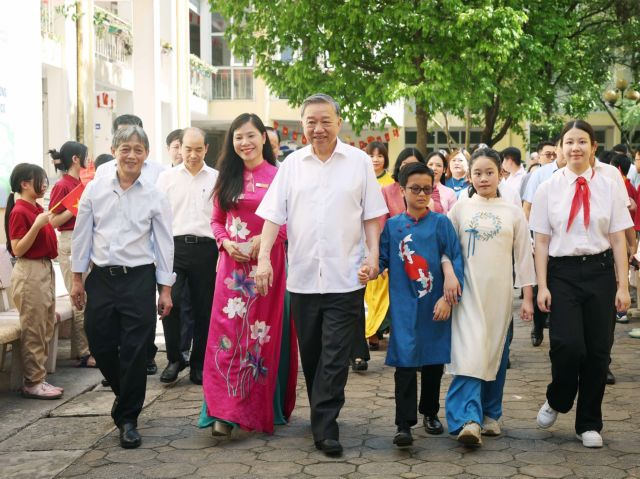 |
| Party General Secretary Tô Lâm visits students at Nguyễn Đình Chiểu and Xã Đàn secondary schools in Hà Nội for International Children's Day on June 1. More than 70 per cent of students at Xã Đàn Secondary School have a hearing impairment, while Nguyễn Đình Chiểu Secondary School carries a special mission of educating and caring for visually impaired children. The Party leader has called for laws to treat people with disabilities as active contributors rather than care recipients. VNA/VNS Photo Thống Nhất |
Party General Secretary Tô Lâm has urged a shift from a medical and welfare-based approach to a fully inclusive social model when crafting policies for those with disabilities, calling for laws to treat the disabled as active contributors rather than care recipients, as he chaired a working session on enforcing the Party and State’s policies and guidelines for persons with disabilities earlier this month.
UNDP Resident Representative Ramla Khalidi spoke with Việt Nam News about the move, praising the directive 'as a landmark step for Việt Nam'.
What is the significance of the Party General Secretary’s new directive on persons with disabilities, and how does it align with global standards on disability inclusion?
UNDP considers the directive to be a landmark step for Việt Nam. For the first time, it clearly and formally affirms that persons with disabilities are an integral part of society. This is more than symbolic. It sends a powerful message of belonging, dignity and equal value, helping to counter stigma and exclusion while fostering disability pride and social cohesion.
Substantively, the directive marks a decisive shift from a charity-based approach to a social inclusion approach that reaffirms the right to learn, the right to work and the right to participate fully in social life for persons with disabilities.
It aligns with the UN Convention on the Rights of Persons with Disabilities, which Việt Nam ratified in 2014, particularly the principles of full and effective participation, respect for disability as part of human diversity, and equality of opportunity.
The directive also moves beyond a medical model of disability assistance, calling for an integrated, cross-sectoral response that empowers individuals. It assigns clear responsibilities to line ministries to ensure accessibility, inclusive education, decent work and social participation within their mandates.
Importantly, it emphasises that ensuring the rights of persons with disabilities is mandatory, not optional, and that accessibility must be embedded from the design stage. This reflects global best practice of universal design, aimed at building a society for all.
UNDP has advocated for meaningful participation of persons with disabilities for many years. In what ways has UNDP contributed to this progress?
UNDP has consistently worked to ensure that persons with disabilities are not only beneficiaries of policies, but active contributors to shaping them.
First, we have invested in long-term capacity building for organisations of persons with disabilities, enabling them to engage meaningfully in policy dialogue and decision-making processes.
Over the past three years, UNDP has also supported potential candidates with disabilities interested in running for elected office to better understand laws, policies and electoral processes. In so doing, it has strengthened their knowledge and skills, confidence and readiness to stand for the 2026 elections at different levels.
Second, UNDP has generated robust evidence by capturing the lived experiences of persons with disabilities through nationwide surveys on accessibility of public services and infrastructure. These data provide evidence to support practical and actionable recommendations for policymakers to strengthen implementation.
Third, as a trusted convenor, UNDP ensures that persons with disabilities, especially those most left behind, including women, persons with multiple disabilities and ethnic persons with disabilities, have safe and accessible spaces to speak and be heard. We provide the necessary accessibility accommodation so that participation is meaningful, and policymakers can listen directly to the voices that matter most.
The directive emphasises inclusive education, accessible infrastructure, digital services and stronger representation of persons with disabilities. From UNDP’s perspective, what should Việt Nam prioritise first to ensure effective implementation?
All rights of persons with disabilities are interconnected and indivisible and must be advanced together, through strong coordination across sectors. In a world of limited resources, prioritisation is, of course, necessary. Such prioritisation, however, must be undertaken in partnership with persons with disabilities, who are best placed to articulate what matters most in a given context and at a given time.
Priorities may vary across provinces and socio-economic groups. For this reason, it is essential that persons with disabilities, in all their diversity, are meaningfully represented in and consulted by Việt Nam’s policymaking bodies at both national and local levels.
This inclusive approach enables persons with disabilities to contribute to priority-setting and helps ensure that policies are well designed, context-appropriate and effectively implemented.
A 2021 rapid assessment conducted by UNDP shows that 98.2 per cent of respondents with disabilities want their voices represented in the National Assembly and local People’s Councils. In recent years, we have seen capable candidates with disabilities with the skills and confidence to stand for the 2026 elections.
Advancing their representation can support effective agenda setting and prioritisation, leading to policies that are more responsive, inclusive and sustainable, in line with Việt Nam’s commitment to leave no one behind.
With more than seven million persons with disabilities nationwide, what impact do you expect this policy shift to have on daily lives? And how can development partners support Việt Nam in turning this vision into reality?
If effectively implemented, the Party Secretary General’s directive can be transformative. Persons with disabilities will be better able to study, work and access services in barrier- and discrimination-free environments, and to participate meaningfully in social, economic and political life.
As their engagement and contributions become more visible, societal attitudes will continue to change, leading to greater respect, dignity and inclusion. Ultimately, disability inclusion makes society more accessible, resilient and liveable for everyone.
Development partners, including UNDP, stand ready to support this vision. We are committed to empowering persons with disabilities as changemakers, while also supporting the Government and other stakeholders with evidence, policy advice, capacity development and inclusive design solutions.
Together, we can translate this strong political commitment into tangible improvements in people’s daily lives and accelerate Việt Nam’s journey toward inclusive and sustainable development. VNS
 Opinion
 Opinion
 Opinion
.jpg) Opinion
Opinion
 Opinion
 Opinion
.jpg) Opinion
Opinion
 Opinion
 Opinion
 Opinion
 Opinion
 Opinion
 Opinion
 Opinion