 Life & Style
Đà Nẵng urged to address bottlenecks to sustain economic growth
1.
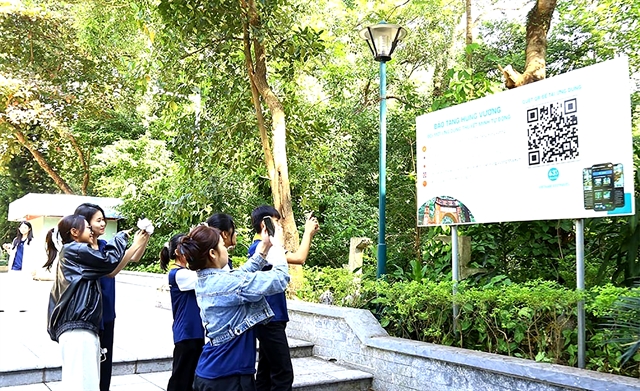 |
| Visitors scan QR codes to access information about the Hùng Vương Museum and its exhibits. — Photo courtesy of Hùng Vương Museum |
PHÚ THỌ For visitors returning to the ancestral land of the nation, exploring Phú Thọ is increasingly becoming a digital experience as well as a journey through history and culture.
At the Hùng Kings Historical Site, QR codes placed at easily accessible locations allow visitors to look up information about the site's history, cultural heritage and artefacts, scan electronic tickets and search for destinations.
For Hoàng Thị Hiền, a visitor from Hà Nội, the technology has made her visit more convenient and engaging.
“I was able to access information about the history, culture and artefacts through QR codes, as well as scan electronic tickets and look up destinations,” she said.
“The information is quick and easy to access, making the journey more interesting and convenient.”
The experience reflects a broader digital transformation under way across the province's tourism sector, where technology is increasingly being used for promotion, visitor services and destination management.
Smart tourism
According to Phạm Tiến Đạt, director of the Hùng Kings Historical Site, the site is stepping up the use of digital technology, digital communications and smart tourism solutions to improve services for visitors.
Its communication channels include a website, Facebook page and TikTok account, alongside public-address systems, electronic information boards and smart tourism devices.
In cooperation with BIDV, the site has installed a 53sq.m LED screen at the entrance to the festival centre. Digital maps and smart wayfinding systems have also been introduced, while security cameras have been installed at temples and along access routes.
These technologies help visitors find information and navigate the site while also strengthening security and supporting destination promotion.
Digital tools are also giving greater visibility to Phú Thọ’s highland destinations, community-based tourism sites, scenic landscapes and the cultural identities of ethnic communities.
Through digital promotional products, smart tourism maps, social media and online booking platforms, visitors can find information about destinations and homestays with just a few taps on a smartphone.
 |
| Long Cốc tea hill is a favourite destination for young people at weekends.— Photo Cungphuot.info |
Đặng Tuấn Hùng, head of the Tourism Management Division under the provincial Department of Culture, Sports and Tourism, said platforms such as Facebook, TikTok and YouTube had become effective channels for promoting highland tourism to domestic and international visitors.
Well-produced videos featuring destinations and local experiences have attracted millions of views, helping previously little-known places reach wider audiences.
Digital promotion is also creating opportunities to showcase local agricultural products, items from the One Commune One Product (OCOP) programme, traditional crafts and indigenous cultural practices.
Digital connections
One of the province's notable developments is the gradual development of the Phú Thọ electronic tourism information system, designed to provide destination information and support visitors during their journeys.
Tourism promotion is also shifting from conventional one-way communication towards more interactive forms.
A destination can now be presented through photographs, videos, digital maps, 360-degree experiences, social media and other electronic communication products. This creates more points of contact with visitors while extending the reach and lifespan of promotional content.
The results are reflected in the province's tourism figures.
In the first six months of this year, Phú Thọ welcomed more than 10.5 million visitors, while tourism revenue exceeded VNĐ10.775 trillion (US$414 million).
During the same period, the province organised 11 domestic tourism events, fairs and exhibitions, combining direct promotion with product development and digital communications.
Connected ecosystem
Phú Thọ is now looking to take its digital transformation further in line with Resolution 57 issued by the Communist Party of Việt Nam on breakthroughs in science, technology, innovation and national digital transformation.
In tourism, the province plans to develop a smart tourism ecosystem supported by modern and integrated technology infrastructure. Priorities include building tourism databases linked to national databases and applying geographic information systems (GIS) to manage, protect make better use of tourism resources.
The province will also expand electronic payments, use digital technology to improve visitor experiences, and increase free Wi-Fi and mobile broadband coverage at key tourism sites.
Tourism businesses will be supported in moving their products and services onto digital platforms, while innovative start-ups in digital tourism will be encouraged.
Technology will also be applied more extensively to tourism management and operations, including online work systems, information-support platforms and software for managing accommodation establishments, tour operators and tour guides.
For Phú Thọ, digital transformation is therefore moving beyond simply putting information online. It is helping to build a more connected tourism ecosystem in which technology, data, businesses and destinations work together to make the province's heritage, landscapes and cultural resources more accessible to visitors. — VNS
Life & Style
 Life & Style
 Life & Style
 Life & Style
 Life & Style
 Life & Style
 Life & Style
 Life & Style
 Life & Style
 Life & Style
 Life & Style
 Life & Style
 Life & Style
.jpg) Life & Style
Life & Style
 Life & Style