 Life & Style
Lawmakers to quiz finance, science ministers in live session on November 12
1.
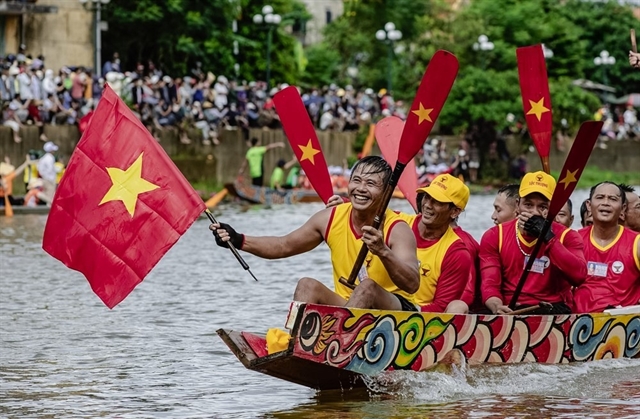 |
| The joy of victory on Kiến Giang River. — Photos baovanhoa.vn |
QUẢNG TRỊ — On Kiến Giang River, the annual boat race has all the hallmarks of a sporting competition, with set distances, rules, teams and rankings.
Yet these features alone cannot explain why the riverbanks ared filled with spectators every National Day, why people living far from home ask about their village boats or why crews spend weeks training for a race lasting only a few hours.
For the people of Lệ Thủy Village, the festival is a tradition rooted in a centuries-old relationship with the river, a celebration of community and since the early years of national independence, a distinctive way of marking September 2.
From river life to an Independence Day tradition
Lệ Thủy has long been shaped by waterways, low-lying rice fields and a dense network of rivers and canals. Travel, farming, fishing and everyday work brought generations of residents into close contact with boats and oars, with skills passed from one generation to the next.
Research suggests that the boat-racing tradition dates back around 500 years. In its earlier form, it was associated with spring festivals and wishes for favourable weather, abundant crops and prosperity.
The boat, first a familiar means of livelihood, gradually became part of the festivities, giving young people an opportunity to demonstrate strength, skill and teamwork.
For Đặng Hào, a local resident in his 80s, people along the Kiến Giang have never viewed the race simply as a matter of winning or losing.
“Our grandparents depended on the fields and the river, so the festival was first of all a prayer for favourable weather, good water and a good harvest," he said.
"After the country gained independence, the race took on a new joy, becoming a day when the whole village celebrated National Day together."
A particularly memorable milestone came in 1946, when the Kiến Giang boat race was held to mark National Day on September 2.
From then on, a folk tradition rooted in agricultural and river life became intertwined with the joy of national independence. Local people began referring to the occasion simply as the 'Independence Day Tết'.
National Day was no longer remembered only through official ceremonies, but also through family reunions, cheers along the river and colourful boats carrying the names of their villages.
A living heritage passed down
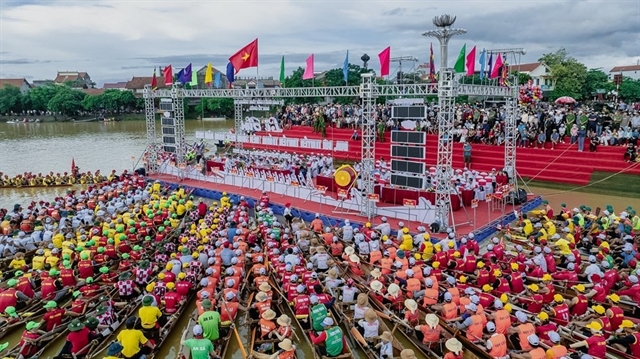 |
| Teams taking part in the traditional boat-racing competition gather in front of the grandstand during the opening ceremony. |
The rowers and paddlers are only the most visible part of the event. Behind them are parents, siblings, former competitors and people working far from home who still follow training sessions and keep track of every race.
For those taking part, that sense of community is particularly strong when they step onto the boat. They know that relatives, neighbours and an entire village are watching from the banks. A victory belongs to everyone, while a defeat simply means training harder for the following year.
Young competitors learn how to hold the paddle, maintain rhythm, read the current and pace themselves from people who once occupied the same seats.
Lê Hùng, an older resident who spent many years following his village's rowing team, said crews inevitably changed as older competitors retired.
“But if the experience continues to be passed down, there will always be someone from the village ready to take the boat onto the river,” he said.
One distinctive feature of the festival is the parallel presence of men's swimming boats and women's racing boats. Men compete using shorter paddles, while women stand and row with longer oars. The techniques differ, but both demand stamina, skill and close coordination.
Nguyễn Thị Hương, a former member of a women's racing team, said some women grew up watching their mothers, aunts or other village women row in the boats. When their own turn came, they began to understand why older generations had always reminded them to maintain the rhythm, conserve their strength and think about the entire team.
The presence of women on the racecourse reflects the communal character of life in Lệ Thủy, where both men and women have helped sustain the cultural practice across generations.
A homecoming on the Kiến Giang
Another side of the festival can be seen on the roads leading back to Lệ Thủy.
Many local people who study, work or live elsewhere still try to return home around National Day. They visit relatives and old friends, then head to the Kiến Giang to watch the boats race.
Lê Văn Hưng, a Lệ Thủy native working in Đồng Nai Province, said he usually tried to arrange his schedule so that he could bring his children home for the occasion.
“I have watched the boat race since I was a child, and now I want my children to know the boat from their home village and understand why Lệ Thủy becomes so lively on September 2. Some things can only be felt by taking children to stand beside the river,” he said.
In 2019, the Kiến Giang River boat racing and swimming festival was included in the national list of intangible cultural heritage. The recognition was not simply for a race, but for the knowledge, customs, skills and community relationships that have grown around the boats and the river.
Today, the festival is larger and more professionally organised, while images of the race are shared widely through television and social media. This offers new opportunities to promote Lệ Thủy's culture and tourism, but also raises a fundamental question: how can the festival grow without losing the community spirit that has kept it alive?
That question is in line with the Politburo's Resolution No. 80-NQ/TW, which places people at the centre of cultural development and emphasises preserving and promoting cultural heritage as a resource for sustainable development, including through tourism.
The Kiến Giang festival is already an example of heritage as a living community resource. Its value lies not simply in the speed of the boats, but in the people, memories and skills gathered around them every September.
The boat-racing tradition may have begun around 500 years ago. But after the autumn of independence in 1945 and the National Day race of 1946, the people of Lệ Thủy gave it another layer of memory.
Eight decades later, that memory remains vivid every September, when the paddles hit the water and the banks of the Kiến Giang once again fill with people. — VNS
Life & Style
 Life & Style
 Life & Style
 Life & Style
 Life & Style
 Life & Style
 Life & Style
 Life & Style
 Life & Style
 Life & Style
 Life & Style
 Life & Style
 Life & Style
 Life & Style
 Life & Style