 Life & Style

Top Vietnamese leader meets with Belgian Senate Speaker, House President
1.
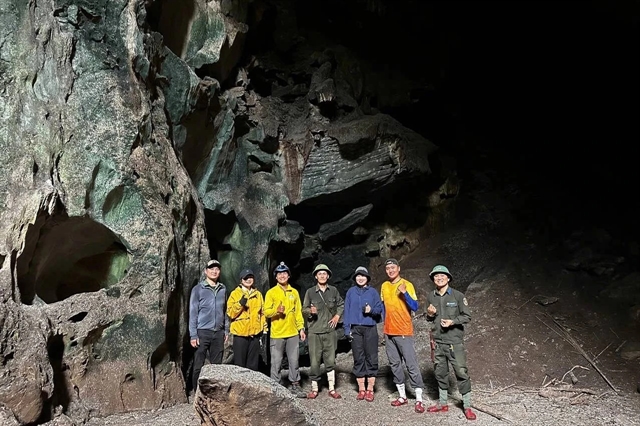 |
| Forest rangers at the cave entrance. — Photos courtesy of Management Board of the Nam Quảng Trị Special-use Forest |
QUẢNG TRỊ — A newly discovered cave with an entrance almost 70 metres wide and a system of multi-coloured stalactites has been found in Quảng Trị Province.
The Management Board of the Nam Quảng Trị Special-use Forest said the cave was identified on Tuesday in sub-area 638S of the Bắc Hướng Hóa Nature Reserve, a remote forested area in the province.
Initial surveys show that the cave opens into a vast chamber, with an entrance stretching close to 70m across. After about 200m, the interior splits into four main branches that extend deep into the mountain. Within these passages, explorers observed a variety of untouched stalactites and stalagmites in diverse shapes. Under torchlight, the formations reflect shimmering colours, creating a striking visual effect.
Officials believe that deeper sections of the cave may contain even larger formations, along with a shallow underground water stream. However, due to limited equipment, the survey team have so far only explored the outer sections and has yet to fully access all four branches.
Nearby, a large sinkhole has also been identified, adding to the area’s geological significance. The site lies not far from Vân Tiên Cave, discovered more than a decade ago and known for its impressive stalactite system. These findings have led experts to suggest that the region may host an extensive underground karst network with interconnected cave systems.
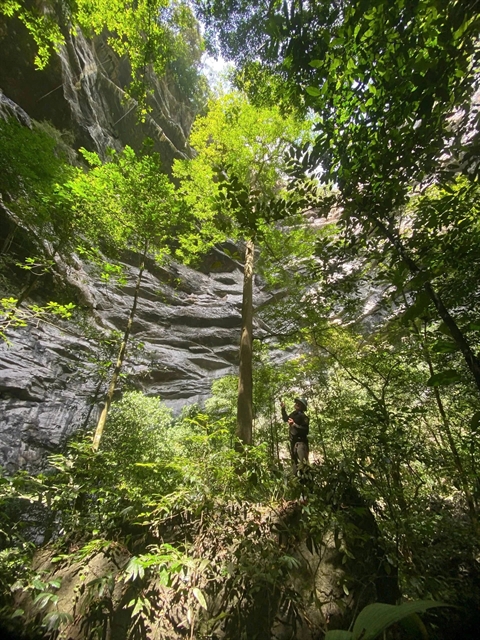 |
| A forest ranger approaches the newly discovered cave area Bắc Hướng Hóa Nature Reserve. |
Karst caves are formed over millions of years as water gradually dissolves limestone, creating underground voids and distinctive formations such as stalactites, stalagmites, sinkholes and subterranean rivers. These natural processes make such caves both scientifically valuable and visually captivating.
Authorities are now planning to collaborate with cave exploration specialists to conduct a comprehensive survey of the site. The study will focus on mapping the cave’s structure and assessing its ecological value, with a view to supporting conservation efforts while exploring the potential for eco-tourism development.
Covering more than 23,000ha, Bắc Hướng Hóa Nature Reserve is known for its rugged terrain, with steep mountains, narrow valleys and dense river systems. The area is home to rich biodiversity, including hundreds of plant and animal species, many of which are listed in Việt Nam’s and the world’s Red Data Books.
The discovery comes amid growing interest in Việt Nam’s cave systems. In late April, a joint British – Vietnamese expedition identified 26 new caves in Phong Nha – Kẻ Bàng National Park, with a total surveyed length of over 13km. Among them, Thiên Cung Cave, stretching more than 4,200m, has been noted for its scientific value and development potential, while Chả Nghéo Cave has drawn attention for its dramatic waterfall plunging into a deep shaft. — VNS
Life & Style
 Life & Style
 Life & Style
 Life & Style
.jpg) Life & Style
Life & Style
 Life & Style
 Life & Style
 Life & Style
 Life & Style
 Life & Style
 Life & Style
 Life & Style
 Life & Style
 Life & Style
 Life & Style