 Life & Style
European higher education week opens new opportunities
1.
|
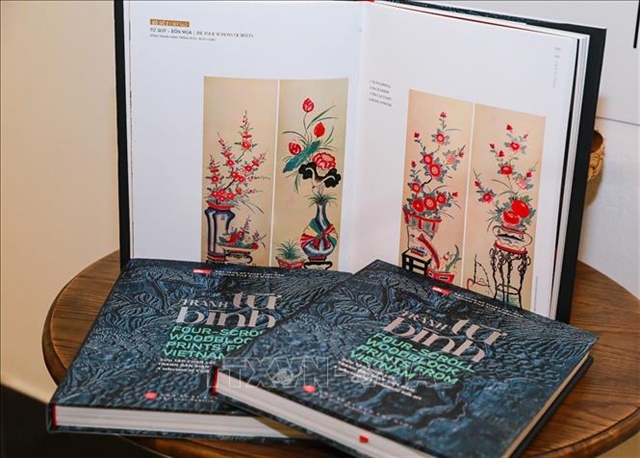
| The bilingual Vietnamese-English book 'Tranh Tứ Bình – Sưu Tập Chọn Lọc Tranh Dân Gian Việt Nam' (Four Scroll Woodblock Prints from Việt Nam: A Selection of Vietnamese Folk Art) was published by Việt Nam Fine Arts Museum and Thế Giới Publishers. — VNA/VNS Photos Khánh Hòa |
HÀ NỘI — The Việt Nam Fine Arts Museum has launched a bilingual Vietnamese – English publication showcasing a curated selection of traditional Vietnamese folk paintings.
The publication Tranh Tứ Bình – Sưu Tập Chọn Lọc Tranh Dân Gian Việt Nam (Four Scroll Woodblock Prints from Việt Nam: A Selection of Vietnamese Folk Art) is the result of the museum’s long-term efforts in research, collection and preservation.
Compiled by the museum’s curators and experts, the publication offers readers a journey into the rich cultural heritage embodied in the distinctive tứ bình (four-scroll woodblock print) folk painting tradition.
These prints are among the most distinctive of Việt Nam's many traditional art forms.
Their lively compositions depict a wide variety of themes and topics, including the four seasons of the growing year, the four stages of human life, episodes from cherished works of literature and popular legends, the Four Immortals and the four idealised female figures, often referred to as Goddesses.
Another key feature of many series is the inclusion of beautiful Hán (Chinese script) or Nôm (Vietnamese ideographic script), providing a textual counterpart to the colourful images enjoyed by the viewer.
"Vietnamese folk paintings, including tứ bình, represent a significant cultural legacy and an integral part of the historical development of Vietnamese fine arts, passed down by previous generations as a valuable artistic heritage for posterity," said museum director Nguyễn Anh Minh at the book launch.
"Each folk painting embodies the messages, aspirations and emotions that past generations sought to pass on to their descendants. More than works of art, they are visual narratives that reflect history, culture, philosophies of life, educational values and aesthetic traditions," Minh said.
The publication present 25 traditional scroll quartet series, including Tứ Quý (the four seasons), Tố Nữ (the Goddess), Tứ Dân (the four kinds of folk) and Bát Tiên (the eight immortals).
|
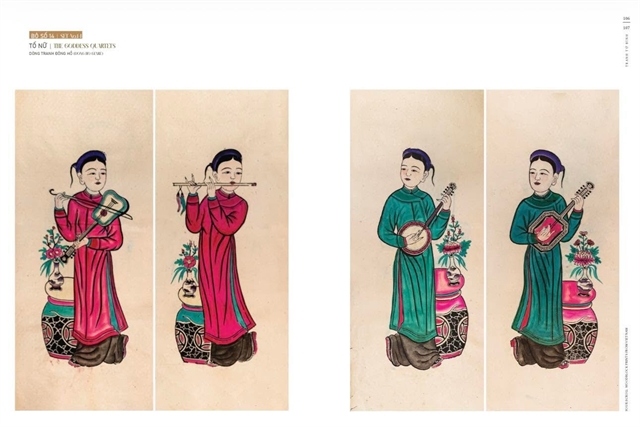
| A set depicting the Goddess, made in the Đông Hồ style. |
Also included in the book are selected historical and illustrative sets, as well as examples of original woodblocks from the Quartet Scroll Collection of the Việt Nam Fine Arts Museum.
Four seasons paintings feature detailed images of seasonal flowers and wildlife with delicate compositions, showing appreciation for the beauty of nature.
The Goddess quartet, created by traditional Hàng Trống artists, depicts the goddess performing with four different musical instruments. In Chinese characters, Tố Nữ means a classic goddess, a master of music, medicine and love, who is a creative force in the universe.
Four folk paintings celebrate the principal occupations of ordinary people in the past – fishermen, woodcutters, farmers and scholars.
"The sets selected for this volume are typical examples of this genre. In effect, they are short poetic songs of love and intimate relationships," said researcher Phan Ngọc Khuê.
Khuê noted: "In traditional Vietnamese society, scholars were honoured as wise and cultivated men of learning who preferred a secluded life.
"Along with other simple folk, they live in harmony with nature, rather than striving for fame and wealth. These paintings have long been warmly appreciated throughout our homeland."
The publication highlights the significance of key tứ bình themes and includes the original Hán characters, phonetic transcriptions and translations for each set of paintings, enabling both Vietnamese and international readers to gain a deeper understanding of the subjects and meanings embodied in these works.
Woodblock printing materials and techniques are also introduced in the publication. Many raw materials are required for the production of Vietnamese woodblock prints. Each is used for a different type of printmaking.
The publication was compiled by a number of experts from the museum, as well as those from the Institute of Hán-Nôm Studies and translator Trịnh Lữ. The book launch was held to mark the 60th anniversary of the VNFAM on June 24. — VNS
Life & Style
 Life & Style
 Life & Style
 Life & Style
 Life & Style
 Life & Style
 Life & Style
 Life & Style
 Life & Style
 Life & Style
 Life & Style
 Life & Style
 Life & Style
 Life & Style
 Life & Style