 Sports
Viên dives again to popularise swimming passion
1.
|
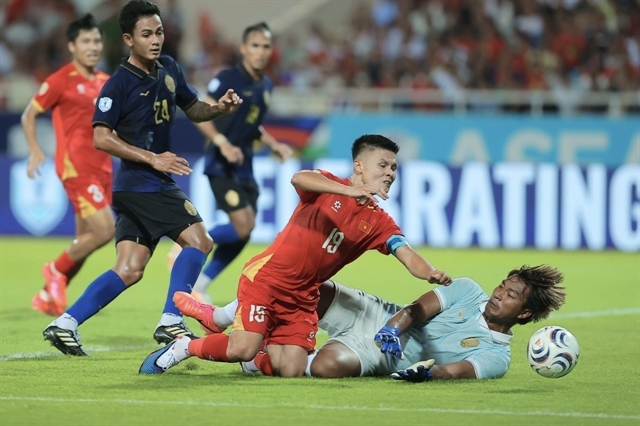
| Nguyễn Quang Hải (#19) struggles to deliver a decent performance at home against Cambodia last Friday. VNA/VNS Photo Minh Quyết |
Anh Đức
Friday night at Mỹ Đình, Hà Nội, should have belonged to Nguyễn Quang Hải.
In the 3-1 victory over Cambodia that sent Việt Nam into the ASEAN Championship semi-finals as unbeaten group winners, the captain made his 84th appearance for the national team, surpassing the legendary Lê Công Vinh to become the most-capped player in Vietnamese football history.
It took Vinh 13 years to reach his mark. Hải needed only nine, from his debut against Jordan in June 2017 to that night, a period in which he helped deliver two regional titles, an Asian Cup quarter-final and Việt Nam's first-ever appearance in the final round of World Cup qualifying.
Should the Golden Star Warriors defend their crown this month, he would become the first Vietnamese player with three ASEAN Championship winner's medals.
At 29, the century of caps is well within reach.
And yet, on the very night he entered the pantheon, social media buried him in criticism. The storm had been brewing all tournament. After the goalless draw with Singapore, he was branded the weakest link.
When he was benched against Indonesia and his replacement Lê Phạm Thành Long impressed in the 3-0 win, forums declared the captain surplus to requirements.
Against Cambodia, one missed chance and a modest computer-generated match rating of 6.8 became the spark for another pile-on, with some declaring the 29-year-old finished, unworthy of legendary status.
Let me say this in simple terms: no player who has given what Hải has given deserves that treatment.
Disappointment with a performance is fair. Criticism of a match is fair. But turning frustration into cruelty towards a man who authored some of the most cherished moments in our football history, from the snowy U23 final in China's Changzhou to the rainbow free-kicks at the 2019 Asian Cup in the UAE, says more about us than about him.
Coach Nguyễn Thành Công put it well when he called the wholesale dismissal of Hải's talent shallow and ungrateful. Even Messi and Ronaldo have had poor runs.
Form is temporary, class is permanent.
The numbers, for what they are worth, tell a kinder story than the algorithms. Against Cambodia, Hải completed 93 per cent of his passes, delivered four key passes, was the most creative player on the pitch and threaded three defence-splitting balls. His mere presence drags defenders out of position, opening space for Nguyễn Đình Bắc and Nguyễn Xuân Son to flourish.
But respect must flow in both directions, and honesty is a form of respect too. The truth is that Hải at 29 cannot be the Hải of 22, and the team around him has changed.
Nguyễn Hoàng Đức and Thành Long offer coach Kim Sang-sik genuine alternatives in midfield, and competition for the captain's place is no longer theoretical. The flashes of magic now come with quieter stretches in between, and against Malaysia in the semi-final at Bukit Jalil, quiet stretches will be punished.
The challenge for Hải is the one every great player eventually faces: to evolve. Fewer heroic solo moments, more tempo control; less burden-carrying, more orchestration of the gifted forwards around him.
Twenty-nine is not old, but it is old enough that change cannot wait. The best chapter of a great career is often the one written after the legs slow and the mind quickens.
So congratulations, captain, on a record built from nine years of service. The fans owe you their respect. And you, in turn, owe them one more reinvention. VNS
Sports
 Sports
 Sports
 Sports
 Sports
_med.jpg) Sports
Sports
 Sports
 Sports
 Sports
 Sports
 Sports
 Sports
 Sports
 Sports
 Sports