 Life & Style
Việt Nam News reporters win global journalism prize about child drowning
1.
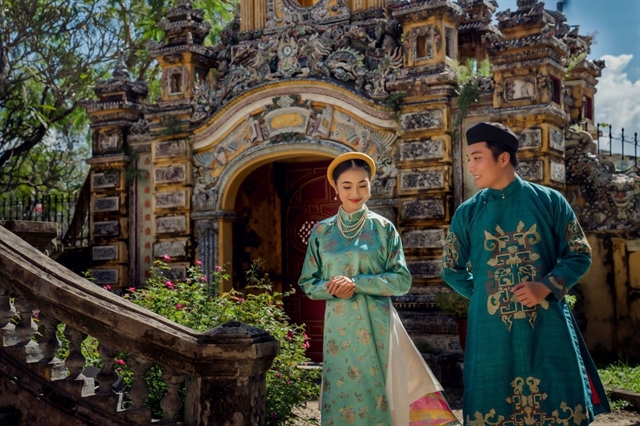 |
| Visitors wearing traditional áo dài stroll through Huế’s imperial heritage quarter. More than a national costume, the áo dài reflects the lifestyle, aesthetics and cultural spirit of Việt Nam’s former royal capital, reinforcing Huế’s growing identity as the country’s áo dài city. Photo sovaba.travel |
HUẾ — Long celebrated for its imperial citadel, royal tombs and poetic landscapes, Huế is entering a new chapter. The centrally governed city has unveiled its adjusted 2021-2030 development plan, marking a strategic shift that places heritage-led growth and sustainable tourism at the heart of its ambitions for the future.
The new blueprint reflects a broader national push to transform culture into an engine of economic development, in line with the goals of the Communist Party's Resolution 80, which identifies culture, tourism and creative industries as important drivers of growth in the country’s next stage of development.
Rather than viewing preservation as an end in itself, Huế is embracing a model that seeks to unlock the economic value of heritage while safeguarding its authenticity. By 2030, the city aims to establish itself as a festival city with a distinctive Vietnamese identity and an international profile.
Green growth
The new strategy places green growth and the circular economy at its core.
Tourism development will increasingly follow strict bioclimatic standards for accommodation facilities and destinations. Local authorities are also accelerating digital transformation and environmental initiatives, including plans to eliminate single-use plastics from night-time tourism zones.
The goal is to strengthen Huế’s reputation as an environmentally responsible destination capable of attracting high-value international visitors who stay longer and spend more.
As competition among Asian tourism destinations intensifies, sustainability is becoming an increasingly important factor in travellers’ decision-making. Huế hopes its blend of cultural depth and environmental stewardship will provide a unique competitive advantage.
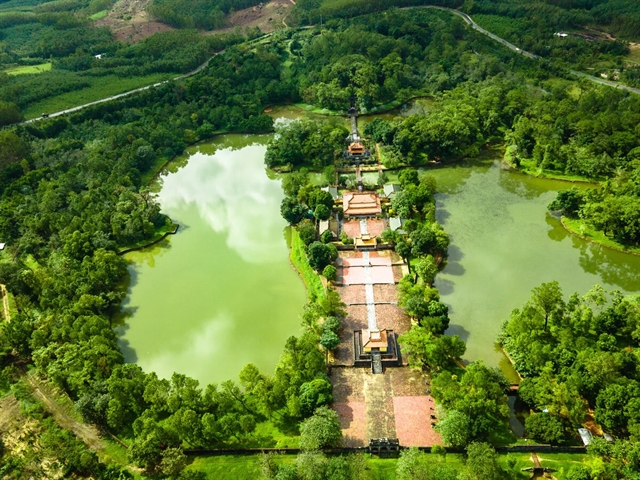 |
| An aerial view of the Tomb of Emperor Minh Mạng, one of Huế’s most celebrated royal mausoleums. Located on Cẩm Khê Mountain about 12 kilometres from the city centre, the complex is renowned for its harmonious blend of architecture, lakes and forested landscapes. Photo quycoctu.net |
Four zones
To encourage longer stays and more diverse visitor experiences, Huế’s tourism space has been reorganised into four complementary zones.
The first is the heritage core and suburban area, centred on the Complex of Huế Monuments and the Hương (Perfume) River. Here, conservation remains a priority, while premium cultural tourism products, royal performing arts and traditional lifestyle experiences are expanded. Garden houses, creative spaces and cultural industry activities are also expected to contribute to a vibrant night-time economy.
Another zone encompasses the lagoon and coastal landscape. Anchored by the Chân Mây–Lăng Cô Economic Zone, this area is envisioned as an international-class marine tourism and resort destination. Authorities are continuing to upgrade infrastructure to support cruise tourism and accommodate luxury transnational superyachts.
Further west, Huế’s mountainous region offers a different appeal. Forests, streams and waterfalls, combined with the rich traditions of ethnic communities, provide opportunities for adventure travel, wellness retreats and nature-based tourism.
The fourth zone focuses on rural and agricultural tourism. Community-based tourism projects, traditional villages and OCOP-certified local products are expected to help preserve rural heritage while creating sustainable livelihoods for local residents.
Together, these four tourism landscapes aim to create a more balanced and interconnected destination, encouraging visitors to explore beyond the city centre.
New experiences
The adjusted master plan also seeks to address one of Huế’s longstanding challenges: a shortage of large tourism and service complexes capable of supporting longer visitor stays.
More importantly, it signals a shift in thinking. Instead of relying solely on existing heritage assets, the city aims to actively create new experiences and value-added services that deepen visitor engagement.
Transport connectivity will play a crucial role. Improved links between Phú Bài International Airport, tourism wharves along the Perfume River and coastal transport corridors are expected to strengthen regional integration and improve accessibility.
At the same time, new commercial and service developments will complement signature tourism brands such as "Huế – Capital of Cuisine" and the city’s growing identity as Việt Nam’s áo dài traditional costume capital.
These initiatives are expected to help transform Huế from a destination known primarily for sightseeing into a dynamic cultural economy where heritage, creativity, hospitality and commerce reinforce one another.
National planning further strengthens this ambition. Under the Government-approved adjustment of the national tourism system plan for 2021-2030, the Quảng Trị-Huế-Đà Nẵng corridor has been identified as one of Việt Nam’s five key tourism growth regions.
Within this development corridor, Huế is recognised as one of the country’s 10 priority national tourism centres, with a focus on cultural industries and the night-time economy.
For a city whose identity has long been shaped by history, the new strategy represents more than an infrastructure plan. It is a vision for how heritage can become a catalyst for innovation, sustainability and prosperity, ensuring that Huế remains not only a guardian of the past, but also a destination confidently looking toward the future. VNS
Life & Style
 Life & Style
 Life & Style
 Life & Style
 Life & Style
 Life & Style
 Life & Style
 Life & Style
 Life & Style
 Life & Style
 Life & Style
 Life & Style
 Life & Style
 Life & Style
 Life & Style