 Life & Style
Việt Nam seeks solutions to AI challenges in education through international cooperation
1.
|
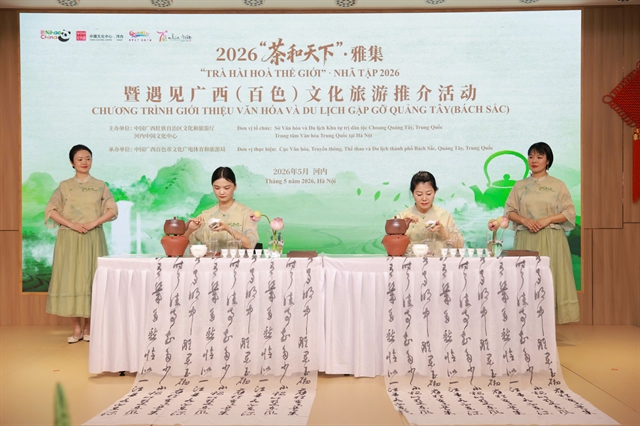
| Artisans perform a tea ceremony at the Tea for Harmony: Yaji Cultural Salon on May 14 at the Chinese Cultural Centre in Hà Nội. Photos courtesy of the Chinese Cultural Centre |
HÀ NỘI — Tourism ties between China and Việt Nam are expected to deepen further following a culture and arts programme held on May 14 at the Chinese Cultural Centre in Hà Nội.
The Tea for Harmony: Yaji Cultural Salon and tourism promotion event themed Meet Guangxi (Baise) brought distinctive Chinese cultural features to the capital through activities organised by the Department of Culture and Tourism of Guangxi Zhuang Autonomous Region.
Visitors were invited to explore some of the region’s best-known destinations and specialities across four experiential spaces: the Tea Tasting Area, Intangible Cultural Heritage Experience Area, Culture and Tourism Exhibition Area and Guangxi Flavour Tasting Area.
Speaking at the event, Xing Jiuqiang, counsellor at the Chinese Embassy in Việt Nam, said Guangxi boasted majestic mountains and rivers, beautiful scenery, rich folk customs and a diverse culture.
|
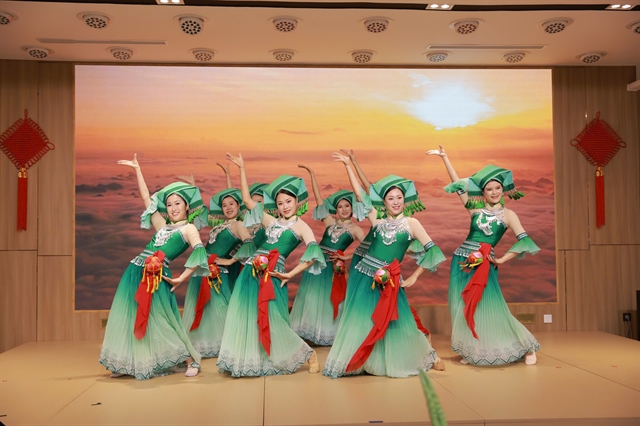
| Artists in a dance performance present the Guangxi Zhuang Autonomous Region's art and music to the Vietnamese public. |
It has served as a gateway for exchange and cooperation between China and Việt Nam, while also acting as an important bridge promoting open exchanges between China and ASEAN. In particular, it is a red-soil region that preserves the revolutionary legacy of President Hồ Chí Minh.
Zhang Deshan, Director of the Chinese Cultural Centre, said: “Tea is not only a cultural product but also a bridge that helps the people of the two countries understand and connect better.
“We use tea as a bridge, and tourism as a bridge to connect people's hearts. The Việt Nam-China Tourism Cooperation Year 2026-27 identifies tourism cooperation as an important element to strengthen people-to-people exchanges. Therefore, today's programme is not only a practical activity to respond to the Tea for Harmony initiative of the Chinese Ministry of Culture and Tourism, but also a vivid testament to the bridging role of our centre in strengthening the bond between the people of the two countries."
He said he expected the tea culture exchange and tourism promotion activity to help Vietnamese visitors gain a deeper understanding of Guangxi, as well as the culture and customs of Baise City.
Baise, which borders Việt Nam’s Cao Bằng and Tuyên Quang provinces, has a deep revolutionary tradition and a rich ethnic cultural identity. The locality is also one of southwest China’s representative tea-producing regions, known for its mild climate and picturesque scenery.
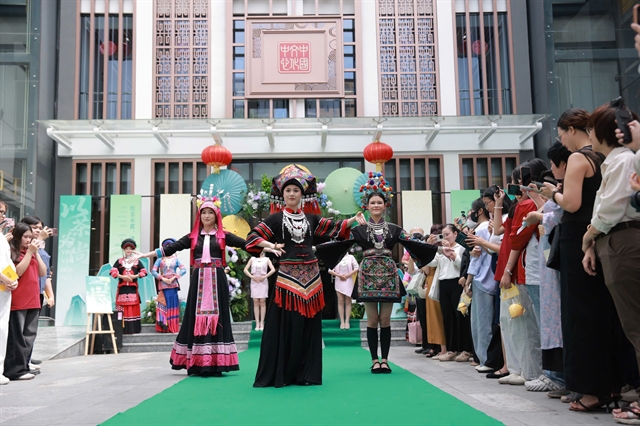
|
| Guangxi Zhuang Autonomous Region's beautiful outfits introduced at the event. |
According to statistics from the Việt Nam National Authority of Tourism, China has consistently been the largest source of visitors to Việt Nam for many years. In 2025, more than 5.28 million tourists from mainland China visited Việt Nam, accounting for 25 per cent of the country’s total international arrivals.
In the first four months of 2026, Việt Nam welcomed more than 1.85 million visitors from mainland China. Of those, more than 272,500 travelled to Hà Nội, marking a 59 per cent increase compared to the same period last year.
Experts said the main factors making Việt Nam an attractive destination for Chinese tourists included its affordable cost of living, inexpensive tourism services, beautiful beaches and rich culture and cuisine.
Meanwhile, tourist destinations near China’s border crossings, offering diverse attractions and flexible travel costs, have drawn Vietnamese visitors to China.
In addition, recent changes to visa policies between the two countries have helped create favourable conditions for tourists on both sides, supporting stronger cooperation, cultural exchange and tourism development.
Nguyễn Trần Quang, deputy director of the Hà Nội Department of Tourism, said the positive figures showed there remained significant potential for tourism cooperation and visitor exchanges between Hà Nội and localities in China.
He added that the figures also reaffirmed Hà Nội’s appeal to Chinese tourists. Quang expressed his hope of strengthening connections and cooperation with Chinese localities to develop distinctive tourism products, expand visitor exchanges and create more opportunities for people in both countries to learn about each other’s history, people and traditional cultural values. — VNS
Life & Style
 Life & Style
 Life & Style
 Life & Style
 Life & Style
 Life & Style
 Life & Style
 Life & Style
 Life & Style
 Life & Style
 Life & Style
 Life & Style
 Life & Style
 Life & Style
 Life & Style




