 Life & Style
Hà Nội adorned in red ahead of Liberation Day
1.
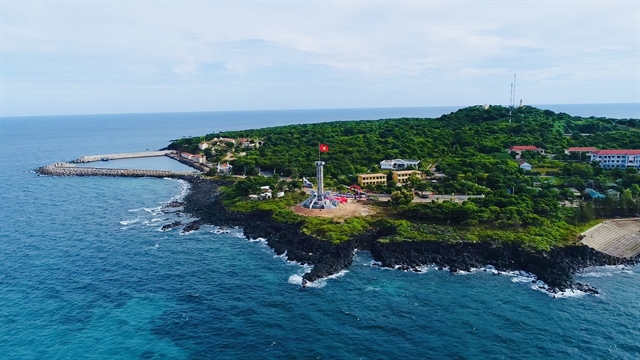 |
| Cồn Cỏ Island appears as a “green gem” in the open sea, distinctive in character and quietly captivating to visitors. — Photo vietnamtourism.gov.vn |
HCM CITY — Rising from the vast waters off central Việt Nam, Cồn Cỏ Island — once known as a wartime “steel island” — is entering a new chapter, reshaping itself into a centre for tourism and services while retaining its role as a quiet outpost in the East Sea.
Yet beneath its pristine forest–marine ecosystem and rich historical legacy, longstanding bottlenecks continue to hold back its development.
How to unlock its potential, allowing this outpost island to advance while preserving its intrinsic values, remains a pressing challenge for local authorities and policymakers.
Unlike more established destinations, the island quietly preserves layers of remarkable heritage: basalt terraces tens of thousands of years old, primary tropical forests, and enduring imprints of war.
Together, these elements shape a “green gem” in the open sea, distinctive in character and quietly captivating to visitors.
War legacy
Few would imagine that this tranquil setting of Cồn Cỏ, covering more than 2.30 square kilometres and some 30 kilometres off the mainland in the former province of Quảng Trị, now part of Quảng Bình, was once among the fiercest “coordinates of fire”.
Following the 1954 Geneva Accords that temporarily divided Việt Nam into North and South, Cồn Cỏ became a strategic position guarding the waters of the North around the 17th parallel.
On August 8, 1959, soldiers of Regiment 270 set foot on the island, raising the red flag with a yellow star, formally asserting sovereignty in the East Sea. From that moment, the island entered years of intense warfare.
Amid relentless bombardment, with nearly 1,000 engagements, soldiers and residents shot down 48 US and Sài Gòn aircraft and sank 17 enemy warships. Nearly 200 officers and soldiers sacrificed their lives to defend every inch of the island.
The name “steel island” was no coincidence, it was forged from resilience, sacrifice, and an unwavering belief: to hold the island was to hold the nation.
Today, walking along its narrow paths, war memories are not confined to books but remain vividly present, trenches, artillery positions, and former battle sites interwoven with tropical greenery. The landscape itself tells its story.
Veterans such as Trần Văn Thà, former island commander, recall those days with calm restraint: rationing fresh water, nights spent in bunkers, and life amid constant winds and waves.
The memories are quiet, yet enduring, much like the island itself.
Natural museum
If history alone defined it, Cồn Cỏ might be remembered simply as a “red address”. What truly sets the island apart, however, is its ecosystem — quietly restored, almost against the odds, in the years since the war.
A short walk from the water’s edge is enough to reveal it. Within a few dozen metres, the coastline gives way to dense, layered tropical forest. Sunlight slips through the canopy in broken shafts, scattering across the forest floor. The scene feels at once untouched and alive.
According to Trần Xuân Anh, chairman of the Cồn Cỏ People’s Committee, around 70 per cent of the island remains covered by natural forest.
Despite the devastation of wartime bombardment, it has largely regenerated. “It may not be vast, but it is dense and full of vitality,” he said, gesturing towards towering trunks wrapped in climbing vines, where birdsong and the hum of insects merge into a quiet, continuous rhythm.
The island itself was formed by volcanic activity more than 40,000 years ago.
Along its shores, layers of basalt step down towards the sea, shaped and reshaped by waves into striking forms.
Bãi Nghè retains the raw character of volcanic rock, while Hương Giang Beach softens into coral sand. To the north-west, Black Stone Beach catches the light on smooth, rounded stones, worn by time and tide.
Beneath the surface, another world unfolds. The surrounding marine protected area spans some 4,300 hectares and is home to 954 recorded species, including more than 260 species of fish and 137 types of coral, some of them among the healthiest reefs in Việt Nam.
Lobsters, sea cucumbers, cuttlefish, groupers, snappers, butterflyfish and giant oysters all thrive here, forming a marine ecosystem of remarkable richness.
For Phạm Hoàng Phương, vice chairman of the Quảng Trị Travel Association and Director of Ken Travel, it is precisely this unspoilt, largely untouched quality that defines the island’s appeal.
Visitors come not only to rest, but also to trace its past — through old trenches, tunnels and the sovereignty flagpole that anchors its history.
He describes Cồn Cỏ as a rare “natural museum”, where primary forest and marine life exist side by side in near-original condition.
In contrast to the energy of Đà Nẵng or Nha Trang, the island offers something quieter — a sense of distance, of stillness — well suited to experiential travel and the growing demand for restorative, “healing” escapes.
Visitors often find themselves struck by the clarity of the sea. “You can see fish swimming around the coral reefs just by looking down, it feels like a natural aquarium,” said Đặng Quốc Khánh, who travelled from Hà Nội.
For those who have spent their lives here, the impression is simpler, but no less telling. “The sea is clean, and there is still plenty of fish and squid,” said fisherman Nguyễn Văn Hải.
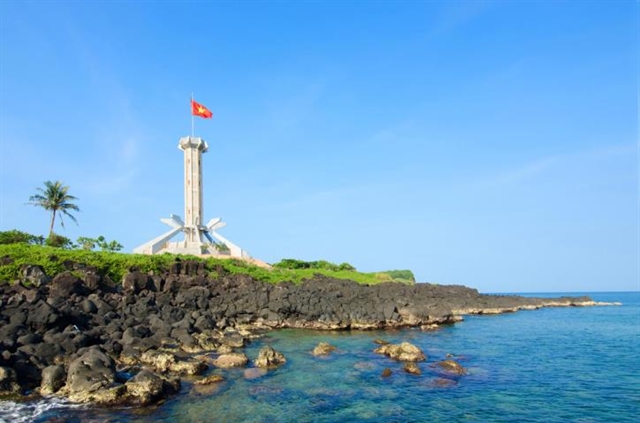 |
| Cồn Cỏ is gradually becoming a “green island” of peace — a gem in the open sea. — VNA/VNS Photo |
Island life
Life on Cồn Cỏ moves at an unhurried pace. There are no traffic lights, no crowded streets — only sea breezes, narrow roads and low houses tucked beneath the trees.
After decades as a purely military outpost, the island began to receive civilian residents in 2002.
By 2004, it had been formally established as an island district. Those who first arrived brought little with them, save for a determination to begin again on land once defined by conflict.
The story of Nguyễn Quang Thánh’s family offers a glimpse into that transition. His father, Nguyễn Văn Tống, had once been part of a commando force supplying the island during wartime.
Nearly four decades later, Thánh returned, not as a soldier, but as a settler, bringing with him his wife and young child. The absence of war did not make the choice an easy one.
Over time, homes began to appear among the trees. At Hoa Phong Ba Kindergarten, children’s voices now carry across the island. Morning cooking fires rise quietly; by late afternoon, fishing boats return to shore.
These are small, familiar signs, but together they mark the steady formation of a community.
Future path
Today, Cồn Cỏ is no longer solely a military island, yet it has not fully emerged as a tourism destination. It exists in a state of transition — between preservation and development, between stillness and expectation.
Geographically, it lies close to Cửa Tùng and Cửa Việt, two of Quảng Trị’s better-known beaches.
With stronger connections, it could become a distinctive highlight within the province’s coastal tourism network.
Phạm Hải Quỳnh, director of the Asia Tourism Development Institute, sees its value in precisely what it has not yet become. “Some places need to be built to attract visitors; others are valuable simply as they are. Cồn Cỏ belongs to the latter,” he said.
People come not only for the seascape, but to listen — to the story of an island that has endured war and is now, quietly, learning to move forward.
From a “steel island” of the past, Cồn Cỏ is gradually reshaping itself into a “green island” of peace — a gem in the open sea, not dazzling at once, but awakening in its own measured, enduring way. — VNS
Life & Style
 Life & Style
 Life & Style
 Life & Style
 Life & Style
 Life & Style
 Life & Style
 Life & Style
 Life & Style
 Life & Style
 Life & Style
 Life & Style
 Life & Style
 Life & Style
 Life & Style



