 Life & Style
HCM City seeks stronger port connectivity, green transition
1.
|
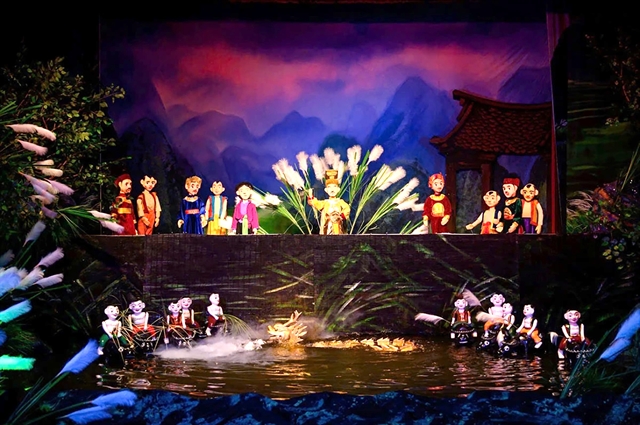
| A scene from 'Hoàng Đế Cờ Lau' (The Emperor of the Reed Flag) by the Thăng Long Water Puppet Theatre depicts the story of Đinh Tiên Hoàng, the first emperor of Đại Cồ Việt.. Photo vov.vn |
HÀ NỘI — Vietnamese puppetry may draw tourists, but behind the spectacle, the centuries-old art form is struggling to survive — caught between fading traditions and the pressures of modern entertainment.
Amid rapid urbanisation, performance spaces for many traditional water puppetry guilds have gradually narrowed.
People’s Artist Nguyễn Hoàng Tuấn, chairman of the Hà Nội Theatre Association, said while northern Vietnam had 27 puppetry guilds in 1986, only 14 remain today. Many traditional plays and original scripts have been lost, hindering restoration and preservation efforts.
Meanwhile, the severe shortage of researchers, theorists and critics in theatre studies has created a significant gap in the knowledge foundation necessary for the long-term development of the art form.
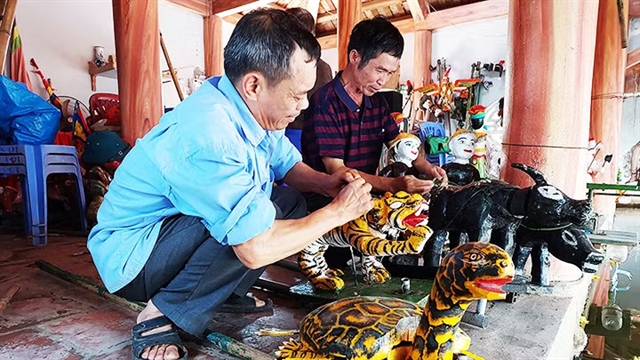
At Ðào Thục puppetry guild in Thụy Lâm Commune on the outskirts of Hà Nội, guild head Đặng Minh Hưng expressed concern that despite annual training courses funded by the city, young participants rarely pursue puppetry as a long-term career after completing their studies. Limited remuneration for puppeteers and irregular performance opportunities make it difficult to retain practitioners and sustain the craft.
|
| Artisans at the Đào Thục puppetry guild adjust puppets ahead of a performance. Photo nhandan.vn |
Vietnamese puppetry also faces pressure to adapt to modern lifestyles, particularly amid growing competition from diverse entertainment forms.
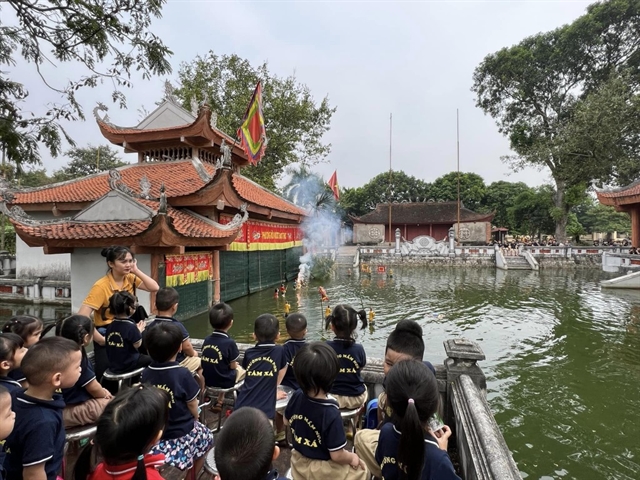
Current audiences are largely international visitors, with water puppetry drawing the greatest attention thanks to its uniqueness as a folk theatre form found only in Việt Nam. Domestic audiences, however, remain limited, except for schoolchildren who attend performances through educational programmes.
Experts suggest that for puppetry to remain relevant in contemporary cultural life, greater attention should be given to developing creative cultural spaces within traditional puppetry villages – the very places where the heritage originated and where performance practices and storytelling traditions have been passed down through generations.
Paths to renewal
Hưng emphasised the need for stronger institutional support, including investment in equipment, upgraded facilities, and improved policies to support puppeteers in practising, preserving and transmitting their craft.
Many experts also stress the urgency for local authorities to systematically review, document and preserve traditional puppet repertoires as a foundation for research, education and creative innovation.
|
| Children watch a traditional water puppet performance in Đào Thục Village, where the craft has been preserved for generations. Photo tuoitrethudo.vn |
Meritorious Artist Lê Văn Ngọ, former director of the Thăng Long Water Puppet Theatre, noted that preservation efforts should not focus solely on the 17 classical performances currently staged in urban theatres, as hundreds of traditional plays still exist in folk communities.
With many guilds now unable to produce puppets themselves and forced to rent them, he proposed increased investment in puppet craftsmanship and the establishment of dedicated preservation centres to archive historical materials and traditional puppet designs for future generations.
Regarding audience development, People’s Artist Trịnh Thúy Mùi, chairwoman of the Việt Nam Theatre Artists Association, underscored that introducing puppetry into schools is a sustainable solution to nurture young audiences’ appreciation for the art form. Theatres and puppetry guilds should harness creativity to bring cultural and historical lessons to life on stage in ways that resonate with students.
With its distinctive storytelling language and strong visual appeal, Vietnamese puppetry holds significant potential to become part of the cultural industry value chain. With systematic investment and innovation, the art form could evolve into a defining cultural brand of Việt Nam. — VNA/VNS
Life & Style
 Life & Style
 Life & Style
 Life & Style
 Life & Style
 Life & Style
 Life & Style
 Life & Style
 Life & Style
 Life & Style
.jpg) Life & Style
Life & Style
 Life & Style
 Life & Style
 Life & Style
 Life & Style