 Life & Style

Viên dives again to popularise swimming passion
1.
Dr Andres Sosa*
Knee pain is one of the most common complaints among active adults living and working in Việt Nam, from expatriates and business professionals to diplomats and frequent travellers. Many of these individuals are diagnosed with early knee osteoarthritis (OA), often based on standard X-rays and described simply as 'wear and tear' of the joint.
But emerging evidence suggests that this explanation may be incomplete.
|
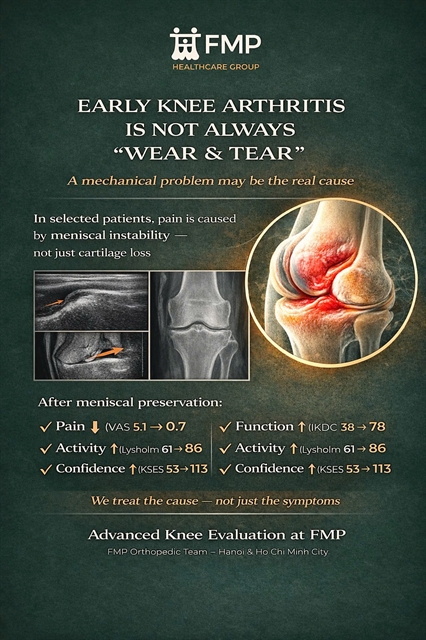
| Early knee osteoarthritis may be driven by meniscal instability rather than cartilage loss alone, highlighting the importance of targeted diagnosis and treatment. — Photo courtesy of Family Medical Practice |
Early knee osteoarthritis, typically classified as Kellgren-Lawrence grades I-II, is often considered a degenerative condition driven primarily by cartilage breakdown. However, conventional radiographs have limited sensitivity in detecting subtle but clinically significant mechanical abnormalities within the joint. As a result, an important contributor to symptoms may be overlooked: the meniscus.
The meniscus plays a critical role in load distribution, joint stability and shock absorption. When it becomes unstable, particularly in the form of meniscal extrusion or subtle tears, it can alter joint biomechanics and significantly increase localised stress on cartilage. This mechanical dysfunction can lead to pain, inflammation and progressive joint deterioration, even when radiographic findings appear minimal.
Recent clinical research conducted at FMP Healthcare Group in Việt Nam has explored this concept further. In a cohort of patients with early knee osteoarthritis and mechanically unstable meniscal lesions, a structured diagnostic and treatment approach was applied. This included initial screening with musculoskeletal ultrasound, followed by magnetic resonance imaging (MRI) to confirm the presence and extent of meniscal pathology.
Rather than relying solely on conservative management, selected patients underwent arthroscopic meniscal preservation procedures aimed at restoring stability and maintaining native tissue integrity.
The results were notable.
Patients experienced a marked reduction in pain, with average visual analogue scale (VAS) scores decreasing from moderate levels preoperatively to minimal levels at follow-up. Functional outcomes also improved significantly, as reflected in validated scoring systems such as the International Knee Documentation Committee (IKDC) and the Knee Injury and Osteoarthritis Outcome Score (KOOS). Importantly, patients reported increased confidence in their knee function and a return to higher levels of activity.
Equally significant were the imaging findings. Follow-up MRI evaluations demonstrated preserved meniscal structure without progression of extrusion or accelerated cartilage loss in the short term. These results support the hypothesis that, in selected cases, meniscal instability is not merely an associated finding but a key mechanical driver of symptoms in early osteoarthritis.
For patients, this has important implications.
A diagnosis of early knee osteoarthritis does not necessarily mean that the condition is purely degenerative or irreversible. In some cases, the underlying problem may be mechanical, and therefore potentially modifiable. Identifying these patients requires a more detailed and dynamic assessment of the knee, combining clinical evaluation with advanced imaging techniques.
This approach is particularly relevant in a population that values mobility and performance. Many expatriates and professionals in Việt Nam maintain active lifestyles, including running, tennis, golf, and gym training. Persistent knee pain not only affects physical health but can also impact work, travel, and overall quality of life.
By shifting the focus from a purely degenerative model to one that recognises mechanical contributors, clinicians can offer more targeted and effective interventions. While not all patients are candidates for surgical treatment, those with clearly defined meniscal instability may benefit from early, structure-preserving strategies rather than prolonged symptomatic management.
Ultimately, the message is clear: early knee osteoarthritis should not be viewed as a uniform diagnosis with a single pathway. It is a heterogeneous condition, and in some patients, the meniscus may hold the key to both understanding and treating their symptoms.
As research continues to evolve, so too should the way we evaluate and manage knee pain, moving beyond 'wear and tear' toward a more precise, personalised approach. — Family Medical Practice

|
| Dr. Andres Sosa. — Photo courtesy of Family Medical Practice |
*Dr Andres Sosa, an expert in orthopaedic surgery and sports medicine, specialises in advanced meniscus repair techniques. With training in Italy, the US, Spain and Singapore, he brings world-class expertise to Hà Nội, offering personalised care for active individuals and professionals.
FMP Healthcare Group operates medical centres in major cities including HCMC, Hà Nội and Đà Nẵng, offering consultations with international doctors, check-up centres and emergency ambulance services.
Visit FMP Hanoi 24/7 at 298i Kim Mã Street, Ngọc Hà Ward, Hà Nội.
To book an appointment, please call (024).3843.0784, or contact via WhatsApp, Viber or Zalo on +84.944.43.1919 or email hanoi@vietnammedicalpractice.com.
Life & Style
 Life & Style
 Life & Style
 Life & Style
 Life & Style
 Life & Style
 Life & Style
 Life & Style
 Life & Style
 Life & Style
 Life & Style
 Life & Style
 Life & Style
 Life & Style
 Life & Style