 Life & Style
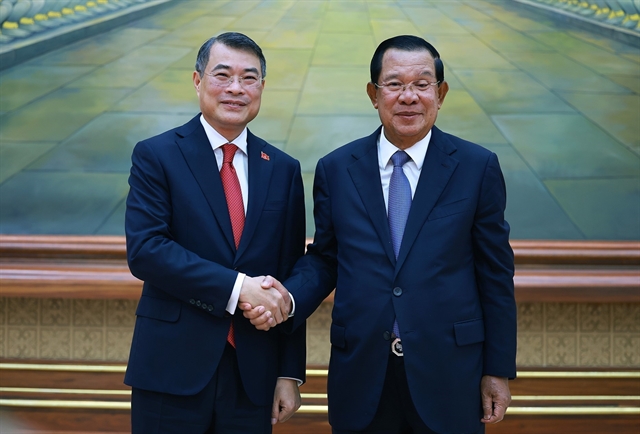
Vietnamese Prime Minister meets Cambodian National Assembly President
1.
|
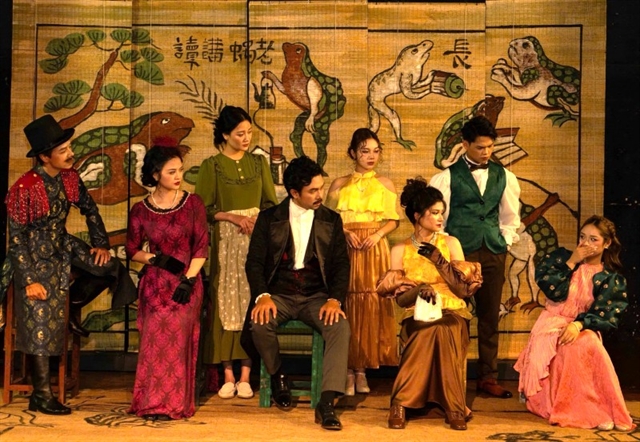
| The stage design incorporates bamboo screens decorated with Đông Hồ folk paintings, infusing ‘Pygmalion’ with a vivid Vietnamese cultural identity and a distinctive local flavour. — Photo daibieunhandan.vn |
HÀ NỘI — Pygmalion – a play by the renowned Irish playwright Bernard Shaw – will be staged next month by the University of Theatre and Cinema at the 8th Asia Theatre Education Centre (ATEC) Festival in Beijing, China.
Written in 1912 and named after the figure from Greek mythology, the play is a sharp social satire that explores class, identity, and gender equality. Shaw demonstrates how social status is a superficial construct, shaped by speech and manners rather than innate superiority.
The story follows phonetics professor Henry Higgins, who transforms Eliza Doolittle, a working‑class flower girl, into a 'lady' to prove that language is the key to social mobility. Through their unusual encounter, with witty and often humorous exchanges, Pygmalion exposes entrenched class prejudices and the invisible barriers dividing society.
Although rooted in the social issues of early 20th‑century England, the play’s themes remain strikingly relevant today, when humanity seeks deeper and more equal recognition of human values.
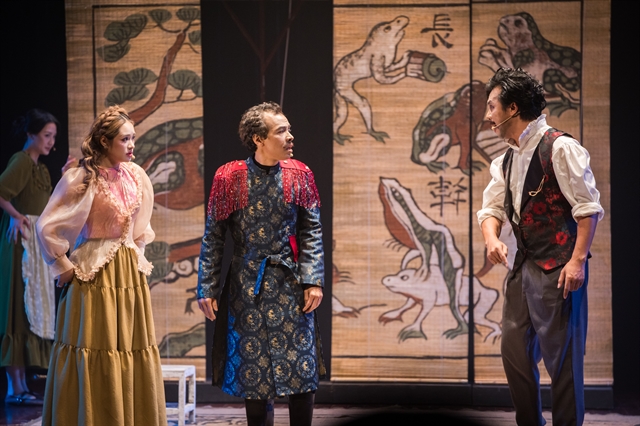
In its Vietnamese staging, Pygmalion becomes more than a classic tale: it opens a space for East – West cultural dialogue, placing questions of identity, prejudice, and human worth in a contemporary context. Here, the journey is not simply one of transformation but of self‑discovery – the pursuit of true human freedom.
Director Dương Thị Thanh Huyền, Deputy Head of the Theatre Faculty at the Hà Nội University of Theatre and Cinema, has chosen not to stage Pygmalion in the traditional European style. Rather than retelling the original story, she seeks to 'Vietnamise' the work through directorial techniques while preserving the spirit of Western drama. Her creative team aims to create a meeting point where the essence of European theatre converses with the rhythms, language, and people of contemporary Vietnamese society.
|
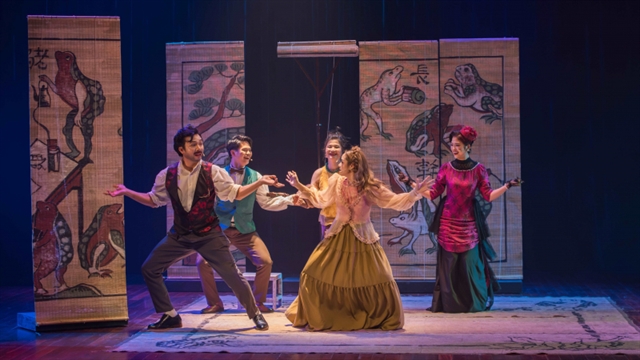
| The production brings together a large ensemble of artists, lecturers and talented young student‑actors from the Hà Nội University of Theatre and Cinema. — Photo daibieunhandan.vn |
While the play retains its London setting, character names, and much of the original context, the treatment of scenery, music, lighting, and performance highlights the East – West cultural interplay envisioned by the director.
In Shaw’s script, language defines social status; on the Vietnamese stage, it becomes a mirror reflecting regional diversity, social mobility, and lingering prejudices. The journey is not merely about learning to 'speak correctly' but, more importantly, about learning to 'be recognised' – a theme that continues to resonate in today’s Vietnamese cultural landscape.
Adapting an English play for a Vietnamese audience required careful translation. Director Huyền explained that her team first had to render the original text faithfully, with someone deeply knowledgeable about theatre ensuring accuracy. As the dialogue was lengthy – rehearsals initially ran for three hours – she edited and condensed the play into a one‑hour performance.
|
| In its Vietnamese staging, ‘Pygmalion’ becomes more than a classic tale: it opens a space for East – West cultural dialogue. — Photo daibieunhandan.vn |
“We had to distil the essence of the original, capturing its meaning faithfully while weaving Vietnamese cultural elements into the production,” she said.
Đông Hồ paintings were used as stage backdrops, while music with Vietnamese resonance provided distinctive highlights.
Meritorious Artist Bùi Như Lai, Rector of the Hà Nội University of Theatre and Cinema, noted that the school chose Pygmalion because it connects closely with contemporary life.
“When staging the play, my team and I sought to bring the rhythm of modern life into the work,” he said.
The production has been carefully prepared with international audiences in mind, placing particular emphasis on Vietnamese identity, especially in its set design and music. Following its premiere on April 2, the play will travel to Beijing to participate in the 8th ATEC Theatre Festival in mid‑May 2026.
Founded in 2005 by the Central Academy of Drama in Beijing, the ATEC Theatre Festival is a biennial event showcasing productions from leading theatre schools across Asia. Its 17 member institutions include the National Academy of Chinese Theatre Arts (China), Nihon University College of Art (Japan), Chung‑Ang University (South Korea), and Nanyang Academy of Fine Arts (Singapore), among others. — VNS
Life & Style
 Life & Style
 Life & Style
 Life & Style
 Life & Style
 Life & Style
 Life & Style
 Life & Style
 Life & Style
 Life & Style
 Life & Style
 Life & Style
 Life & Style
 Life & Style
 Life & Style