 Life & Style

PM Hưng meets with Cambodian People's Party, Senate leader Hun Sen
1.

|
| Lai Châu's stunning natural beauty is an advantage for the province to develop its tourism industry. Photo taybacsensetravel.com |
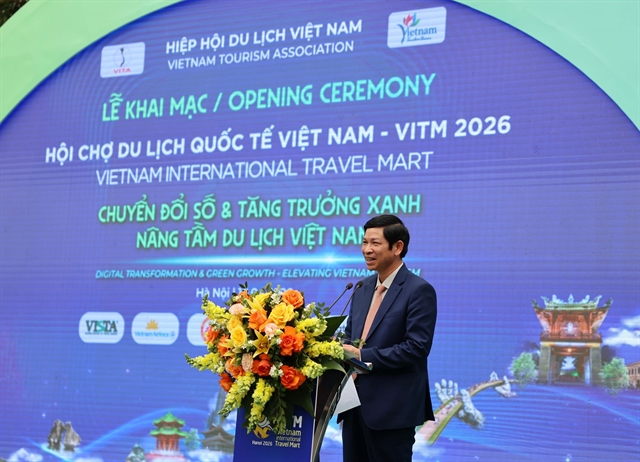
HÀ NỘI — Lai Châu people brought their traditional songs, dances and beautiful nature to the Việt Nam International Travel Mart 2026, hoping to attract more visitors in 2026 while seeking suggestions for stronger tourism development.
Lai Châu has long been famous for its majestic natural landscapes, being home to seven of the 10 highest mountain peaks in Việt Nam.
Its legendary landmarks, such as the Ô Quy Hồ Pass, mountain peaks Pu Si Lung and Bạch Mộc Lương Tử, along with its pristine vegetation and vibrant rhododendron forests, are must-visit places in tourists' lists.
Recently, the province has made its mark on the tourism map with many new typical destinations such as the Rồng Mây Glass Bridge tourist area, the Ô Quy Hồ Sky Gate, the cave complex, cloud-hunting areas and unique experiences, paragliding activities to conquer the 'roof of Indochina' in Sì Thâu Chải Village and the journey to explore the local culture in the Sìn Suối Hồ community tourism village.
Lai Châu's indigenous cultural space is also a highlight, as it is home to 20 ethnic groups living together, creating a diverse and unique cultural treasure. Among them, the Sìn Suối Ho community tourism village has achieved ASEAN standards.
Speaking at a tourism promotion conference on April 11, Nguyễn Đình Hùng, deputy director of the Lai Châu Department of Finance, said that in recent years, the province's tourism activities flourished and achieved many positive results.
During the 2021-25 period, Lai Châu welcomed over 5 million tourists, with total tourism revenue estimated at over VNĐ3,800 billion (US$ 144,3 million).
The infrastructure was increasingly invested in and modernised. Accommodation and service facilities were developed, with over 138 establishments offering 1,255 rooms, along with many standardised restaurants.
Telecommunications infrastructure, internet networks, and fibre optic cables were widely deployed throughout the province, increasingly meeting the needs of tourists.
The local authority wanted to directly meet and introduce to investors, businesses and tourists to Lai Châu's potential, advantages and current tourism products and then strengthen cooperation, develop new products and expand links with other cities and provinces.
Hùng said that with the motto 'Businesses prosper - Lai Châu develops', the province was committed to accompanying and creating favourable conditions for businesses and tourists in the process of investing, exploiting, and experiencing tourism products. Lai Châu aimed to build an image of a safe, friendly, attractive, and experience-rich destination.
|
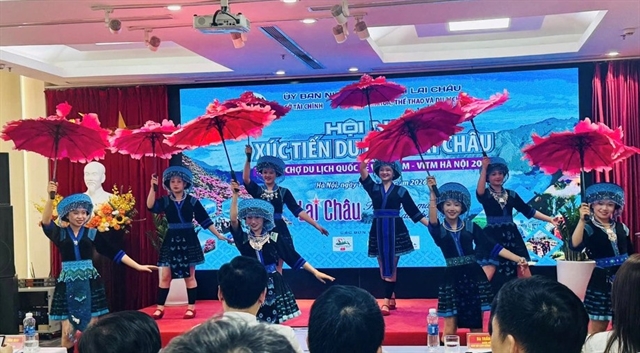
| Lai Châu artists travelled more than 400km to Hà Nội to show their beautiful dance at the conference. VNA/VNS Photo |
At the conference, delegates proposed many solutions and suggestions to promote sustainable and efficient tourism development.
Among them, Nguyễn Thị Hoa Mai, deputy director of the Việt Nam National Authority of Tourism, said Lai Châu had all the conditions to achieve a breakthrough if local leaders and people knew how to exploit its great potential.
“Lai Châu belongs to the group of provinces with the highest and most rugged terrain in Việt Nam, certainly suitable for trekking, adventure and exploration tourism," she said.
"As home to 20 groups of people, the province had an advantage in developing community tourism where visitors could discover and enjoy the unique cultural identity of each group.
"Tourists could also taste the pristine and majestic landscape. which were nearly untouched by development, aligns perfectly with the current tourism trend of slow travel and deep feelings.
"The year-round cool weather is good for Lai Châu to promote leisure, wellness and health tourism," she said.
Mai suggested that Lai Châu needed to base its tourism development on green economy and cultural experiences, targeting long-stay and high-spending tourist groups.
“Lai Châu needs to focus on harnessing indigenous knowledge and developing immersive, distinctive cultural products and narratives rooted in its unique heritage to attract visitors. A ‘living’ museum representing the province’s 20 ethnic groups is a strong example of this approach,” Mai said.
In addition, the province needed to clear infrastructure problems, attract large corporations to form a leading tourism ecosystem, and improve the quality of local human resources. — VNS
Life & Style
 Life & Style
 Life & Style
 Life & Style
 Life & Style
 Life & Style
 Life & Style
 Life & Style
 Life & Style
 Life & Style
 Life & Style
 Life & Style
 Life & Style
 Life & Style
 Life & Style