 Life & Style
Top leader hails friendship association's role in nurturing Việt Nam–Denmark ties
1.
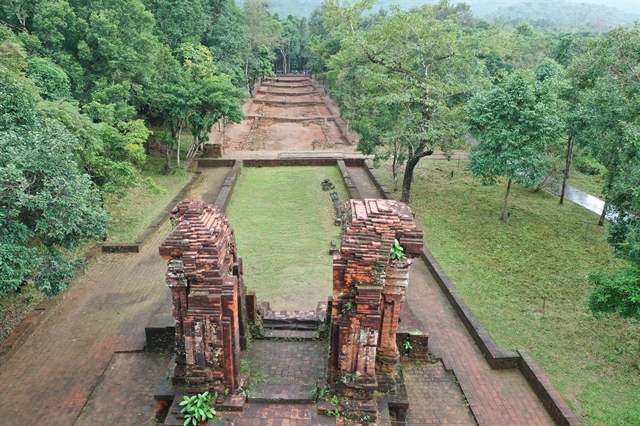 |
| A view of an entrance road leading from the K Tower to the central area of the Mỹ Sơn Sanctuary. It would be a sacred road of Hindu Deities during the Champa Kingdom from previous centuries. — Photo courtesy of Mỹ Sơn Sanctuary's management board |
MỸ SƠN SANCTUARY — New excavations have revealed what archaeologists describe as a rare and significant discovery at Mỹ Sơn Sanctuary: an ancient entrance road linking the K Tower to the central complex, believed to have served as a sacred route for Hindu deities and a royal passage for Champa kings and priests between the 10th and 12th centuries.
Reports from archaeological programmes conducted at the site from July to November show that this sacred road and entrance structure have been unearthed for the first time in the known history of the World Heritage Site, according to the management board of the Mỹ Sơn Sanctuary.
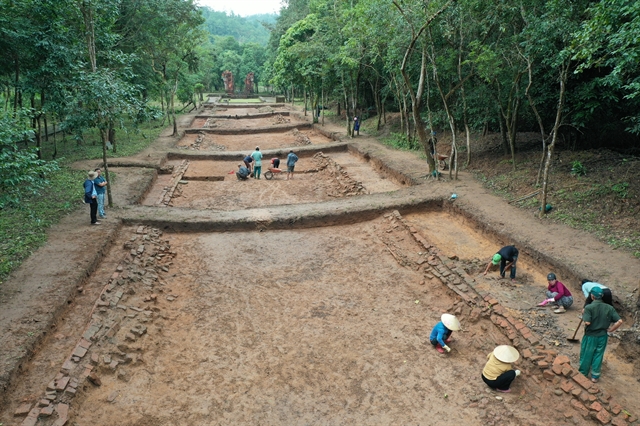 |
| An excavation on a sacred road in the Mỹ Sơn Sanctuary, a world heritage site, 70km from Đà Nẵng City. The discovery of the road was seen as the greatest archaeological achievement of Việt Nam in modern times. Photo courtesy of Mỹ Sơn Sanctuary's management board |
It said the road, built between the 10th and 12th centuries, had not been known until June 2023 when a group of archaeologists from the Institute of Archaeology and the sanctuary’s management board began the first excavations over a 220sq.m area during 2023-24.
Ngô Văn Doanh, an expert at the Institute for Southeast Asian Studies, said the finding of the road is not only of great architectural value, but also highlights the unique position of the first fully excavated pathway within the sanctuary.
“It also identified the positions of five gates on the right side of the guide wall of the sacred road. And the discovery had not been identified by Henri Parmentier, a prominent archaeologist with the L’EÙcole Francaise d’Extreâme Orient (the Far East Archaeological Research Institute) and French archaeologists in different excavations at the site in the 19th century,” Doanh said.
“Documents and items from the latest excavations strongly confirmed that the road is a sacred entrance to the Mỹ Sơn Sanctuary, one of the greatest archaeological achievements of Việt Nam in modern times.”
Nguyễn Ngọc Quý, an expert from the Institute of Archaeology, shared that a group of Indian archaeologists had earlier identified two gates to the east and west of the K Tower, as well as a section of the guide wall leading to towers E and F during a restoration project in 2017-18.
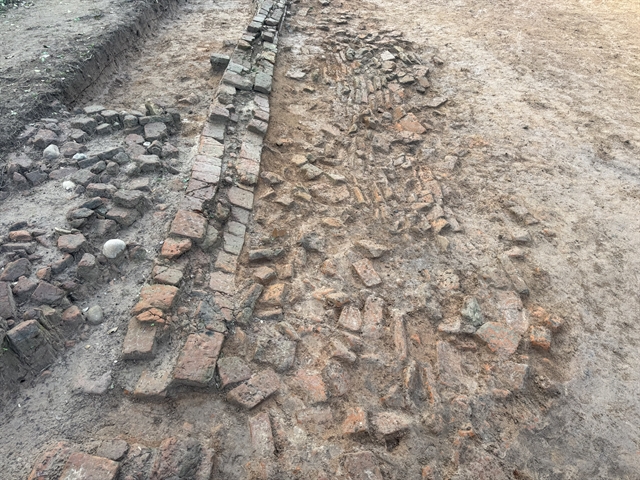 |
| Stones and bricks are found on the surface of the newly excavated entrance road in the Mỹ Sơn Sanctuary. The road would be built from the 10th to 12 century. Photo courtesy of Công Khiết |
The first excavation around K Tower in 2023-24 revealed two additional guide wall sections of the entrance road leading from K Tower to towers E and F, Quý said.
An archaeological research and excavation programme carried out in July 2025 uncovered a road section to the east of K Tower measuring about 75m in length and 9m in width, according to the report.
The road surface was compacted from a mixture of sand, pebbles and crushed bricks with a thickness of 0.15m to 0.2m. The guide walls were constructed from bricks on foundations made of brick powder and ground pebbles, the sanctuary’s management board reported. The excavation also identified a number of artefacts and fragments of terracotta and ceramics dated to between the 10th and 12th centuries.
Researcher and artist Nguyễn Thượng Hỷ, an expert on Champa culture, said the initial findings of the sacred road would contribute to a better understanding of Champa spirituality and religious practices.
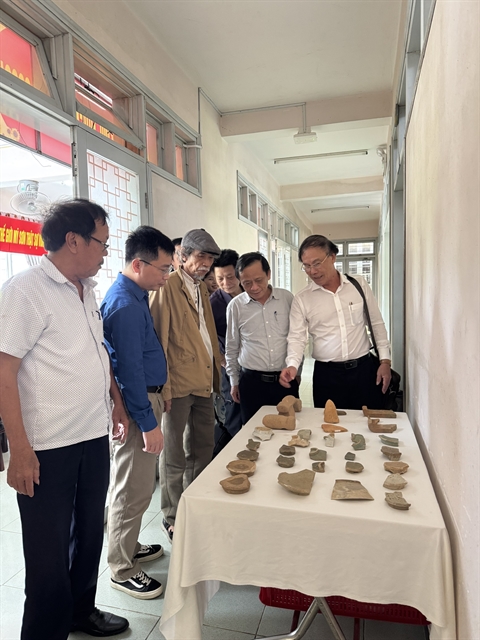 |
| Aftefacts excavated from an entrance road of the Mỹ Sơn Sanctuary are on display at a conference on the report of the excavation on the road. Photo courtesy of Công Khiết |
He said recent excavations along the road have sparked further research into its significance as a key spiritual entrance to the Mỹ Sơn Sanctuary.
Deputy head of the management board of the Mỹ Sơn Sanctuary World Heritage Site, Nguyễn Công Khiết, said more conservation and restoration programmes will be carried out to support archaeological research and promote tourism.
The Mỹ Sơn Sanctuary, recognised by UNESCO as a world heritage site in 1999, remains one of the most popular destinations in Quảng Nam Province, alongside Hội An Ancient Town and the Chàm Islands–Hội An World Biosphere Reserve.
Located about 70km from downtown Đà Nẵng, Mỹ Sơn is the only central complex of Champa towers dating from the 4th to the 13th centuries, representing a unique centre of the former Champa Kingdom in central Việt Nam.
Many artefacts excavated from the sanctuary have been preserved and displayed at the Chăm Sculpture Museum in Đà Nẵng since 1915, with significant contributions from French archaeologist Henri Parmentier.
The restoration and preservation of Mỹ Sơn Sanctuary have also benefited from the dedication of the late Polish archaeologist and architect Kazimierz Kwiatkowski, known as ‘Kazik’, along with the support of international organisations and the governments of Italy, India and Poland over the past decades. — OVN/VNS
Life & Style
 Life & Style
 Life & Style
 Life & Style
 Life & Style
 Life & Style
 Life & Style
 Life & Style
 Life & Style
 Life & Style
 Life & Style
 Life & Style
 Life & Style
 Life & Style
 Life & Style