 Economy



ECO Expo Asia opens at Hong Kong AsiaWorld-Expo in late October
1.
|
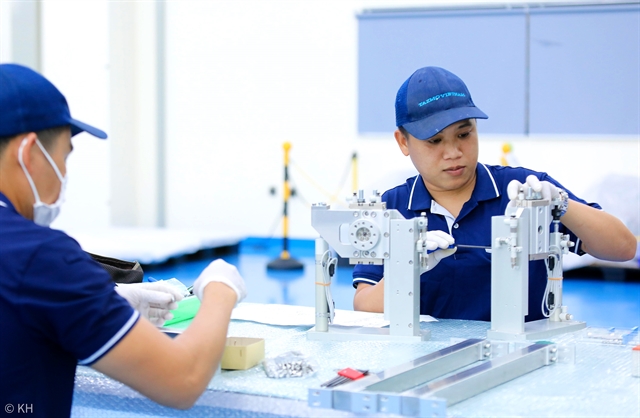
| Chip production at TAZMO Việt Nam in Tây Ninh Province. Investors in key industries could receive tax and credit incentives in return for specific commitments in technology transfer. — VNA/VNS Photo Thành Phương |
HÀ NỘI — The Ministry of Industry and Trade (MoIT) has proposed adding semiconductors, high-tech electronics, offshore wind power, strategic minerals and rare earths to the list of key industries, as Việt Nam seeks to strengthen industrial self-reliance and attract major global investors.
Under the latest draft of the Law on Key Industries, which comprises 11 chapters and 95 articles, energy and energy equipment, offshore wind power, strategic minerals and rare earths, metallurgy and materials would be added to the list of crucial sectors.
Also included in the list are basic and high-tech chemicals, mechanical engineering and manufacturing, shipbuilding and marine construction, railways, automobiles, semiconductors and high-tech electronics, supporting industries, and environmental and recycling industries.
These industries are strategically important to Việt Nam's industrialisation and modernisation, as well as to strengthening domestic industrial capacity and the country's participation in global value chains, the ministry said.
MoIT also emphasised the roles of these industries in enhancing economic, energy and national security while supporting environmental protection and sustainable development.
Việt Nam is preparing to develop major infrastructure projects in transport, energy and digital infrastructure, including high-speed and urban railways, offshore wind farms, small modular nuclear reactors, gas-fired power plants, green hydrogen and ammonia projects.
Building domestic capacity to master core technologies and manufacture key products and equipment is therefore crucial to ensuring the country's security and resilience, according to MoIT.
Developing key industries would also help Việt Nam meet localisation and rules-of-origin requirements to avoid risks from international trade disruptions and expand the country's export markets, the ministry said.
The push comes as the global energy transition, digital transformation and expansion of high-tech industries intensify competition for strategic minerals, rare earths, advanced materials and other critical inputs.
Việt Nam has significant potential in strategic minerals, but has yet to establish a complete value chain from mining and deep processing to the production of materials, components and industrial equipment, according to the ministry.
Creating mechanisms to develop the strategic minerals industry is important for energy security, resource security and the long-term development of national industry, the MoIT noted.
The draft law devotes separate chapters to offshore industries and rare earths and strategic materials.
It also proposes a national strategic industry fund, support for national industrial capacity, mechanisms for market development and preferential treatment for products and services researched, designed, manufactured, integrated or mastered in Việt Nam.
Investment incentives
According to Deputy Director of the MoIT’s Industry Agency Phạm Văn Quân, the draft proposes special incentives to attract leading global technology companies while giving Vietnamese firms greater opportunities to join global supply chains.
Investors in key industries could receive tax and credit incentives as well as preferential access to strategic resources and large-scale projects, but would be required to make specific commitments on technology transfer, workforce training and development of domestic suppliers.
The draft also includes mechanisms to monitor those commitments, with incentives to be withdrawn if investors fail to meet their obligations.
Quân pointed out that Việt Nam has recently attracted major semiconductor investors through special mechanisms, but commitments on technology transfer, workforce training and support for Vietnamese suppliers remain general and have not met expectations.
If the proposed mechanisms are approved, the ministry expects that Việt Nam could attract about 500 leading global companies to invest and manufacture in the country's key industries, Quân said.
The draft also proposes special mechanisms for public procurement, State orders, task assignments and localisation requirements to create markets for key industrial products and services. — VNS
Economy
 Rikkeisoft ký kết MOU với LAC.Co, LTD - thúc đẩy hợp tác kinh doanh toàn diện trong lĩnh vực an ninh mạng.jpg) Economy
Economy
 Economy
 Economy
 Economy
 Economy
 Economy
 Economy
 Economy
 Economy
 Economy
 Economy
 Economy
 Economy
 Economy