 Economy



ECO Expo Asia opens at Hong Kong AsiaWorld-Expo in late October
1.
|
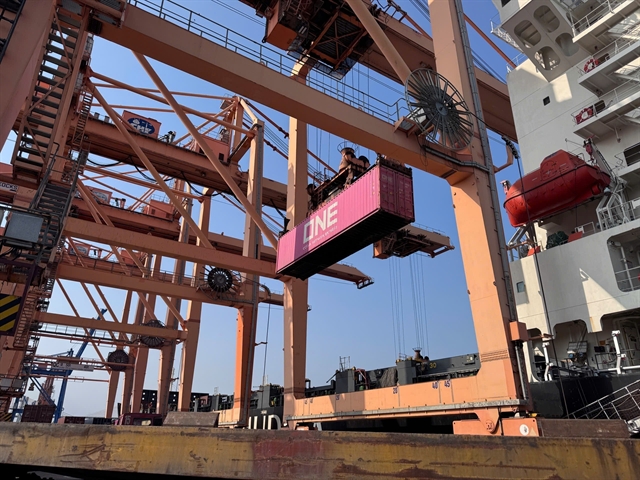
| A container being handled at Hải Phòng Port. MBS Securities forecasts that container throughput across Việt Nam's seaport system will reach around 36.7 million TEUs in 2026, up 15 per cent from the previous year. — VNA/VNS Photo |
HÀ NỘI — The Vietnam Ship Agents, Brokers and Maritime Services Providers Association has proposed establishing an International Maritime Centre (IMC) to help the country capture more of the economic value generated by its rapidly growing seaport sector.
Developed as a smart green hub, the proposed centre would include maritime finance, insurance, brokerage, legal and arbitration services, as well as workforce training.
The association also proposed tax, land and foreign exchange incentives to attract international financial institutions, insurers and maritime arbitration organisations to establish headquarters or branches at the centre.
Nhữ Đình Thiện, the association’s general secretary, cited estimates by international consulting firms that the centre could contribute nearly one per cent to GDP annually over the next decade, create tens of thousands of high-value jobs and attract billions in investment.
Special mechanisms for establishing the centre should also be studied, including a clear location, management model and implementation roadmap, according to the association.
Amendments to the Law on Marine and Island Resources and Environment should incorporate the development of the IMC to create a legal framework for coordinated implementation, the association said.
The proposal comes as Việt Nam’s port sector enters a new phase of growth, with rising trade and foreign investment driving demand for maritime transport.
MBS Securities forecasts that container throughput across Việt Nam's seaport system will reach around 36.7 million TEUs in 2026, up 15 per cent from the previous year, with volumes expected to rise rapidly in the final two quarters.
Deep-water ports are expected to gain market share due to their infrastructure and ability to handle large vessels, while new and expanded projects are being accelerated to accommodate rising cargo volumes.
By 2030, the port systems of Hải Phòng and HCM City are expected to handle 14.92 million TEUs and 18.25 million TEUs, respectively.
According to Thiện, despite significant potential, the domestic maritime industry remains concentrated in the final stages of the service chain, including transportation and cargo handling.
Most high-value services, including marine finance, protection and indemnity insurance, legal and arbitration services, brokerage services and fleet management, are still carried out in established maritime centres such as Singapore and Hong Kong (China).
Establishing a maritime centre would help Việt Nam to capitalise on its growing trade flow to generate higher value, but it would require more than investment in port infrastructure.
He also urged a transparent and business-friendly institutional environment to encourage investment in high-value maritime services. — VNS
Economy
 Rikkeisoft ký kết MOU với LAC.Co, LTD - thúc đẩy hợp tác kinh doanh toàn diện trong lĩnh vực an ninh mạng.jpg) Economy
Economy
 Economy
 Economy
 Economy
 Economy
 Economy
 Economy
 Economy
 Economy
 Economy
 Economy
 Economy
.jpg) Economy
Economy
 Economy