 Economy


Việt Nam, EU and Belgium seek deeper, practical cooperation
1.
|
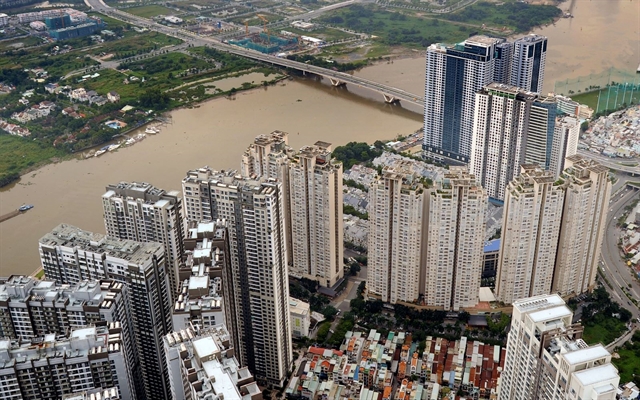
| Apartment buildings in HCM City. — Photo baotintuc.vn |
HÀ NỘI — The property market is shifting away from speculative investment toward projects backed by clear legal status, genuine housing demand and long-term value, even as new housing supply remains heavily concentrated in the high-end segment, the Vietnam Real Estate Research Institute said on Thursday.
The market was undergoing a fundamental shift as investors increasingly favour developments with transparent legal documentation and sustainable value instead of short-term price gains, the institute said in its report on the second quarter and first half of 2026, released at a seminar in HCM City.
Director of the institute Nguyễn Văn Đính said the market's recovery was continuing, but differences between market segments, regions and developers were becoming more pronounced as changes in regulations, project costs and buyer preferences reshaped the industry.
According to the report, housing supply continued to improve as legal bottlenecks eased, project approvals accelerated and more large-scale developments entered the market, although many developers remained cautious about launching new projects.
New housing launches totalled nearly 34,000 units in the second quarter of 2026, down about 10 per cent from the previous quarter, while total supply in the first half reached around 98,000 units, up about 50 per cent from a year earlier. More than 70,000 of those units were newly launched in H1, with supply concentrated in major urban centres and areas benefiting from new transport infrastructure.
Despite the increase in supply, the mismatch between housing supply and demand remained largely unchanged.
Nearly 82 per cent of newly launched apartments were in the high-end, luxury or ultra-luxury segments, while mid-range apartments accounted for only about 18 per cent and affordable commercial housing was almost absent, the report said. New low-rise housing and land plots were also concentrated in large urban developments with established infrastructure and amenities.
Lưu Quang Tiến, a member of the institute's market research and evaluation council, said rising land, financing and construction costs, together with higher quality standards, had pushed developers towards more expensive projects.
Affordable commercial housing was unlikely to return in significant numbers without changes to housing classification standards or reference pricing mechanisms that better reflected current development costs, he said.
End-users, long-term investors drive demand
|
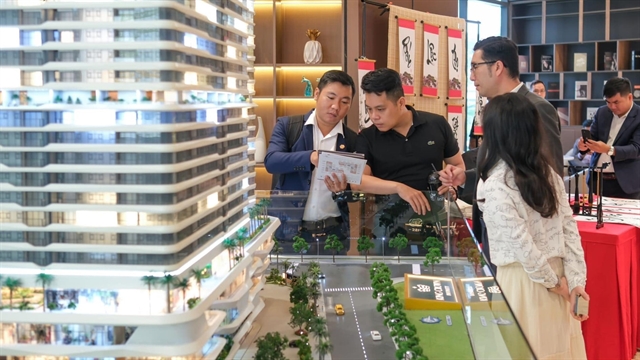
| Buyers examine a residential property project in HCM City. — Photo nhadautu.vn |
Experts at the seminar said that demand from homebuyers and medium- to long-term investors remained the market's main source of support in the second quarter, with buyers increasingly favouring projects backed by completed infrastructure, clear legal status and rental income potential over speculative land purchases.
Investment decisions were increasingly based on factors including pricing, financing terms, legal status, construction progress, handover quality and rental yields, rather than expectations of rapid capital gains, they said.
The market recorded about 23,600 primary transactions in the second quarter, bringing total first-half transactions to around 48,000, according to the report.
Primary housing prices remained elevated as higher development costs and a pipeline dominated by premium projects limited downward price pressure, the report said. Instead of cutting prices, developers increasingly relied on discounts, mortgage support and extended payment schedules to attract buyers.
Average primary apartment prices nationwide reached about VNĐ80 million (more than US$3,060) per square metre in the second quarter and VNĐ76.5 million per square metre in the first half, up about 10 per cent from 2025.
In HCM City, average primary apartment prices were broadly unchanged from the previous quarter at about VNĐ108 million per square metre. In the former Bình Dương province, prices averaged about VNĐ58 million per square metre as more projects were positioned in the premium segment.
The secondary market showed wider price divergence after a period of rapid gains. Areas supported by completed infrastructure and genuine housing demand continued to post steady price growth, while projects driven mainly by speculative expectations or future planning announcements faced weaker liquidity.
Separately, data from the National Statistics Office of Vietnam showed the number of newly established real estate companies rose 23 per cent year-on-year in the first six months of 2026, while total registered capital increased 71 per cent, indicating continued investment by developers despite a more selective market environment. — VNS
Economy
 Economy
 Economy
 Economy
 Economy
 Economy
 Economy
 Economy
 Economy
 Economy
 Economy
 Economy
 Economy
 Economy
 Economy