 Economy

Việt Nam, EU and Belgium seek deeper, practical cooperation
1.
|
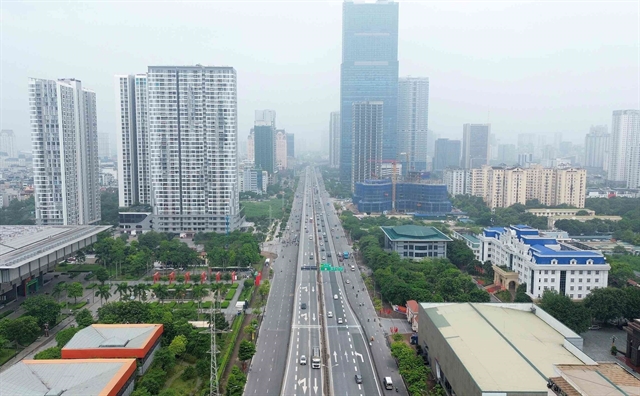
| Many luxury and branded residential projects in Hà Nội continue to command premium prices, although values have begun to soften following the rapid surge seen in late 2025. VNA/VNS Photo |
HÀ NỘI — Luxury real estate in Hà Nội continues to maintain high price levels, but sluggish liquidity has left many investors struggling to recover capital or restructure their portfolios when needed.
For nearly six months, Trần Minh Quân, an entrepreneur based in Hà Nội, has been working with brokers to sell a villa worth more than VNĐ40 billion in a southern urban area of the city. However, he has encountered a frustrating reality that the more he lowers the price, the harder it becomes to find a buyer.
At the peak of the property fever period, Quân was regarded as a major investor with substantial financial resources. His portfolio currently includes two villas, one shophouse and three branded residences in central Hà Nội, with a combined value exceeding VNĐ200 billion.
Most of these assets were acquired during the overheated market period of late 2022 and 2023, financed through a combination of personal capital and leverage. At the time, brokers regularly reported price increases of billions of đồng each month. However, the market began to reverse course in 2026.
One of Quân's villas, previously valued at nearly VNĐ48 billion, is now being offered for just over VNĐ42 billion, but has still to attract any buyers. Meanwhile, he continues to pay nearly VNĐ200 million per month in loan interest, management fees and other related expenses, vnbusiness.vn reported.
The asset remains highly valuable, and its market price is still about 20 per cent higher than when he purchased it, but taking profits right now is extremely challenging, Quân admitted after nearly six months of trying to sell. Despite multiple price reductions, finding a suitable buyer has proven increasingly difficult.
After holding premium real estate assets for several years, he recently sought to reallocate part of his capital into industrial real estate and other assets capable of generating more stable cash flows.
His experience reflects a broader trend unfolding in Hà Nội's luxury property market, where even well-capitalised investors are finding it difficult to realise profits.
Market surveys indicate that many luxury and branded residential projects in Hà Nội continue to command premium prices, although values have begun to soften following the rapid surge seen in late 2025.
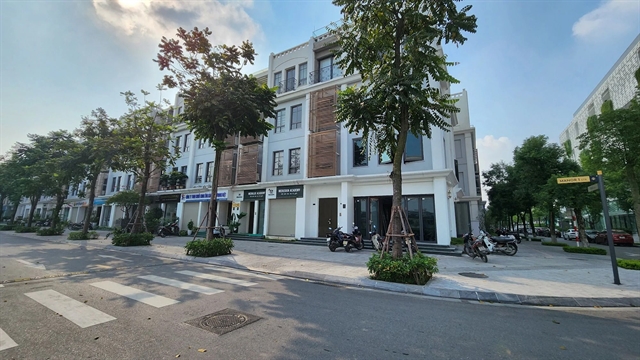
Data from batdongsan.com.vn shows that prices at a branded residential project near Hoàn Kiếm Lake have fallen about 20 per cent from their peak in the fourth quarter of 2025. Meanwhile, prices at The Manor Central Park, a luxury residential project, are more than 10 per cent below their October 2025 levels.
However, the key issue is not the price correction itself but the lack of liquidity. Even after many owners reduced asking prices by 10–20 per cent, transaction volumes have remained relatively limited.
Trần Văn Đăng, a founding member of a brokerage firm specialising in high-end real estate in Hà Nội's Linh Đàm area, said the luxury housing segment has experienced a noticeable decline in liquidity since late 2025.
According to Đăng, during the market boom, investors were willing to pay exceptionally high prices on the expectation that values would continue rising. As investment capital has become more restrained, however, the number of buyers capable of purchasing properties worth tens or even hundreds of billions of dong has dropped significantly.
Many homeowners have cut prices by 10–20 per cent from previous asking levels in an effort to attract buyers. However, this is a highly selective segment, and buyers remain cautious while interest rates are still relatively high. As a result, successful transactions remain limited, he said.
He added that the majority of active buyers today are owner-occupiers or investors with substantial cash reserves who are less dependent on bank financing. Speculative investors, meanwhile, have largely exited the market.
|
| The Manor Central Park project continues to market its townhouses, villas and shophouse products. Photo danviet.vn. |
Buyer sentiment changing
Beyond changing market conditions, buyer sentiment has also shifted considerably.
Phạm Thị Miền, deputy director of VARS IRE, noted that as the cost of capital continues to rise, buyers are no longer able to rely on financial leverage as easily as before.
Rather than making quick purchasing decisions as they did during the boom years, buyers are now spending more time evaluating their long-term financial capacity and the practical income-generating potential of properties before committing capital.
As a result, branded residences are no longer being purchased solely on expectations of future appreciation. Instead, they must demonstrate tangible value through rental potential, location advantages, and scarcity.
Experts view this as a necessary market correction after years of rapid property price growth and it is also a normal part of the market cycle.
However, the likelihood of a sharp decline remains limited because the supply of luxury real estate in central Hà Nội continues to be extremely constrained. Scarce land resources and rising development costs continue to support elevated price levels in this segment.
In addition to supply-and-demand dynamics, the luxury property market is also being influenced by land policy developments.
Nguyễn Văn Đình, chairman of the Vietnam Association of Realtors, warned that if official land price frameworks are aligned too closely with market prices that have been inflated by speculation, they could inadvertently legitimise artificially high valuations and make it even harder for the market to return to more sustainable levels.
Land expenses now account for as much as 60–70 per cent of the selling price of many projects. As land prices continue to rise, developers have very little room left to reduce housing prices. — VNS
Economy
 Economy
 Economy
 Economy
 Economy
 Economy
 Economy
 Economy
 Economy
 Economy
 Economy
 Economy
 Economy
 Economy
 Economy