 Economy
Việt Nam, EU and Belgium seek deeper, practical cooperation
1.
|
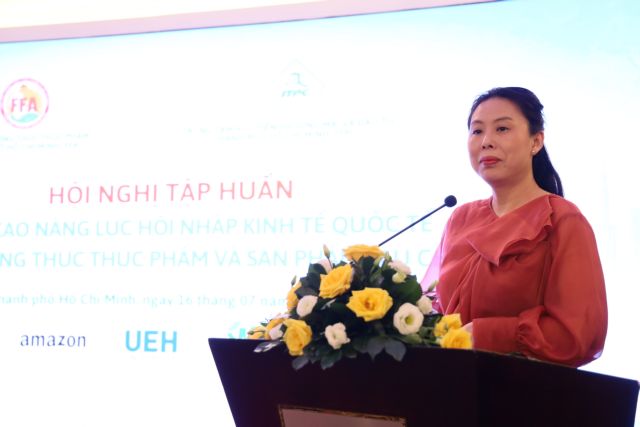
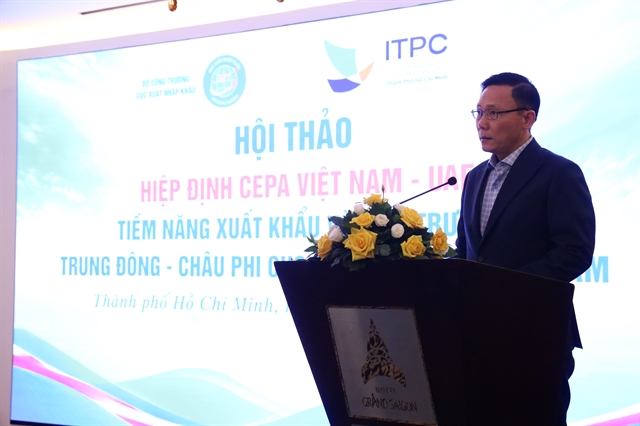
| Hồ Thị Quyên, deputy director of the Investment and Trade Promotion Centre of HCM City, delivers the opening speech at the "Enhancing International Economic Integration Capacity for the Food, Foodstuffs and Processed Agricultural Products Sector" training workshop held in HCM City on July 16. — Photo courtesy of ITPC |
HCM CITY — While free trade agreements do open up huge export opportunities, tariff preferences only truly deliver efficiency when businesses meet increasingly stringent requirements in terms of quality, environment, and traceability, a training workshop heard in HCM City on July 16.
Organised by the Investment and Trade Promotion Centre of HCM City (ITPC) and the Food and Foodstuff Association of HCM City (FFA), "Enhancing International Economic Integration Capacity for the Food, Foodstuffs and Processed Agricultural Products Sector" sought to equip businesses with strategic thinking and practical solutions to strengthen their competitiveness while providing a platform for experts and enterprises to identify bottlenecks and develop strategies to elevate Vietnamese agricultural brands in global markets.
Opening the event, Hồ Thị Quyên, deputy director of the ITPC, said Việt Nam's agricultural, forestry, and fishery exports were worth some US$35.88 billion in the first half of 2026, up 6 per cent year-on-year.
She said new-generation FTAs, particularly the Comprehensive and Progressive Agreement for Trans-Pacific Partnership (CPTPP), offer major advantages since member countries have committed to eliminating tariffs on 97-100 per cent of imports of Vietnamese goods.
"However, tariff preferences only become export orders when businesses meet market standards."
She said the agricultural processing sector still faces a number of challenges, including unstable raw material supply and a low rate of deep processing, while major markets such as the EU, the US, and Japan are tightening requirements on sustainability and product traceability.
Nevertheless, export prospects remain promising, she said.
The agriculture sector is targeting fruit and vegetable exports of $9.81 billion, seafood exports of more than $12 billion, and coffee exports of around $9.64 billion in 2026, and these products offer opportunities to increase value with deeper processing and higher quality standards, she said.
Trần Thị Phương Hoa, vice chairwoman of the FFA, said international integration is no longer simply about market access or competing on price since global consumers are paying greater attention not only to the final product but also to how it is produced.
Transparency, social responsibility, and a commitment to sustainable development have become key factors in determining the competitiveness of Vietnamese exporters, she warned.
|
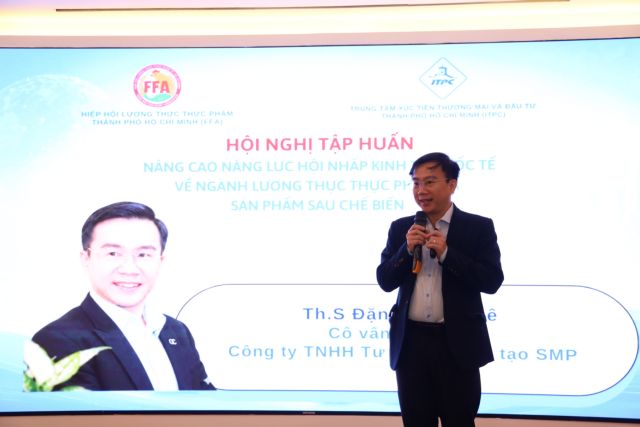
| Đặng Bùi Khuê, senior adviser at SMP Consulting and Training Co., Ltd., speaks on the challenges and opportunities presented by the CPTPP at the workshop in HCM City on July 16. — Photo courtesy of ITPC |
Speaking on new-generation FTAs, particularly the CPTPP, and their implications for Việt Nam's food, foodstuffs, and processed agricultural sectors, Đặng Bùi Khuê, senior adviser at SMP Consulting and Training Co., Ltd., said new-generation FTAs they have far more demanding technical requirements than earlier FTAs.
He noted that the CPTPP goes beyond sanitary and phytosanitary (SPS) measures and technical barriers to trade (TBT), and incorporates commitments on labour rights in line with International Labour Organization standards, environmental protection, biodiversity, and the legality of raw materials.
Businesses therefore need to allocate resources for testing, certification, and compliance with international standards to maintain their long-term competitiveness, he said.
Nguyễn Lê Gia Khánh, senior account manager at Amazon Global Selling Vietnam, said cross-border e-commerce enables Vietnamese businesses to build brands and sell directly to international consumers.
She pointed to Trường Thọ seagrapes of Seagrapes Vietnam Co., Ltd., which ranks among the top nine best-selling products in its category on Amazon and has steady monthly sales of around 1,000 units.
Dr Hoàng Văn Việt of the Global Intellectual Business Association said green standards have become a core competitive advantage rather than an option.
Consumers in developed markets increasingly expect businesses to back up their environmental commitments with verifiable data, he said.
This requires close coordination across the entire value chain, from raw material production and processing technology to product commercialisation.
Nguyễn Lý Trường An, deputy director of Blue Sea Transportation Trading Co., Ltd., said while Việt Nam's agricultural, forestry, and fishery exports exceeded $70 billion in 2025, the sector captures relatively limited added value because deep processing accounts for only 23 per cent.
At the same time, increasingly stringent non-tariff barriers are placing additional pressure on exporters, he said.
He said businesses need to increase their rate of deep processing while fully complying with new-generation FTA requirements covering SPS measures, TBT, rules of origin, and environmental regulations such as the EU Deforestation Regulation.
He also called for closer cooperation between businesses, industry associations, and government agencies to build transparent and sustainable value chains. — VNS
Economy
 Economy
 Economy
 Economy
 Economy
 Economy
 Economy
 Economy
 Economy
 Economy
 Economy
 Economy
 Economy
 Economy
 Economy