 Economy

Real estate bond interest rates hit 13 per cent per annum
1.
|
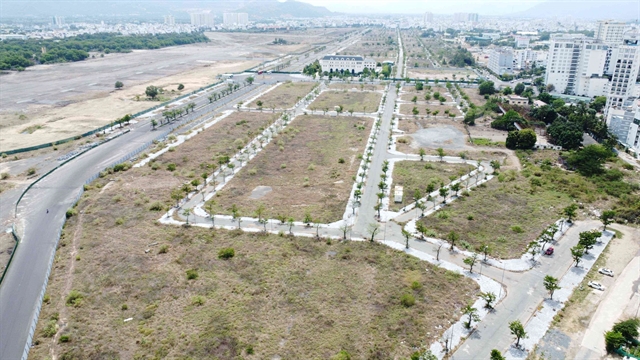
| A land area for sale in Khánh Hòa. Overseas Vietnamese are expected to be potential customers of the domestic real estate market. VNA/VNS Photo |
HÀ NỘI — Sustained remittance inflows, coupled with breakthrough changes in the legal framework governing land, housing and real estate business activities, are opening up significant opportunities for overseas Vietnamese to invest more in the domestic property market.
According to data from the State Bank of Vietnam’s branch in HCM City, total remittances to HCM City in 2025 were projected to reach about US$10.5 billion, equivalent to VNĐ267 trillion.
This continues to represent a significant financial resource, contributing not only to the city’s economy but also to Việt Nam’s broader real estate market.
Cấn Văn Lực, chief economist of BIDV, said remittances are showing a clear shift away from supporting consumption towards investment and asset accumulation.
When investors’ rights and obligations are clearly defined, and against the backdrop of political and economic stability, capital flows from overseas Vietnamese are likely to increase, particularly into long-term investment channels in which real estate products. Real estate is a familiar investment channel for Vietnamese people, Lực said.
Matthew Powell, Director at Savills Hanoi, believes recent provisions under the 2024 Land Law and the amended Law on Real Estate Business have introduced meaningful changes for overseas Vietnamese investors participating in Việt Nam’s property market.
“These adjustments improve overall market transparency and allow overseas Vietnamese to access property transactions with rights broadly equivalent to those of domestic Vietnamese residents,” Powell said.
He added that clearer legal frameworks play a critical role in increasing investor confidence, particularly as many overseas Vietnamese maintain long-term family, economic, and social ties to Việt Nam, with frequent travel between Việt Nam and their countries of residence. The revised regulations provide investors with a clearer legal basis when making investment decisions.
Beyond legal clarity, Powell highlighted political stability as a fundamental factor supporting long-term investor confidence. In addition, ongoing FDI inflows, adjustments to investment policies, and continued infrastructure development, including roads, railways, and airports, are collectively opening up new development areas across the country.
“Market confidence is not driven by a single regulation, but by the combined effect of multiple factors improving the overall investment environment, in which real estate plays an important role,” he said.
A representative of the Vietnam Association of Realtors (VARS) stated that expanding property ownership and transaction rights for overseas Vietnamese would create additional medium- and long-term demand for the market, especially at a time when the sector is in need of stable capital flows with limited speculative characteristics.
Overseas Vietnamese investors tend to adopt a long-term perspective, prioritising legal clarity and sustainable income generation over short-term speculation, according to VARS.
If channelled into appropriate segments, this source of capital could contribute to improving both the stability and liquidity of the real estate market.
However, VARS also cautioned that, to attract overseas Vietnamese capital effectively, the market must continue to improve information quality, enhance legal transparency for projects and strengthen post-sale property management capacity.
Lê Hoàng Châu, chairman of the HCM City Real Estate Association (HoREA), emphasised that remittances represent one of the most stable and low-cost sources of capital for Việt Nam’s economy.
Unlike loans or indirect investment capital, remittances do not create repayment pressure and are typically long-term in nature. With appropriate mechanisms to encourage transparent and efficient investment of these funds into real estate, remittances could become an important driver of market development, Châu said.
Nevertheless, HoREA pointed out that the key challenge lies not only in legal regulations but also in their implementation. Policy execution must be consistent across localities, avoiding situations in which laws are interpreted and applied differently from one area to another, thereby creating difficulties for investors.

|
| A luxury apartment project located on Trần Hưng Đạo Street, Đà Nẵng. —VNA/VNS Photo |
Apartments attracting overseas Vietnamese
Recent studies indicate that apartments remain the preferred property segment for overseas Vietnamese investors in Việt Nam.
According to Powell, payment structure is a key factor behind this preference. Apartments are commonly sold on an off-plan basis, with staged payment schedules that are more flexible compared to landed housing, which typically requires a large upfront payment.
In some cases, developers also offer financial support schemes, helping to ease cash flow pressures for investors.
In addition, many overseas Vietnamese investors are already familiar with large developers, particularly those with international partnerships or standards, which helps build trust when entering the market.
Apartments are often viewed as a suitable entry point, allowing investors to gain initial exposure to the market before considering larger-scale investments.
In terms of selection criteria, Savills notes that overseas Vietnamese investors generally assess properties in a similar way to other investor groups. Key considerations include location, surrounding infrastructure, capital appreciation potential, rental demand and rental yields.
For investors who are not based in Việt Nam, property investments are typically intended for leasing or long-term investment purposes. As a result, operational efficiency, tenant appeal, and transparency in transaction processes are particularly important.
In addition to major cities such as HCM City and Hà Nội, some well-established markets, such as Đà Nẵng, are increasingly viewed as practical options for overseas investors, including overseas Vietnamese, due to relatively clear planning frameworks, completed infrastructure, and product types that allow for straightforward assessment of leasing potential.
Project quality, supporting amenities, overall area development and clear legal procedures remain key factors shaping long-term investment decisions.
Đinh Minh Tuấn, southern regional director of Batdongsan.com.vn, observed that apartments offer advantages in terms of liquidity, rental potential and more accessible initial capital compared with landed property.
Apartments are commonly sold off-plan, with payment schedules spread across different stages, enabling investors - particularly overseas Vietnamese - to manage cash flow more effectively than making a single large upfront payment.
In addition, many developers are now offering financial support policies, cooperating with banks or providing rental guarantees, helping to reduce operational pressure for investors who do not reside permanently in Việt Nam. — VNS
Economy
 Economy
 Economy
 Economy
 Economy
 Economy
 Economy
 Economy
 Economy
.jpg) Economy
Economy
_med.jpg) Economy
Economy
 Economy
 Economy
 Economy
 Economy