 Economy



Việt Nam, Denmark issue joint statement on establishment of Comprehensive Strategic Partnership
1.
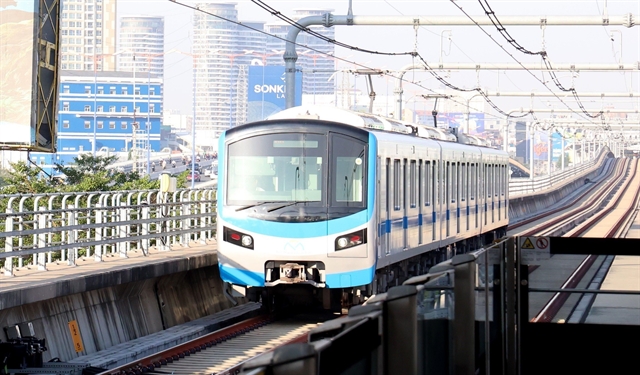 |
| The Bến Thành – Suối Tiên metro line in HCM City. The Ministry of Contruction will promote development of transport infrastructure for green transformation this year, including metro. —VNA/VNS Photo |
HÀ NỘI — Developing infrastructure, particularly serving digital and green transformation, is one of the Ministry of Construction's key tasks in 2026, aiming to enhance the effectiveness of state management in the construction sector.
This transformation provides a foundation for connecting and sharing data with ministries, sectors and localities, promoting the development of digital government, the digital economy and smart cities.
Recently, the Ministry of Construction officially put into operation the national database on construction activities along with key digital systems and platforms of the sector, giving concrete form to the Party’s and the State’s policies on accelerating the development of science and technology, innovation and national digital transformation.
These policies include the Politburo's Resolution 57 on breakthroughs in science and technology development, innovation and national digital transformation; the Government's Resolution 71 on amending, supplementing, and updating the Government’s action programmes implementing Resolution 57; and directives from the central steering committee on science and technology development, innovation, and digital transformation.
Nguyễn Việt Hùng, Deputy Minister of Construction said: “The establishment of the national database on construction activities marks an important shift in management, and builds a unified data foundation, creating effective supports in direction and administration, while providing official and transparent information to citizens and businesses.”
According to Lê Thanh Tùng, director of the Information Technology Centre under the Ministry of Construction, the national database on construction activities is integrated with specialised databases of many fields, including infrastructures of railway, road and aviation, professional ability in construction sector, seagoing vessels and seafarers in the maritime sector, vehicle inspection, urban clean water supply and drainage, housing and the real estate market, and urban development.
The synchronised operation of these databases and information systems has formed a unified, consistent and interconnected digital data infrastructure from the central to local levels.
This is a foundation for modern, transparent, and data-driven management, improving the efficiency of administrative procedures and reducing time and costs for citizens and businesses.
These databases and information systems also help strengthen supervision, monitoring and evaluation of the quality of public services provided by state agencies, while supporting leaders in forecasting and policymaking in construction, urban development and technical infrastructure.
They provide a basis for data connectivity and sharing with ministries, sectors and localities, promoting digital government, the digital economy and smart cities.
Đông Minh Tiến, a representative of Đông Tiến Transport Enterprise in Nghệ An Province, noted that sharing digitised and stored database among citizens and businesses would eliminate repeated submissions, making administrative transactions among agencies, organisations and enterprises more convenient and time-saving.
At the conference reviewing the Ministry of Construction’s performance in 2025 and outlining tasks for 2026, Prime Minister Phạm Minh Chính emphasised that one of the construction sector’s breakthroughs would be the development of science and technology, innovation, digital transformation, green transformation and the circular economy with a focus on green transport and smart urban development.
The PM said that 2026 would be a year of special significance as it is the first year of implementing the resolution of the 14th National Party Congress and the socio-economic development plan for the 2026–2030 period.
One of the three strategic breakthroughs is the development of synchronised and modern infrastructure, especially multimodal transport infrastructure, technology infrastructure, infrastructure serving digital transformation, green transformation and energy transition to achieve double-digit growth.
In 2026, the Ministry of Construction aims to implement a project to establish an innovation centre to carry out tasks in the new phase associated with digital transformation.
In addition, the ministry will implement the project on developing a national key laboratory system for railways (high-speed rail and urban railways) and smart infrastructure to serve research, transfer and mastery of technologies for deploying key national railway projects.
According to statistics from the Government’s monitoring system, the Ministry of Construction completed its assigned tasks in 2025 relating to building e-government and digital transformation, with a satisfaction rate of 93.3 per cent from citizens and businesses using public services provided by the ministry. — VNS
Economy
 Economy
.jpg) Economy
Economy
 Economy
 Economy
 Economy
 Economy
.jpg) Economy
Economy
 Economy
 Economy
 Economy
 Economy
 Economy
 Economy
 Economy