.jpg) Economy
Economy



Cyber CARE Summit 2026 launched to connect capital-wide school digital safety
1.

|
| Freezing shrimp for export at a Minh Phú Seafood JSC factory. —VNA/VNS Photos |
HÀ NỘI — Nearly a decade of determined effort has failed to deliver Việt Nam’s long-held ambition of becoming a US$10 billion shrimp exporter, with the industry still falling well short of the target set by the Government.
In 2025, shrimp export turnover reached a record $4.6 billion, an improvement but only about $1 billion higher than the $3.85 billion recorded in 2017, the year the ambitious goal was announced.
That target was set after the domestic shrimp sector posted strong growth in 2017, when exports jumped 22.3 per cent year on year. The momentum prompted the Government to approve a national action plan for shrimp industry development through 2025, structured in two phases.
During the first phase from 2017 to 2020, the focus was on boosting productivity, output, quality and value by applying science and technology and reorganising production. The aim was to reach $5.5 billion in export turnover by 2020, equivalent to average annual growth of nearly 11 per cent.
The second phase, covering 2021 to 2025, sought to build a high-tech shrimp industry in major production hubs such as Bạc Liêu, formerly part of Cà Mau, before expanding nationwide. Through investment in infrastructure and technical services, the Government hoped to lift exports to $10 billion, targeting average annual growth of 12.7 per cent.
Despite these plans, results have fallen far short of expectations.
Stagnant growth despite ambitious plans
Shrimp exports stood at $3.55 billion in 2018, about $300 million lower than in 2017. Figures then fluctuated at $3.38 billion in 2019, $3.7 billion in 2020, $3.9 billion in 2021, $4.3 billion in 2022, $3.4 billion in 2023 and $3.9 billion in 2024. The data show the sector has struggled to move decisively beyond the $4 billion threshold.
Over the nine years from 2017 to 2025, shrimp export value increased by just $750 million, from $3.85 billion to $4.6 billion, far below early projections.
A director of a seafood export company in the Cửu Long (Mekong) Delta, who asked not to be named, said the Government’s objectives were well intentioned but implementation had yet to produce tangible results.
He cited weaknesses including inadequate irrigation systems, poor seed quality, persistent disease outbreaks and the slow transformation of farming practices envisioned in the action plan.
“Where has Bạc Liêu’s high-tech shrimp farming zone progressed over the years?” the director asked, noting that outcomes remain incomplete.
Launched in early 2018, the Bạc Liêu high-tech shrimp farming zone was expected to deliver a breakthrough for both the province and the national shrimp industry and help realise Việt Nam’s $10 billion export ambition, according to saigontimes.vn.
So far, however, investment attraction at the zone has fallen well below expectations, with no businesses investing for many years in what was once seen as a flagship model.
|
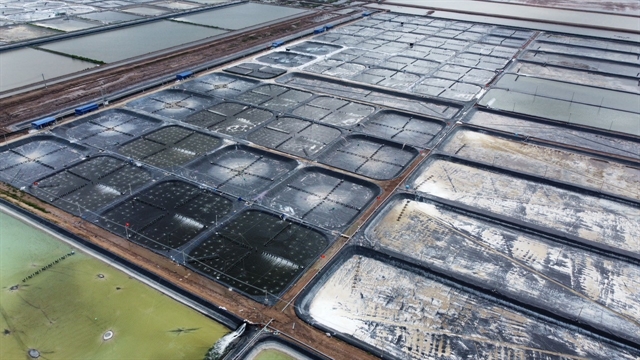
| Cà Mau currently manages 435,000ha of brackish water shrimp farming, which accounts for about 40 per cent of the nation’s total shrimp farming area. |
Lê Văn Sử, Vice Chairman of the People’s Committee of Cà Mau Province, said infrastructure supporting the shrimp industry’s development still falls short of expectations, despite the national action plan identifying it as a key solution.
Speaking at a recent conference reviewing the agricultural sector in 2025, Sử urged the Ministry of Agriculture and Environment to allocate funding to help Cà Mau invest in infrastructure, particularly irrigation systems, in line with production plans. This, he said, is vital to ensuring sustainable growth of the shrimp industry and adapting to climate change.
Beyond infrastructure, Sử stressed the need to advance technology applications, promote digital transformation and build a strong shrimp value chain linked to the collective economy as key drivers of future growth.
Cà Mau currently manages 435,000ha of brackish water shrimp farming, accounting for about 40 per cent of the nation’s total shrimp farming area. Of this, more than 40,000ha are devoted to intensive and super-intensive farming, while nearly 200,000ha are used for improved extensive farming.
In 2025, the province’s total shrimp output reached nearly 600,000 tonnes, maintaining its leading position in the national shrimp industry, Sử added.
Nguyễn Việt Thắng, chairman of the Vietnam Fisheries Society, said Vietnamese shrimp is now exported to more than 100 countries, including demanding markets such as the US, the EU, Japan, South Korea, Australia and Canada.
Despite this broad reach, the industry faces multiple challenges, including climate change, high production costs, disease outbreaks, competition from rival producers and geopolitical instability.
The sector must also contend with strict food safety standards, traceability requirements and environmental protection regulations, Thắng said.
To address these challenges, businesses must adopt eco-friendly technologies and accelerate digital transformation in shrimp farming, said Deputy Minister of Agriculture and Environment Phùng Đức Tiến.
The industry is already applying advanced solutions such as Biofloc, Micro-Nano Bubble Oxygen, recirculating aquaculture systems and the three-stage shrimp farming model to minimise waste and reduce environmental impact. The use of biological products is also emerging as a key trend in sustainable farming practices, Tiến said. — VNS
Economy
 Economy
 Economy
 Economy
 Economy
 Economy
 Economy
.jpg) Economy
Economy
_med.jpg) Economy
Economy
 Economy
 Economy
 Economy
 Economy
 Economy
.jpg) Economy
Economy