 Economy



Khánh Hoà Province fines 14 accommodation establishments for foreigner management violations
1.
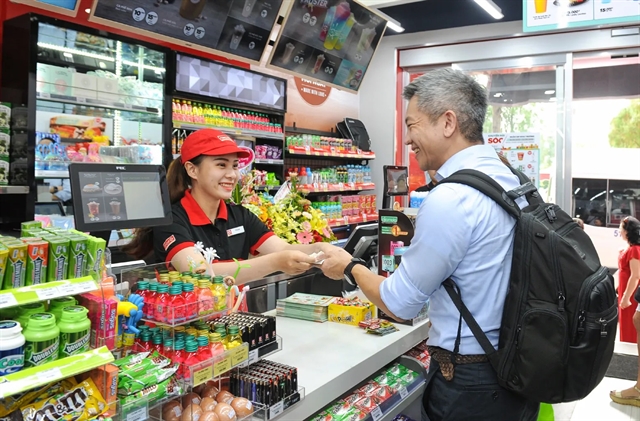 |
| A convenience store in Hà Nội. Photo kinhtedothi.vn |
HÀ NỘI — Việt Nam’s mini-mart and convenience store segment is entering a new expansion cycle, with major domestic and foreign retailers accelerating store openings after a period of restructuring and recovery, industry insiders and analysts said.
The mini-mart chain Bach Hoa Xanh (BHX), owned by Mobile World Investment Corporation (MWG), plans to open around 1,000 new stores in 2026, mainly in the northern region. In Ninh Bình Province, 20 outlets are being piloted.
The timing is considered favourable as Hà Nội is set to close more than 200 temporary and spontaneous markets during 2026–2027, potentially creating additional room for modern retail formats to expand.
Analysts at VNDirect Securities expect BHX’s revenue to rise by over 20 per cent year-on-year in 2026, supported by broader store coverage and improved efficiency. MWG projects the chain will contribute 30 per cent of group revenue and 20 per cent of total profit next year.
In 2025, BHX recorded revenue of about VNĐ46.9 trillion, up 14 per cent from 2024, after opening 789 new stores. After-tax profit reached VNĐ812 billion, equivalent to a net margin of 1.72 per cent. Maintaining positive earnings while expanding rapidly indicates a more stable operating model and improved cost control.
Meanwhile, WinMart+, operated by WinCommerce, a member of Masan Group, plans to open 1,000 new stores in 2026, including more than 300 in the first quarter. Expansion will focus on the North and Central regions, where the chain already has a strong foothold.
WinCommerce has identified rural areas as a key growth driver, as nearly two-thirds of the population live there while modern retail penetration remains below 15 per cent. In 2025, the company opened 764 new WinMart+ outlets nationwide, bringing the total to 4,592 stores. Its rural mini-mart model posted revenue growth of nearly 40 per cent during the year.
Foreign retailers are also stepping up competition. South Korea’s GS25 plans further northern expansion in 2026, targeting strategic provinces and cities. In November 2025, the chain opened its 50th store in Hà Nội. It now operates more than 400 outlets in the southern region.
Japan’s 7-Eleven is likewise expanding northwards, intensifying competition in the capital, where both GS25 and 7-Eleven are challenging Circle K, which has more than 190 stores in Hà Nội.
Analysts say the sector’s outlook is supported by gradual improvements in consumer purchasing power. In a February 2026 update, Lương Thị Kim Chi, head of sector research at Asia Commercial Bank Securities (ACBS), said economic stimulus measures, adjustments to personal income tax and the extension of the Value-Added Tax reduction are expected to underpin retail demand.
New tax regulations may also reshape competition. Under the National Assembly's Resolution No 198/2025/QH15, and the Ministry of Finance's Decision No. 3389/QĐ-BTC, the lump-sum tax regime for household businesses is abolished from January 1, 2026, requiring self-declaration and tax payment. Analysts believe stricter compliance requirements could weigh on small retailers, allowing larger chains to capture additional market share.
According to Kantar Worldpanel, modern trade accounted for about 35–40 per cent of retail sales in urban areas and 15–20 per cent in rural areas in 2025. The shift from traditional to modern retail formats is expected to continue as chains expand and consumers increasingly favour convenience and product standardisation. — VNS
Economy
 Economy
 Economy
.jpg) Economy
Economy
 Economy
 Economy
 Economy
 Economy
.jpg) Economy
Economy
_med.jpg) Economy
Economy
 Economy
 Economy
 Economy
 Economy
 Economy