.jpg) Economy
Economy



Military aircraft transports more samples of war martyrs’ remains to Hà Nội for DNA identification
1.
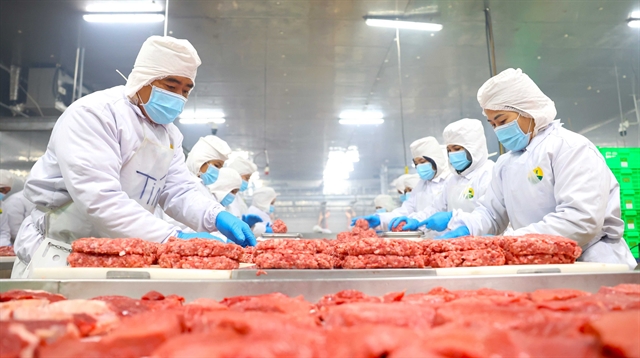 |
| Pacow International Co, Ltd’s beef products have been highly regarded in the Halal market for their strict compliance with hygiene standards, slaughtering procedures and supply chain transparency. — VNA/VNS Photo |
HÀ NỘI — The rising number of Vietnamese agricultural and food products obtaining Halal certification creates a great opportunity for domestic goods to penetrate rapidly global Muslim market.
As Việt Nam accelerates efforts to restructure its export markets, the Halal market is emerging as a promising avenue for deeper trade integration, aligned with the country’s long-term vision of sustainable growth.
The nation's export market restructure includes to diversify markets and reduce reliance on traditional trading partners.
According to international organisations, the global Muslim population now exceeds two billion people, accounting for roughly 25 per cent of the world’s population.
The Halal economy is projected to reach approximately US$5 trillion by 2030, extending well beyond food and beverages into cosmetics, pharmaceuticals, logistics, tourism and Islamic finance.
Notably, the Halal market is no longer a niche market, but an increasingly comprehensive consumer market, where ethical standards, traceability, transparency and production integrity are prioritised.
Non-Muslim consumers are also gravitating towards Halal products, viewing certification as a guarantee of quality, safety and sustainability.
With its strengths in tropical agriculture, food processing and deep integration through next-generation free trade agreements (FTAs), Việt Nam is widely regarded as having significant potential to develop a structured Halal industry.
However, to turn that potential into a competitive advantage, Halal certification is not just a standard, also must be as an industry-wide development strategy.
Increasingly, firms are engaging with the Halal market in a proactive and strategic manner. HR Essence Co, Ltd has recently announced that several of its product have obtained Halal certification from the National Halal Certification Centre, including coffee, cereals and premium bird’s nest cereals.
The significance is not in the number of certified products but in the company’s approach. According to Hương Nguyễn, chairwoman of HR Essence, entering the Halal market requires a comprehensive restructuring of the value chain, from sourcing raw materials and production processes to quality management systems, branding and market access strategies.
In this sense, Halal is not merely a passport to export markets, but a filtering mechanism that compels businesses to raise governance standards, standardise procedures and invest seriously in intrinsic product value.
This marks a fundamental distinction between pursuing Halal certification as an export requirement and developing Halal products as a long-term industry strategy.
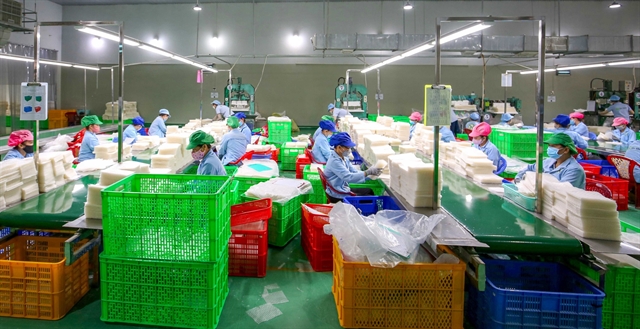 |
| Rice paper produced by Tân Nhiên Co, Ltd has obtained JAKIM Halal certification, demonstrating full compliance with Islamic Shariah requirements. —VNA/VNS Photo |
The National Halal Certification Centre said that Vietnamese Halal products are gradually shifting from contract manufacturing towards higher value-added positioning, linked to branding and traceability.
Shortly after receiving certification, HR Essence successfully exported its first shipment to Malaysia - one of the region’s most demanding Halal markets.
Malaysia occupies a pivotal position in the global Halal market. With Muslims comprising more than 60 per cent of its population, the country aims to become a global Halal hub by 2030, targeting a Halal GDP of $58.5 billion, equivalent to about 11 per cent of national GDP.
Institutionally, Malaysia is recognised for maintaining one of the world’s most rigorous and professional Halal standards systems. Therefore, gaining access to this market represents more than a commercial milestone; it enables Vietnamese goods to expand further into the Middle East and other Muslim-majority markets.
A representative of the Malaysian Embassy in Việt Nam stated that the growing number of Vietnamese products securing Halal certification is opening substantial scope for cooperation - not only as an end-consumer market, but also in connecting regional Halal supply chains. Nevertheless, significant barriers remain.
According to the Việt Nam Trade Office in Malaysia, the principal challenge for Vietnamese firms is not product quality but their ability to integrate into the Halal ecosystem.
While Halal certification is not legally mandatory for all product categories, it is often a prerequisite for entry into modern distribution systems. Without certification, companies are frequently excluded at the initial stage of commercial negotiations.
Malaysia’s certification procedures are considered complex and costly, requiring in-depth understanding of Sharia law, technical standards and local consumer culture.
Beyond technical requirements, softer factors also present obstacles. Packaging, labelling and brand narratives of Vietnamese products are often insufficiently aligned with Muslim consumer expectations. Many products that meet quality standards nonetheless fail due to culturally inappropriate communication strategies.
Meanwhile, regional competitors such as Thailand, Indonesia and China have moved ahead in formulating national Halal strategies - ranging from enterprise support policies and certification systems to specialised trade promotion initiatives.
These realities underscore that Halal is not a market businesses can enter spontaneously. It demands coordinated efforts among government agencies, industry associations, certification bodies and enterprises.
Vietnam’s establishment of a National Halal Certification Centre recognised by Malaysia represents a significant institutional advantage. However, to fully leverage this asset, the centre’s role should be expanded beyond certification to include strategic advisory services, training, market connectivity and the development of a national Halal database.
For enterprises, Halal must be defined as a long-term strategic direction rather than a temporary solution when traditional markets face difficulties.
This entails serious investment in market research, product redesign, supply chain standardisation and brand-building anchored in ethical and sustainable values.
At the macro level, Halal should be integrated into national trade promotion programmes, high-value agricultural development strategies and broader efforts to strengthen Việt Nam’s national brand in the new growth phase.
Halal is not simply a certificate but a new competitive arena - one in which only companies with robust governance, strategic vision and sustained commitment will endure and expand. — VNS
Economy
 Economy
 Economy
 Economy
 Economy
 Economy
 Economy
 Economy
 Economy
 Economy
 Economy
 Economy
 Economy
 Economy
 Economy