 Economy


OPPO Find X10 Series Launches Globally with True-to-Life Imaging and All-Round Flagship Upgrades
1.
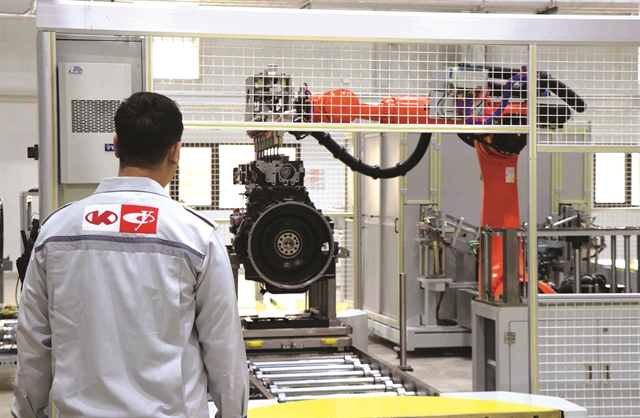 |
| Robots operate in the engine manufacturing process at the Kim Long Motor Company in Huế. VNA/VNS Photo |
HÀ NỘI — As Việt Nam looks towards its 2045 development vision, the resolution of the 14th National Congress of the Communist Party of Việt Nam (CPV) sets out more than long-term goals. It defines a clear policy roadmap to strengthen institutions, improve the business environment and position the private sector as a central driver of sustainable growth.
In the report at the opening session of the 14th National Congress, Party General Secretary Tô Lâm stressed the need to fully harness the role of all economic sectors.
He said the State sector would continue to play the leading role in ensuring macroeconomic stability, maintaining major economic balances and providing strategic direction and guidance, while the private sector is identified as one of the most important driving forces of the economy.
The resolution underlines the need to create a favourable business environment, protect property rights and freedom of enterprise, foster strong domestic companies with international competitiveness and promote the application of knowledge and technology in production and business.
Experts say that swift implementation will require a focus on key pillars, including institutional reform, unlocking resources for the private sector and promoting science, technology and innovation.
According to Tô Xuân Thao, director of the Institute for Small and Medium Enterprise Research under the Việt Nam Union of Science and Technology Associations, the 14th Party Congress resolution strongly reaffirms the private sector as a major engine of growth while opening new development space oriented towards higher quality and sustainability.
Beyond general policy directions, the resolution sets out specific requirements to improve mechanisms and policies, encouraging the private sector to develop in a lawful and healthy manner and to contribute more to the national economy.
One notable direction is the encouragement of household businesses and individual production and business establishments to shift into formal enterprise models. This is seen as a crucial pathway to expanding development space, given that this group represents a large and dynamic economic force but still faces limits in access to capital, land, production facilities and support policies.
The resolution’s guiding view does not simply prioritise an increase in the number of private enterprises. It also places strong emphasis on improving operational quality, legal compliance and the capacity for sustainable development.
Over the next five years, if policies supporting the private sector and business model transformation are implemented in a coordinated way, small and medium-sized enterprises (SMEs) are expected to gain more room to grow and play a bigger role in the country’s new growth structure.
Digital and green transition
The resolution also sends a clear message on digital transformation and innovation, which are no longer optional but essential. SMEs are expected to move from experience-based and manual management models towards data-driven, process-based and technology-enabled governance.
Alongside digitalisation, SMEs are encouraged to adjust their strategies towards greener development. The use of energy-saving technologies, efficient resource management and product traceability will help boost competitiveness and meet rising standards in both domestic and international markets.
From a policy perspective, Thao said he expected the resolution’s major orientations to be translated soon into practical and accessible measures. In particular, administrative reform linked with digitalisation was seen as decisive in cutting compliance costs for businesses.
At the same time, policies on access to capital and production sites should be designed flexibly to suit the characteristics of SMEs, creating stable and long-term momentum for the sector.
 |
| The wastewater treatment system at Nam Cầu Kiền Industrial Park in Hải Phòng, a green industrial park invested by Shinec JSC. -- VNA/VNS Photo |
Confidence across sectors
According to Mạc Quốc Anh, vice chairman of the Hà Nội Association of Small and Medium Enterprises, a transparent investment environment and predictable policy framework are fundamental for businesses to commit to long-term investment, innovation and integration.
Sharing the view, Tô Hoài Nam, vice chairman and secretary general of the Việt Nam Association of Small and Medium Enterprises, said the overarching spirit of the 14th National Congress was to create an environment where enterprises can grow based on genuine capabilities rather than relationships or short-term incentives.
With more than 98 per cent of Vietnamese businesses classified as small and medium-sized enterprises, institutional reform, lower compliance costs and the promotion of digital and green transformation would determine their ability to participate in value chains.
Business confidence is evident across sectors. In logistics, a field still burdened by high costs and fragmented infrastructure, enterprises expect policies to remove bottlenecks and strengthen regional connectivity.
Trần Đức Nghĩa, chairman of the Hà Nội Logistics Association, said the orientations of the 14th Party Congress opened new development opportunities, allowing businesses to restructure operations and enhance competitiveness.
Meanwhile, service and tourism enterprises are seeking strong policies to stimulate demand, expand markets and develop human resources.
Lê Công Năng, chairman of WonderTour, said the 14th Party Congress came at a critical time when the economy needed to renew its growth model amid intensifying global competition. With substantive State support, businesses would be ready to invest, expand operations and integrate more deeply into regional value chains.
From policy to practice
Green transformation has also been highlighted as an inevitable trend. According to Phạm Hồng Điệp, chairman of Shinec Joint Stock Company, the orientations of the 14th Party Congress provide the foundation to complete the legal framework for the circular economy, digital transformation and sustainable development, enabling enterprises to pursue the net-zero emissions target by 2050 in a feasible way.
A clear and consistent institutional framework will reduce compliance costs, allowing businesses to focus on technological innovation and productivity improvement. These measures create a transparent environment, encourage long-term investment, stimulate innovation and become driving forces for Vietnamese enterprises to achieve breakthroughs in the new development phase.
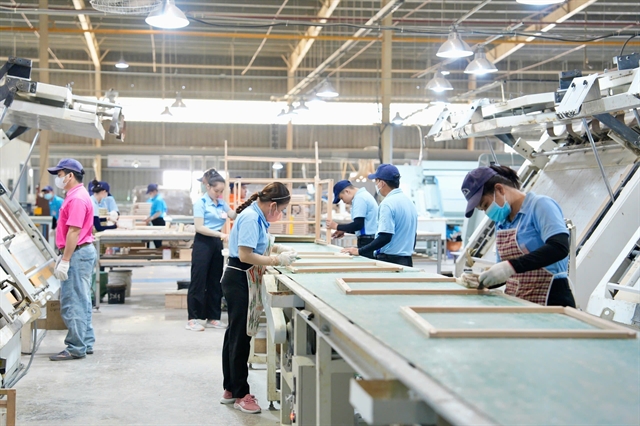
Nguyễn Chánh Phương, vice chairman of the HCM City Handicraft and Wood Industry Association (HAWA), said the double-digit growth target and the designation of the private sector as a strategic growth driver under the 14th Party Congress received strong support from wood industry enterprises.
More than 90 per cent of furniture and wood-product manufacturers are private enterprises, with purely Vietnamese companies accounting for over 80 per cent of the sector. Current production capacity stands at around 51–52 per cent compared with foreign direct investment enterprises at 48–49 per cent, showing that while capacity is broadly balanced, domestic enterprises still have the potential to take a leading role in the supply chain, according to Phương.
Since 2024, HAWA has aimed to build a self-reliant supply chain led and driven by Vietnamese enterprises. With the orientations from the Party Congress, this goal is fully aligned, appropriate and achievable.
Phương stressed that the resolution of the 14th National Party Congress would provide a strong foundation for the association to develop concrete action programmes, supporting enterprises to enhance competitiveness, participate more deeply in value chains and adapt to digital and green transformation in the new context.
HAWA’s strategic action groups focus on strengthening enterprise competitiveness, improving trade promotion environments and working with the State to create a stable and sustainable policy environment for forestry development. In this context, green transformation would be an inevitable trend while digital transformation would be a key tool to accelerate it, forming the core competitiveness of enterprises, Phương noted.
He also said domestic forestry-related policies were relatively stable and supportive of business development. However, international policy stability would remain crucial, particularly in meeting requirements such as the EU Deforestation Regulation (EUDR) and US tariff policies. The Government’s role in ongoing negotiations to ensure stable tariff levels would be vital for business and investment confidence.
Many business leaders have expressed hope that the 14th Party Congress resolution will be translated into coordinated and practical measures, fostering a healthy business environment, fair competition and a transparent legal framework. This is considered essential for the private sector, comprising more than one million enterprises and five million household businesses, to reach its potential and make more substantial contributions to the economy.
Nguyễn Quốc Hiệp, chairman of the Việt Nam Association of Construction Contractors, also called for the major orientations of the congress to be translated into actionable resolutions, implemented consistently from the central level to ministries, agencies and localities, and delivering tangible change on the ground.
Ultimately, the test of the 14th Party Congress resolution will not lie in its ambition, but in its execution. If its commitments are translated into clear, consistent and predictable policies, the private sector — already the backbone of Việt Nam’s economy — will be positioned not only to grow in scale, but to lead in innovation, productivity and sustainable development as the country advances towards its 2045 vision. — VNS
Economy
 Economy
 Economy
 Economy
 Economy
 Economy
 Economy
 Economy
 Economy
 Economy
 Economy
 Economy
 Economy
 Economy
 Economy