 Economy
Lotte, Phát Đạt combine strengths in Thu Thiem project
1.
|
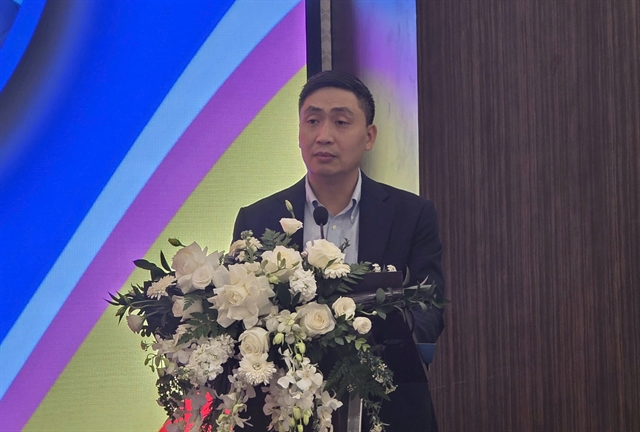
| Hoàng Minh Chiến, deputy director of the Vietnam Trade Promotion Agency, speaks at the event on Tuesday afternoon. — VNS Photo Ly Ly Cao |
By Ly Ly Cao
HÀ NỘI — Vietnamese exporters are being urged to strengthen competitiveness, deepen value creation and accelerate digital adoption as global supply chains undergo restructuring and trade requirements grow increasingly stringent.
Speaking at a forum themed 'Solutions to Enhance the Competitiveness of Vietnamese Export Products in the Global Trade Chain', Hoàng Minh Chiến, deputy director of the Vietnam Trade Promotion Agency under the Ministry of Industry and Trade (MoIT), said the country's export sector is facing major challenges but also opening up new opportunities amid rising protectionism, sustainability requirements, traceability standards and digital transformation.
"To effectively seize these opportunities, the requirement for Việt Nam's export industries is not only to maintain growth but, more importantly, to enhance product competitiveness and increase value across the entire chain, from design and materials to production, branding, distribution and international market expansion," he said.
Digitalisation and technology adoption are highlighted at the forum, with industry representatives saying that it must go hand in hand with structural upgrades in production.
Lê Xuân Vỹ, deputy general director for Digital Transformation at TNG Investment and Trading JSC, said foreign-invested enterprises often lead Vietnamese firms in technological capability, but early adoption can significantly improve competitiveness.
"If we move ahead in technology, it creates much greater value for our products," he said, adding that automation initiatives initially lifted productivity by 5-10 per cent, with targets set to reach 15-20 per cent.
Higher productivity has helped reduce reliance on labour at a time when competition for workers is intensifying in Việt Nam, prompting companies to accelerate transformation to meet market demands.
From the footwear sector, Phan Thị Thanh Xuân, vice chairwoman and secretary general of the Vietnam Leather, Footwear and Handbag Association (LEFASO), urged businesses to view contract manufacturing as a stepping stone rather than a limitation.
She pointed to a gradual shift toward higher-value models, such as OEM, with material sourcing, and ODM, where firms take on design responsibilities, increasing added value and strengthening enterprise capability.
Yet challenges remain. The localisation rate for raw materials in the leather and footwear industry stands at only 50-55 per cent. Improving domestic supply would help raise value creation while enabling faster sample development.
"If manufacturers in China can present samples within hours, Vietnamese companies may take months," she said, warning that delays can affect order flows, particularly for smaller producers and start-ups.
Xuân also identified gaps in design training and marketing professionalism, noting that many firms still depend heavily on buyers to initiate contact rather than proactively promoting products in target markets.
|
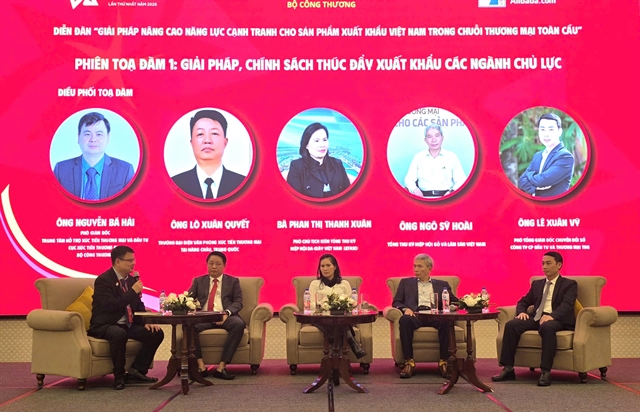
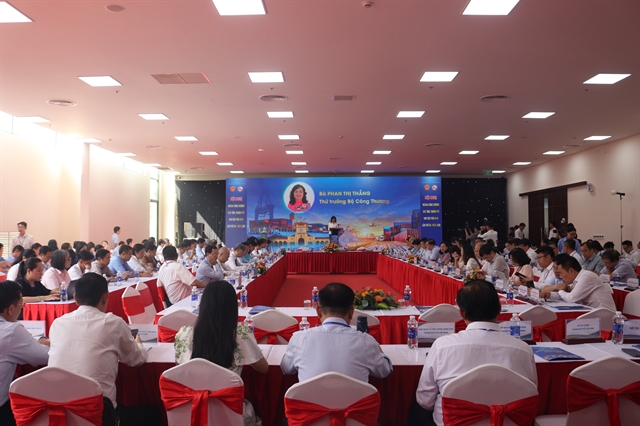
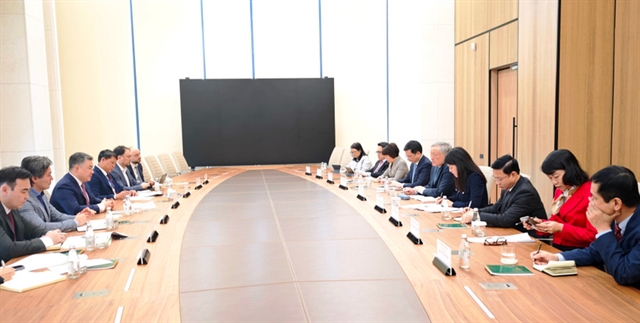
| Delegates at the panel discussion session. — VNS Photo Ly Ly Cao |
In the wood industry, export turnover has surpassed US$17 billion, but more than half of shipments are concentrated in the US market, raising exposure to trade remedy investigations and tariff risks.
Cao Văn Thanh, chief of office at the Vietnam Timber and Forest Product Association, stressed the urgency of diversifying markets and expanding into regions with untapped potential, such as the Middle East, Africa and South America, despite acknowledging that these destinations require long-term investment and structured strategies.
Sustainability requirements are also becoming unavoidable. Forum participants highlighted that green production, energy efficiency and emissions reduction are increasingly mandatory conditions for market access.
Lò Văn Quyết, head of the Vietnam Trade Promotion Office in Hangzhou, China, said that investing in compliant wastewater treatment systems not only meets tightening environmental standards, but can also reduce operating costs by approximately 10-12 per cent.
Quyết described China as a vast market with rapidly growing consumption, particularly among the middle class. However, he advised exporters to stay updated on import policies, legal regulations, payment risk management and brand protection to avoid disputes and unfair competition on e-commerce platforms.
Beyond manufacturing capability, speakers pointed to the need for stronger global marketing.
Bok Dug Gyou, deputy director of the Korea Trade-Investment Promotion Agency (KOTRA), emphasised integrated export marketing support, participation in international exhibitions, overseas infrastructure expansion, professional workforce training and financial assistance aligned with international standards.
He recommended Việt Nam to intensify international trade fairs, strengthen specialised trade promotion training, improve market intelligence capacity and attract global buyers and distributors to domestic events while expanding overseas promotion infrastructure.
Held within the framework of the first Glorious Spring Fair 2026, the forum was designed as a platform for Government agencies, industry associations, international partners and businesses to exchange market insights, discuss policies and propose practical solutions to help Vietnamese firms participate more deeply in global commerce. — BIZHUB/VNS
Economy
 Economy
 Economy
 Economy
 Economy
 Economy
 Economy
.jpg) Economy
Economy
 Economy
 Economy
 Economy
 Economy
 Economy
 Economy
 Economy