 Economy



84 individuals investigated for transnational online frauds
1.
|
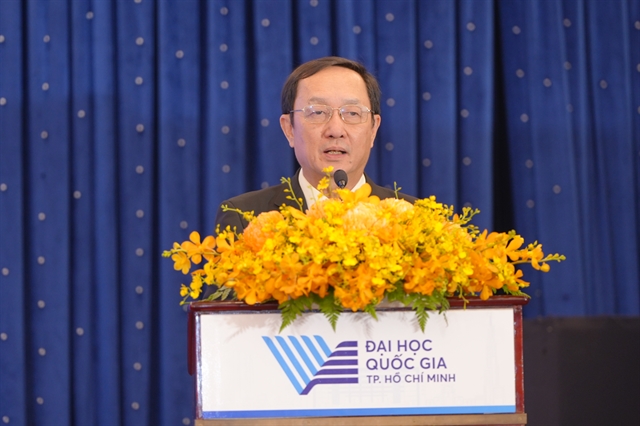
| Huỳnh Thành Đạt, deputy head of the Party Central Committee’s Commission for Information, Education and Mass Mobilisation, speaks at a workshop on enhancing the competitiveness of Vietnamese enterprises in HCM City on January 28. — VNS Photo Nguyễn Diệp |
Nguyễn Diệp
HCM City — Businesses must be placed at the centre of innovation and development if Vietnam is to strengthen its long-term competitiveness, Huỳnh Thành Đạt, deputy head of the Party Central Committee’s Commission for Information, Education and Mass Mobilisation, told a workshop held HCM City on January 28.
The “Enhancing the Competitiveness of Vietnamese Enterprises in the New Era” workshop was organised by the HCM City Business Association and the Vietnam National University-HCM City (VNU-HCM).
Đạt said competitiveness must be built on productivity, quality, efficiency, innovation and adaptability, rather than on cheap labour or exploitation of natural resources.
“Enterprises should not merely benefit from policies but become the core drivers of innovation, transformation and international integration.”
Knowledge, science and technology and a supportive institutional framework play a decisive role in this process, he said.
This approach aligns closely with key resolutions issued by the Politburo like No. 57 on breakthroughs in science, technology, innovation and national digital transformation, No. 68 on private sector development and No. 79 on strengthening the State-owned economic sector, he added.
|
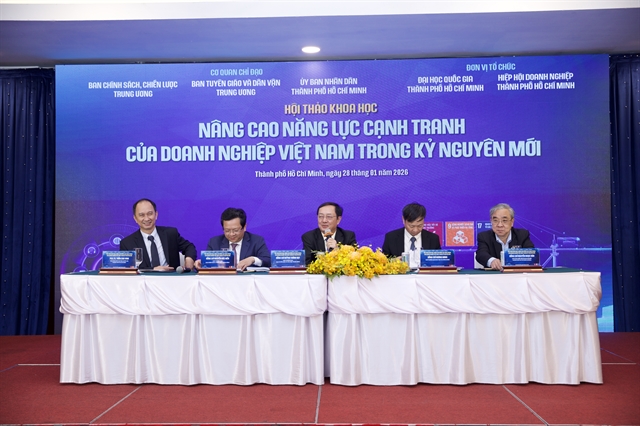
| A panel discussion at the workshop on enhancing the competitiveness of Vietnamese enterprises in the new era in HCM City on January 28. — VNS Photo Nguyễn Diệp |
Assoc Prof Dr Trần Cao Vinh, vice chancellor of the university, said the successful 14th National Party Congress had identified the 2026–30 period as a time for major breakthroughs, ushering the country into a “new era of national rise”.
“In this new context, enterprises — especially private ones — are identified as the most important driving force of the economy”.
However, Vietnamese enterprises are facing the major challenge of how to take the lead amid the dual transition towards digitalisation and green growth, he warned.
He said improving competitiveness requires close coordination among the “three pillars”: a developmental State, innovative universities and dynamic enterprises.
“Competitiveness today must be grounded in productivity, innovation and value creation”.
Offering an international perspective, Professor Vũ Minh Khương from the Lee Kuan Yew School of Public Policy at the National University of Singapore said enterprise competitiveness should be measured through a comprehensive framework, not merely low costs.
Key indicators include productivity and resource efficiency, value-added content, job quality and income, market power, resilience, technological mastery, innovation capacity and position in global value chains, he said.
“These factors rest on three core pillars: operational capability, strategic capability and complementary advantages.”
While operational capability reflects execution capacity — such as cost control, quality, digitalisation and innovation — strategic capability involves market positioning, leadership, governance, branding and corporate culture, he explained.
Complementary advantages stem from industry clusters, business ecosystems, infrastructure, institutions and the national business environment, he said.
He proposed a development-oriented State model in which enhancing enterprise competitiveness is placed at the heart of the national development strategy.
“The State should not replace businesses, but act as a facilitator — creating enabling policies, investing in infrastructure and improving institutions to amplify enterprise capabilities”.
|
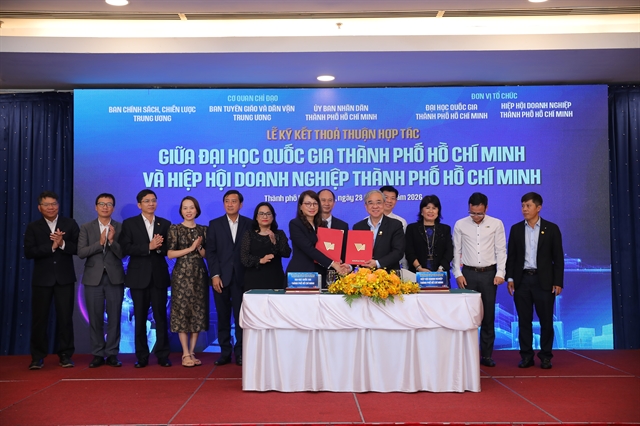
| Representatives of Việt Nam National University-HCM City and the HCM City Business Association on January 28 sign a cooperation agreement to strengthen university-business linkages. — VNS Photo Nguyễn Diệp |
Đặng Huỳnh Ức My, chairwoman of TTC AgriS, shared experiences from the agricultural sector, highlighting high-tech circular agriculture as a strategic pathway to sustainable competitiveness.
“Agriculture must shift from a production-focused mindset to a smart agricultural economy driven by data, technology and value-chain linkages."
Digital transformation, supported by unified agricultural data frameworks, artificial intelligence and big data, would enable real-time monitoring, risk forecasting, traceability and more transparent governance, she said.
Integrating production, trade, services and finance across the value chain is essential, alongside stronger research collaboration and the commercialisation of green, high value-added agricultural products, she added.
The workshop concluded that strengthening enterprise competitiveness in the new era requires a holistic approach, with businesses at the centre, supported by effective institutions, innovation-driven education and a proactive, enabling State. — VNS
Economy
 Economy
 Economy
 Economy
 Economy
 Economy
 Economy
 Economy
 Economy
 Economy
 Economy
 Economy
 Economy
 Economy
 Economy