 Economy



84 individuals investigated for transnational online frauds
1.
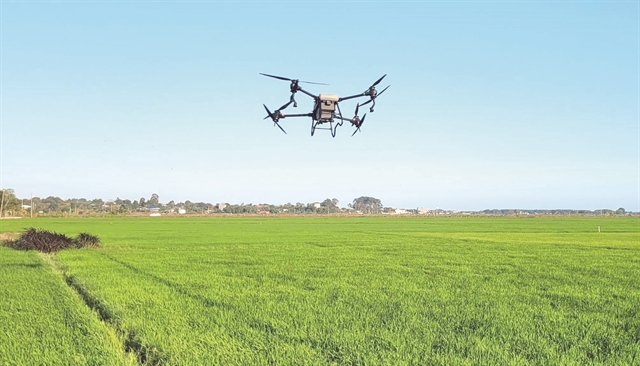 |
| A drone is spraying pesticides over rice fields in Long Điền Commune, Hồ Chí Minh City. Việt Nam is aiming to renew the country’s growth model based on modern means. — VNA/VNS Photo Hoàng Nhị |
One year after the Politburo of the Communist Party of Việt Nam issued Resolution 57, the country is starting to see visible results from its push to place science and technology, innovation and digital transformation at the centre of economic expansion, though more efforts are needed to convert policy momentum into solid foundation for long-term two-digit growth.
Adopted at the end of 2024, Resolution 57 was introduced at a time when Việt Nam’s traditional growth model was losing momentum and the fourth industrial revolution was reshaping the global economic landscape where AI, semiconductors, big data and biotechnology became critical to national competitiveness.
After nearly four decades since major economic reforms, the advantages of cheap labour and natural resources were fading, while productivity growth remained low. Without a decisive turn towards knowledge, technology and innovation, economists warned the country could stall in the middle-income trap.
In that context, Resolution 57 was designed and widely seen as a strategic declaration on the country’s new development path with science and technology, innovation and digital transformation identified as no longer supporting tools but key drivers for breakthrough growth in the digital era.
The resolution sets out clear and ambitious goals. By 2030, Việt Nam aims to become a developing country with modern industry and upper-middle income status, a digital economy contributing 30 per cent of GDP, and among leaders in science and technology within ASEAN.
By 2045, Việt Nam aims to become a high-income developed country and a leading Asian hub for smart manufacturing, startups and innovation.
A shift in mindset
What sets Resolution 57 apart is not how much money will be spent, but the transformation in governance thinking.
For years, regulators had struggled to keep pace with innovation. New business models such as ride-hailing, fintech and blockchain-based services had often encountered legal uncertainty.
Resolution 57 created a change, calling for a shift from control-oriented governance to creating an enabling environment, which means governance focuses on building institutions and infrastructure while giving businesses and researchers room to experiment and encouraging risk-taking.
The resolution also stands out for the level of political commitment behind it. Party General Secretary Tô Lâm chaired the Central Steering Committee, underscoring determination to make sci-tech, innovation and digital transformation the centre of the country’s growth, according to Deputy Minister of Science and Technology Vũ Hải Quân.
The National Assembly and the Government moved rapidly to translate the resolution into practice. The NA passed Resolution 193 on piloting special mechanisms for the 2025-30 period. The Government followed with the issuance of Resolution 71 on the action plan to implement Resolution 57 together with dozens of related directives, dispatches and documents.
Early outcomes
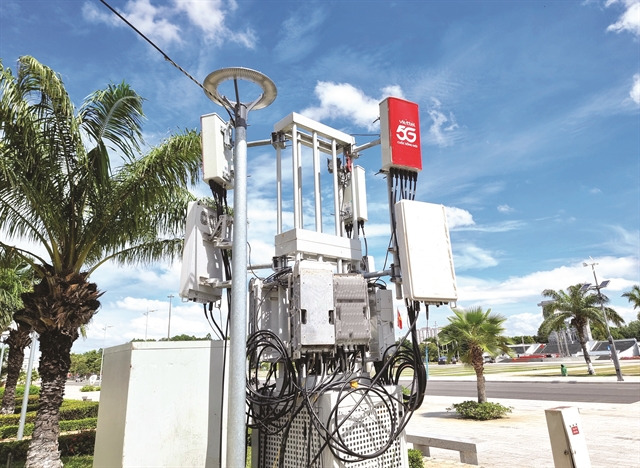 |
| A 5G station in Khánh Hoà Province. Resolution 57 has delivered significant measurable results in the first year of implementation. VNA/VNS Photo Nguyễn Thành |
Last year was a foundational one for institutions for the new development phase in this area. One of the most tangible outcomes has been an unprecedented wave of legal reforms aimed at clearing issues that have plagued science and technology for decades.
The Government submitted 28 related laws together with the issuance of dozens of decrees to create the legal framework for data management, digital transactions, public-private partnership in research, commercialisation of scientific results as well as human resource development.
Resolution 57 also delivered measurable results in the first year of implementation.
The Central Steering Committee for Science and Technology Development, Innovation and Digital Transformation's report said that the resolution helped lift its contribution to over 16.4 per cent of GDP.
According to the Ministry of Science and Technology, Việt Nam moved up 41 places to rank 67th in telecommunications infrastructure while Internet speed climbed 42 places to 18th. E-Government improved to 71st, up 15 places, and information security to 17th, up 8 places.
The digital economy accounted for 18.72 per cent of GDP in 2025, close to the target of 20 per cent, together with strong growth in revenue from digital technology and ICT industries.
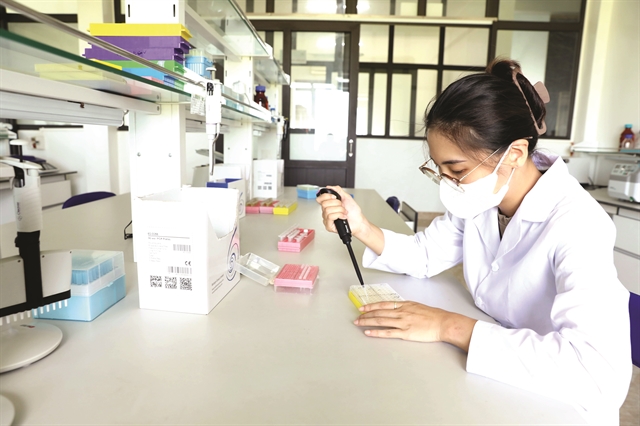 |
| Thái Bình Seed Company applies science and technology in research and production to develop high-yield and high-quality crop varieties. VNA/VNS Photo Thế Duyệt |
Việt Nam also saw significant improvement in digital infrastructure and data. In August 2025, National Data Centre 1, which meets international standards, officially came into operation.
By the end of 2025, 5G coverage reached 58.9 per cent of the population. About 26 per cent of Internet users were able to access the Internet with speeds above 1Gb per second, placing Việt Nam among the world’s top 10 countries in fixed broadband speed.
The Prime Minister in June approved a list of technology groups with 35 strategic products, including AI, data, blockchain, next-generation networks, automation, semiconductors, biomedical technology energy, rare earth, ocean and deep-earth technology, network security, and aerospace.
Việt Nam ranked 44th out of 139 economies in the Global Innovation Index, leading the group of lower-middle-income countries. The country’s startup ecosystem rose to 55th globally and fifth in ASEAN, with around 4,000 innovative startups, including two unicorns, the ministry’s report showed.
By the end of 2025, more than half of public services at the central level were available online, while nearly all services at the local level had online access. Increased use of digital public services helped save an estimated sum of VNĐ4.1 trillion (US$156 million).
Another notable shift has been the closer link between the State, researchers and businesses. In 2025, private investment accounted for 67.2 per cent of total research and development spending, indicating deeper engagement by enterprises in innovation.
Việt Nam now has 53 sci-tech organisations recognised at regional and global levels, providing a stronger base for enterprise-led research.
Resolution 57 has also accelerated international tech integration. In 2025, Việt Nam signed more than 70 international cooperation agreements in science and technology, focusing on strategic fields such as AI, semiconductors, biotechnology and aerospace.
New growth chapter
 |
| Youth volunteers in Hà Nội help residents use smart devices, access the internet safely and carry out online public services. VNA/VNS Photo Phạm Tuấn Anh |
The first year of Resolution 57 has also revealed challenges which highlight that political consensus and policy design are necessary, but execution capacity is decisive, according to the Central Steering Committee for Science and Technology Development, Innovation and Digital Transformation.
The committee pointed out problems including slow issuance of guidelines which hindered the translation of policies into practice, poor local digital infrastructure and capacity, slower-than-planned national and sectoral database building, slow disbursement and resource allocation, shortage of high-quality human resources and risk of cybersecurity and data protection.
The committee stressed that in 2026, the resolution would be accelerated with emphasis on disciplined implementation, measurable outcomes and real impact rather than plans or processes.
Priority would be given to strategic technologies, digital infrastructure, data, high-quality human resources and practical applications that directly serve people and businesses, while strengthening leadership accountability, inter-agency coordination, cybersecurity and digital sovereignty.
Stressing that Việt Nam’s new growth model must be built on science and technology, innovation and digital transformation to restructure the economic foundation, Deputy Prime Minister Nguyễn Chí Dũng urged focus of resources on core factors including infrastructure, data, strategic technologies and high-quality human resources. Businesses should be placed at the centre of the national innovation system, he added.
Minister of Science and Technology Nguyễn Mạnh Hùng noted that 2026 would be a year of acceleration, shifting from developing institution to creating measurable results with impacts on economic growth and quality of life.
Meanwhile, FPT Chairman Trương Gia Bình proposed prioritising AI as a foundational technology for digital government, establishing a national cybersecurity defence alliance, promoting public-private partnership in emerging technologies such as semiconductors and low-altitude economy. He also stressed the importance of achieving technology self-reliance for rapid and sustainable growth.
Việt Nam is developing two more resolutions, including one on renewing the country’s growth model based on science and technology, innovation and digital transformation, and the other on strategic solutions to drive double-digit growth linked to the establishment of a new growth model. VNS
Economy
 Economy
 Economy
 Economy
 Economy
 Economy
 Economy
 Economy
 Economy
 Economy
 Economy
 Economy
 Economy
 Economy
 Economy