 Economy


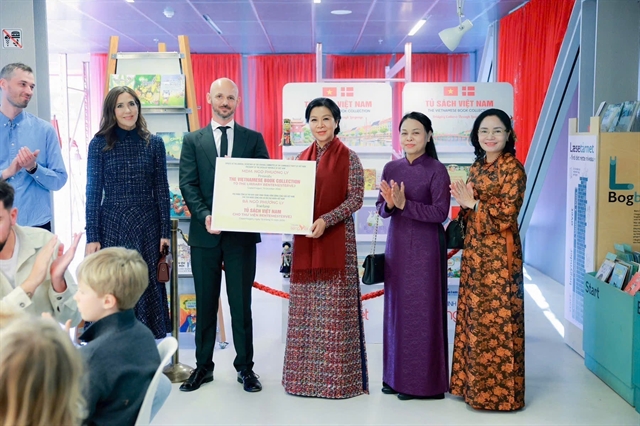
Việt Nam's first lady, Danish Queen present Vietnamese book collection to Copenhagen library
1.
|
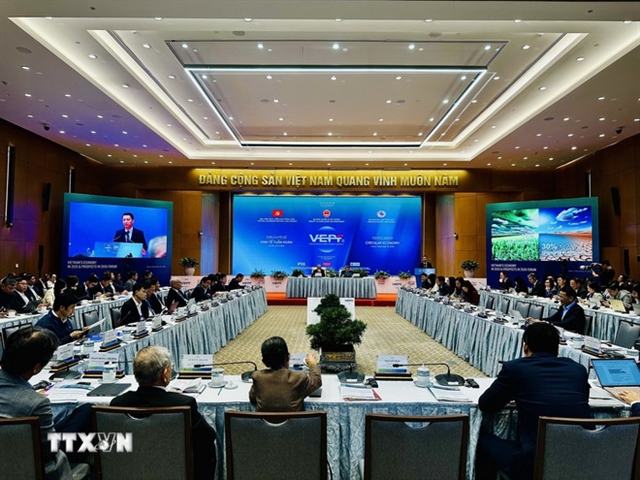
| Participants at the Vietnam Economic Forum 2025, Outlook for 2026 in Hà Nội, December 16, 2025. VNA/VNS Photo Việt Đức |
HÀ NỘI — The Government of Việt Nam and the Central Policy and Strategy Commission jointly hosted the Vietnam Economic Forum 2025, Outlook for 2026, in Hà Nội on Tuesday under the theme Rapid and Sustainable Development of the Vietnamese Economy, Green Transformation in the Digital Era.
The forum attracted more than 500 delegates attending in person and over 1,000 participants joining online from 34 locations nationwide, taking part in sessions focused on the circular economy under the theme Promoting Green Transformation and Circular Economy Development to Realise High Growth and Sustainable Development.
Phạm Đại Dương, Deputy Head of the Central Policy and Strategy Commission, emphasised that achieving Việt Nam’s strategic development goals would require a strong breakthrough in the growth model. The new model, he said, must be sustainable, comprehensive and inclusive, placing greater emphasis on quality, efficiency and competitiveness rather than growth speed alone.
At the core of this transformation are two closely linked processes: digital transformation, aimed at building a digital economy and digital society, and green transformation, focused on developing in harmony with nature, adapting to climate change and fulfilling international commitments, particularly the goal of achieving net-zero emissions by 2050, according to Dương.
Digital and green transitions are no longer optional choices but objective requirements of development. Closely interconnected and mutually reinforcing, they form a dual transition that is expected to serve as a major global growth driver in the coming decades.
From the perspective of state management, Lê Công Thành, Deputy Minister of Agriculture and Environment, noted that Việt Nam had established a relatively comprehensive system of orientations and legal frameworks for green growth and circular economy development. The merger of the Ministry of Agriculture and Rural Development with the Ministry of Natural Resources and Environment reflected a shift towards integrated ecosystem-based management, linking natural resources and climate considerations to support sustainable development.
However, Thành acknowledged that the green transition in Việt Nam still faced significant challenges. Many enterprises, cooperatives and farmers continue to rely on traditional production methods and face constraints in capital, technology and management capacity. In addition, emerging markets such as carbon markets and biodiversity credits remain underdeveloped and lack effective coordination.
From an international perspective, Francesca Nardini, Deputy Resident Representative of the United Nations Development Programme in Việt Nam, cited global projections indicating that the circular economy could help Việt Nam reduce urban waste by 30–34 per cent and cut greenhouse gas emissions by 40–70 per cent during the 2030–2060 period. These changes, she noted, would also create jobs and reduce dependence on imported raw materials.
Nardini added that UNDP recommended implementing circular economy initiatives through pilot models to better quantify risks and benefits before scaling up nationwide.
Sharing practical experience at the local level, Cung Trọng Cường, Director of the Huế City Institute for Development Studies, presented Huế’s approach to circular economy implementation. He said the city issued a plan to implement the National Action Plan on the Circular Economy through 2035 (Plan No. 284/KH-UBND), with the goal of developing a green, smart city with lower emissions and more efficient resource use.
The plan sets concrete targets to 2030, including renewable energy accounting for at least 20 per cent of total primary energy consumption, full collection and treatment of domestic solid waste and treatment of over 60 per cent of urban wastewater. To achieve these goals, Huế identified 14 priority circular economy interventions across six sectors, including construction, agriculture and food, transport, waste management, textiles and tourism.
Forum participants concluded that green transformation and the circular economy would represent the only viable pathway for Việt Nam to achieve high growth while ensuring sustainable development in the digital era. — VNS
Economy
.jpg) Economy
Economy
 Economy
 Economy
 Economy
 Economy
 Economy
 Economy
 Economy
 Economy
 Economy
 Economy
 Economy
 Economy
 Economy