 Sci-Tech
Việt Nam–Denmark ties gain fresh momentum with comprehensive strategic partnership
1.
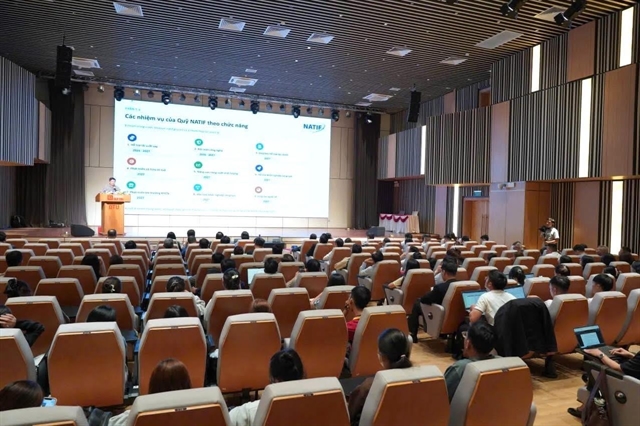 |
| Overview of the seminar on the call for funding proposals for AI-based technology innovation projects for 2026 and the direction for support and funding in 2027. Photos courtesy of NATIF |
HÀ NỘI — The National Technology Innovation Fund (NATIF) plans to fund 15 projects in 2026 to help businesses move artificial intelligence (AI) from pilot testing into production and commercial use.
Businesses can receive up to VNĐ3 billion (US$117,000) in state funding per project, provided their proposals address clearly defined business needs, specify deliverables and set measurable targets.
The programme was outlined at a workshop jointly organised by NATIF and Duy Tân University in Đà Nẵng on September 29. The event invited funding proposals for technology innovation projects using AI in 2026 and discussed funding and support priorities for 2027.
Speaking at the workshop, NATIF Deputy Director Tạ Việt Dũng said the legal framework for science, technology and innovation was being refined, with greater emphasis on practical applications and measurable outcomes.
Research and technological innovation, he said, must address businesses’ needs, deliver results that can be applied in practice and lead progressively to commercialisation.
These principles underpin the 2026 programme. NATIF plans to select and sign contracts for 15 projects, each to be completed within 12 months.
State funding will cover up to 50 per cent of implementation costs, capped at VNĐ3 billion per project. Businesses must contribute at least 50 per cent of the total budget from their own cash resources.
Projects must focus on one of three areas: replacing imported technology; mastering and adapting technology for domestic use; or acquiring technology through lawful transfers to develop products and solutions that meet practical needs.
Beyond technological development, proposals must demonstrate how they will solve a specific business problem. Projects must aim to deliver a viable product or minimum viable product (MVP), measure improvements in productivity, quality, costs or revenue, and show potential for wider adoption.
The programme also aims to train around 250 AI experts and engineers through practical work, support training for about 100 engineers from participating businesses and 100 interns, and help develop approximately 50 AI models, products or solutions made in Việt Nam.
Proposals must be submitted online at oms.natif.vn by 5pm on October 10, 2026. Selection and contract signing are expected to be completed in December.
From 2027, NATIF expects to broaden its funding and support beyond AI to meet a wider range of business needs for technological innovation.
Planned areas of support include technology innovation, loan interest subsidies, financial support vouchers, intellectual property development, productivity and quality improvements, innovative start-ups, the commercialisation of research results and initiatives to encourage a culture of entrepreneurship and innovation.
Support for commercialisation will involve intermediary organisations, technology exchanges and links between technology providers and potential users, helping bring research results and technology into production and commercial use more quickly.
On the sidelines of the workshop, a representative of MRIV International, a member of the Mitsubishi Research Institute Group, introduced a Việt Nam–Japan technology innovation co-funding programme involving NATIF and Japan’s New Energy and Industrial Technology Development Organisation (NEDO).
The programme is expected to involve at least one Vietnamese business or organisation and one Japanese partner, with priority given to energy, the environment, AI, automation and advanced technology.
It is among the international co-operation initiatives NATIF plans to pursue from 2027, giving businesses further opportunities to access international funding, expertise and technology. — VNS
Sci-Tech
 Sci-Tech
 Sci-Tech
 Sci-Tech
 Sci-Tech
 Sci-Tech
 Sci-Tech
 Sci-Tech
 Sci-Tech
 Sci-Tech
 Sci-Tech
 Sci-Tech
 Sci-Tech
 Sci-Tech
 Sci-Tech
.jpg)