 World
World
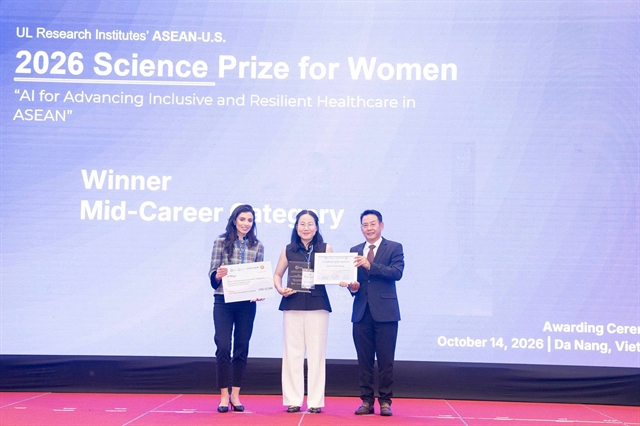
Vietnamese scientist wins ASEAN-US Science Prize for Women
1.
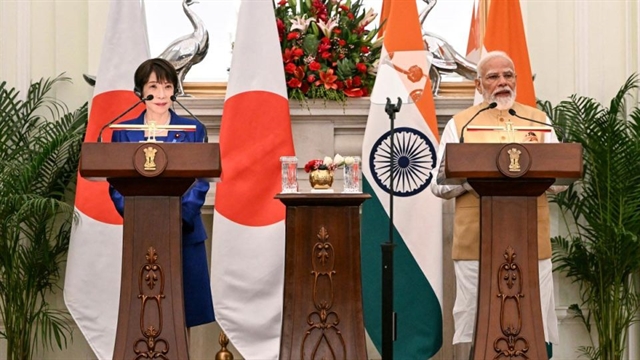 |
| Japan's Prime Minister Sanae Takaichi (left) listens as India's Prime Minister Narendra Modi speaks during their joint press statements after their meeting at the Hyderabad House in New Delhi on July 2, 2026. —AFP/VNA Photo |
TOKYO — Japanese Prime Minister Sanae Takaichi and her Indian counterpart Narendra Modi held talks in New Delhi on Thursday and confirmed deepening bilateral cooperation in such areas as economic security and artificial intelligence.
“It is becoming increasingly important to build this mutually complementary cooperative relationship – one in which Japan and India leverage each other’s strengths to grow stronger and more prosperous together – amidst the current turbulent international situation,” Takaichi said at a joint appearance following their talks.
She identified as priority areas the deepening of the strategic partnership, the promotion of cooperation on economic and energy security, and growth competition through collaboration on investment and innovation.
“Under our Special Strategic and Global Partnership, I would like to take Japan-India relations to new heights,” she added.
Joint statement
A joint statement to be issued by Japanese Prime Minister Sanae Takaichi and her Indian counterpart Narendra Modi was to reaffirm the content of last year’s agreement and call for promoting mutually complementary cooperation in such pressing areas as economic security. The statement was to place value on the evolution of a free and open Indo-Pacific vision as advocated by the Takaichi administration.
In the security sector, in addition to progress in maritime security cooperation, the statement was to welcome Japan’s revision of Three Principles on Transfer of Defense Equipment and Technology and the principles’ operational guidelines, made in April. It was also to include plans to hold a Japan-India foreign and defense ministerial meeting within this year.
The statement was to express grave concerns over economic coercion and nonmarket policies, with China’s rare earth export restrictions in mind. In energy security, Japan and India will work together to enhance their energy supply and storage capabilities.
The statement was to include Japan’s support for a better business environment in India and Japanese small and medium-sized firms’ expansion into the Indian market. Cooperation toward the introduction in India of the E10 series of Shinkansen trains, currently under development by East Japan Railway Co., was also to be promoted.
Invest ¥2 tril
Japanese companies were to sign 120 cooperation agreements with Indian counterparts, injecting ¥2 trillion in total, in a significant step forward in expanding into the rapidly growing Indian market.
The agreements were to be made in line with Thursday’s meeting between Takaichi and Modi.
She told reporters before her departure from Japan, “The public and private sectors will work together to broaden the scope of Japan-India cooperation to make the economy strong,” citing deeper economic and security cooperation and collaboration on technological innovation as priorities of her visit.
According to government sources, the 120 agreements to be reached this time included Fujifilm Corp.’s cooperation on chip materials manufacturing in India and Suzuki Motor Corp.’s biogas plant project. Collaboration spreads across a wide range of industries, such as Japanese artificial intelligence startups working with Indian counterparts on app development.
Last year, Japan and India agreed to set a target of ¥10 trillion in private investment in India from Japan over 10 years, and the ¥2 trillion worth of projects under the expected cooperation agreements is part of that effort.
Regarding scientific and technological cooperation, the statement was to emphasise that promoting innovation, including AI, is extremely important for further broadening the foundation of cooperation.
According to a draft of the statement, the two countries position themselves as strategic research and development partners in the field of AI and will strengthen industry-government-academia collaboration in developing AI models. To promote joint research, the statement was to agree that they are committed to engage in exchanges of human resources among universities and companies and to invite 500 highly skilled AI professionals from India to Japan by 2030.
The statement was to address frontier AI – highly capable AI models, which the two leaders recognize as possessing high cyber capabilities but also carrying the risk of misuse. Japan and India were to decided to strengthen cooperation on AI-enabled cybersecurity systems, particularly for critical infrastructure. — THE JAPAN NEWS/ANN
World
 World
World
 World
World
 World
World
 World
World
 World
World
 World
World
 World
World
 World
World
 World
World
 World
World
 World
World
 World
World
 World
World
 World
World