 World
World
VN-Index ends lower despite liquidity hit over $1 billion
1.
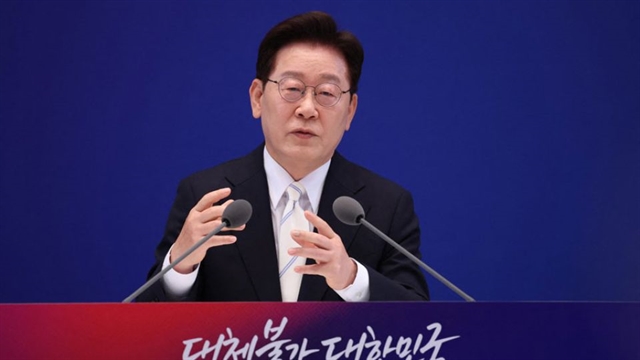 |
| South Korean President Lee Jae Myung attends a press conference to mark the first anniversary of his inauguration at the Blue House in Seoul on June 8. — AFP Photo |
SEOUL — South Korea's President Lee Jae Myung has unveiled an ambitious plan to build the country’s own generation of security-technology champions, seeking to cultivate companies capable of matching industry leaders such as Palantir.
Lee set a goal of creating five companies valued at more than 1 trillion won (US$650 million) and 50 firms with annual sales exceeding 100 billion won by 2030.
Lee announced the initiative while chairing a strategy meeting at Cheong Wa Dae in Seoul, where officials outlined plans to foster next-generation security technology companies and support the defense and space industries.
“The emerging security market will become a new opportunity for the Republic of Korea’s innovative startups,” Lee said on Friday, referring to South Korea by its official name during the meeting.
“Just as the US’ Palantir and Anduril grew from the conviction and passion of young entrepreneurs into world-leading security innovators, we will spare no effort in supporting Korean innovation companies so they, too, can stand at the forefront of the emerging security market.”
Lee underscored the importance of cultivating advanced security technology companies, saying modern warfare is expanding beyond the traditional domains of land, sea and air into space, cyberspace and artificial intelligence.
Lee said cutting-edge civilian technologies – including advanced semiconductors, drones, robots and satellite networks – have become critical to national security.
“Fostering security innovation companies at the national level is of paramount importance if the Republic of Korea is to transform itself from a traditional defence industry powerhouse into a global leader in emerging security technologies,” Lee said.
“Our government seeks to foster innovative companies with proprietary cutting-edge technologies in emerging security fields such as artificial intelligence, drones, cybersecurity and aerospace,” Lee added.
During the meeting, Lee stressed the need to nurture defense technology innovators.
Lee pointed out that South Korea’s defence industry remains “heavily skewed toward large companies and hardware-based weapons systems” and that its “procurement structure is slow and rigid.”
“We must build innovative companies capable of competing head-to-head with the US’ Palantir, valued at 480 trillion won, and Germany’s Helsing, valued at 26 trillion won,” Lee said.
To achieve the 2030 goal, Lee laid out a series of measures aimed at helping young security technology firms move more quickly from development to government procurement.
In nondefense areas such as aerospace, the government plans to introduce a new contract system designed to allow public agencies to quickly purchase innovative technologies and products.
In the defence sector, the government will create a fast-track acquisition system so advanced weapons systems can be initially deployed within a year.
Lee also said the government would expand strategic investment in the emerging security industry by establishing a Korean version of In-Q-Tel, the US CIA-backed venture capital model that links investment in startups with technologies needed for national security.
The Korean government also plans to build a stronger pipeline of security technology talent by designating universities as startup hubs and expanding support for young entrepreneurs, Lee added.
To support the effort, Lee said the government will launch an interagency task force and push for a special law aimed at creating a new defense procurement system centered on innovative companies.
During the meeting, First Vice Minister of SMEs and Startups Roh Yong-seok laid out a plan to foster startups developing next-generation security technologies. Administrator of Korea AeroSpace Administration Oh Tae-seog outlined measures to strengthen new security through the space and aerospace industry.
Defence Minister Ahn Gyu-back outlined a four-pronged strategy to accelerate the military’s adoption of advanced technologies and strengthen South Korea’s defence innovation ecosystem.
Ahn said the military would expand units dedicated to testing innovative technologies from one to nine by the second half of this year. Ahn also pledged to broaden access to military data by converting it into AI-compatible formats and making more datasets available for civilian use.
The ministry will also establish a fast-track acquisition system tailored to rapidly evolving technologies.
Ahn said the military would take the lead in creating public demand for domestically developed drones and expanding the industry’s ecosystem.
As part of the effort, the ministry will accelerate the deployment of the K-Lucas, a domestically developed long-range loitering munition, and train 500,000 drone-capable troops so that every service member can use drones “as a second personal weapon.”
“By rapidly fielding advanced capabilities such as AI-enabled drones, strengthening the military’s ability to employ them, and fostering a domestic defence innovation ecosystem, the Defence Ministry aims to achieve three objectives simultaneously,” Ahn said.
Attendees from the private and research sectors will include the heads of security-related research institutes, experts and representatives from relevant organisations, including the Korea National Defence University, the Agency for Defence Development, the Korea Aerospace Research Institute, the National Security Research Institute, the Korea Startup Forum and defence fund managers. — The Korea Herald/ANN
World
 World
World
 World
World
 World
World
 World
World
 World
World
 World
World
 World
World
 World
World
 World
World
 World
World
 World
World
 World
World
 World
World
 World
World