 World
World

Korean folk art meets digital media in Hà Nội
1.
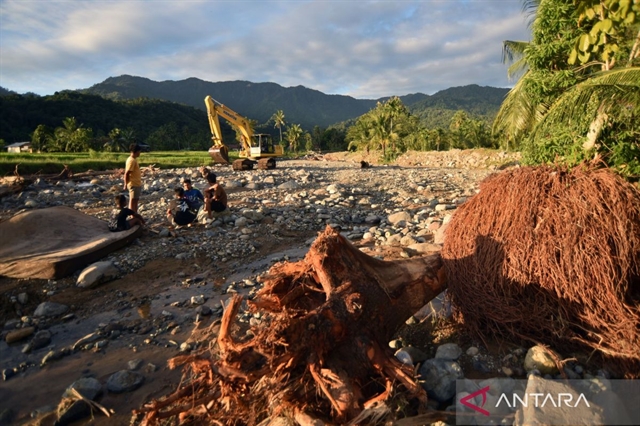 |
| Residents in an area affected by flash floods in Lapau Munggu, Kuranji, Padang, West Sumatra, on August 4, 2026. — ANTARA Photo |
JAKARTA — The Indonesian Government has developed a cross-sectoral response framework to prepare for the risk of a strong El Niño in the second half of 2026, focusing on four priority areas: agriculture and forestry; energy and water resources; healthcare; and fisheries and food.
Deputy for Food, Natural Resources, and Environment at the Ministry of National Development Planning Lenardo A.A. Teguh said at a national dialogue on strengthening response against the phenomenon on August 4 that the new policy brief identifies risks, maps the distribution of impacts, and formulates response directions, according to the Indonesian news agency Antara.
Previously, the Meteorology, Climatology, and Geophysics Agency (BMKG) forecast that a strong El Niño could emerge in the second half of 2026, potentially reducing rainfall in some areas to below 20mm per month. The government estimates that without early intervention, economic losses from climate change in priority sectors could exceed 2 quadrillion IDR (US$111 billion).
Under its response plan for agriculture and forestry, Indonesia is stepping up forest and peatland fire prevention and firefighting, deploying weather modification technology, improving irrigation systems, putting boreholes into operation, distributing drought-resistant crop varieties, and expanding agricultural insurance. These measures aim to mitigate the impact of drought on rice, palm oil and coffee production.
In energy and water resources, water storage facilities and river basin conservation infrastructure are being maintained, while weather modification measures are being implemented to help sustain water supplies and minimise impacts on hydropower generation. Meanwhile, reduced cloud cover during the dry season is expected to create favourable conditions for higher solar power generation.
In healthcare, Indonesian authorities are planning to strengthen surveillance of climate-sensitive diseases such as dengue fever and malaria, enhance the preparedness of the healthcare system, ensure access to clean water, and step up risk warnings for communities.
Meanwhile, oceanographic data will be used to develop production plans and apply more efficient aquaculture technologies. — VNA/VNS
World
 World
World
 World
World
 World
World
 World
World
 World
World
 World
World
 World
World
 World
World
 World
World
 World
World
 World
World
 World
World
 World
World
 World
World

.jpg)