 World
World
Sơn La hit by two earthquakes within 30 minutes
1.
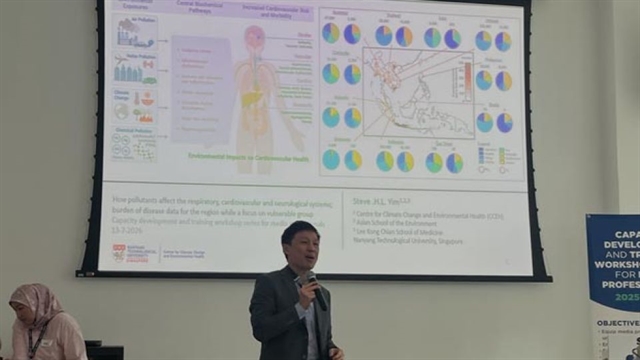 |
| Centre for Climate Change and Environmental Health (CCEH) Director Prof Steve Yim giving a lecture at “Cutting Through the Haze: Transboundary Air Pollution, El Niño and Health Reporting,"" held at Sunway University, Malaysia. — ANN/VNS Photo |
MANILA — The Southeast Asia environment is in a highly vulnerable context as it faces multiple hazards, with countries in the region being disproportionately affected by the invisible yet severe impacts of climate-exacerbated air pollution.
Centre for Climate Change and Environmental Health (CCEH) Director, Prof. Steve Yim, discussed the relationship between climate change, air pollution, and health during a two-day workshop titled “Cutting Through the Haze: Transboundary Air Pollution, El Niño and Health Reporting”.
In his talk, attended by journalists from South and Southeast Asia, Prof. Yim first laid the foundation that air pollution causes a specific type of lung cancer, which is lung adenocarcinoma (LADC).
“Globally, while it is good that lung squamous cell carcinoma (LSCC) – a subtype of lung cancer associated with smoking – has shown a decreasing trend because the smoking population is sliding, it is important to note that lung adenocarcinoma (LADC), a subtype caused by air pollution, has shown an increase, especially for women,” said Prof. Yim.
The environmental professor linked the rise in LADC cases to inhaling black carbon, a fine particulate matter from the incomplete combustion of fossil fuels such as gas and diesel, and said that this is an overlooked concern because governments around the world have still not yet regulated emissions of black carbon, as compared to other emissions.
Air pollution isn’t just contained in one place, nor does it come from a specific source, which is why he emphasised that this pollution and concern can be local and transboundary.
In Singapore, where traffic from motorised vehicles is a source of air pollution, air pollution is somewhat regulated by more stringent laws governing car ownership. On the other hand, for countries like Cambodia, there are diversified sources of emissions.
The professor also presented graphs showing emissions from neighbouring countries and their sources, which showed that border-sharing Southeast Asian countries in the Mekong readily exchange pollutants with other locations.
Meanwhile, there were more local emissions in separate archipelagic countries like Indonesia and the Philippines at upwind locations. In contrast, countries at the downwind locations would be easily affected by emissions from upwind countries, as shown in the relationship between Indonesia and Singapore.
“Warmer climates brought up haze episodes in Indonesia, Malaysia, and Singapore, especially in 2015 during periods of El Niño, and the toxic species strongly associated with this spike was black carbon.
“Climate variability and weather patterns that impact the air are also variables in the transboundary nature of air pollution,” said Prof. Yim.
He also stated that air pollution doesn’t just come from the air, but also from the effects of deforestation when land is not managed properly, such as over-expansion of cropland.
“We cannot apply one strategy for different countries; that’s why I say a co-benefit is important because if we do not have a systematic and comprehensive way to control emissions, we would not be able to maximize the benefit.
“We need cooperation in the region to solve the problem not only by ourselves but also by talking to the neighbouring countries to solve the problem together,” Prof. Yim concluded.
Across the workshop sessions, speakers emphasised the urgent need for a regional and overall approach to address transboundary air pollution and planetary health.
They emphasised that while air pollution is invisible, its impacts on health and the planet are experienced in varying degrees in the region, which is why reporting and conversations about it must be encouraged to shape policies for the health and welfare of people and the planet. — ANN/VNS
World
 World
World
 World
World
 World
World
 World
World
 World
World
 World
World
 World
World
 World
World
 World
World
 World
World
 World
World
 World
World
 World
World
 World
World