 World
World

LOAN Foundation awards scholarships to disadvantaged students on 10th anniversary
1.
|
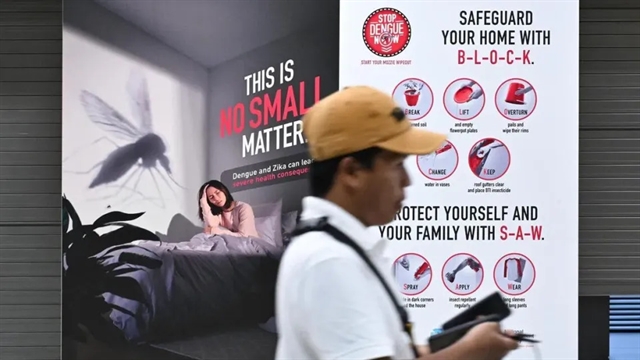
| According to data from the National Environment Agency, there were 1,180 reported cases of dengue in Singapore in the first half of 2026. —THE STRAITS TIMES/ANN Photo |
SINGAPORE — While dengue numbers in Singapore remain low, a change in the dominant serotype could point to increasing infections here, said experts.
According to data from the National Environment Agency (NEA), there were 1,180 reported cases of dengue here in the first half of 2026 – 54 per cent down from the 2,583 cases over the same period in 2025.
Dengue cases in Singapore have fallen in recent years, amid an expansion of Project Wolbachia – an initiative to control the Aedes mosquito population here.
However, infections have been creeping up with the country experiencing peak dengue season, which runs from May to October.
There were 770 dengue cases recorded between April and June, an 87.8 per cent increase from the 410 seen in the first quarter of the year.
This comes amid a change in the predominant dengue serotype in the Republic.
The DENV-3 serotype – which made up just 19.1 per cent of cases in January – comprised 59.9 per cent of infections here in June, according to the NEA’s quarterly dengue surveillance data, published on July 21.
There are four dengue serotypes, or strains, which are distinct but closely related.
People who are infected by one serotype can still be infected by one of the other three. A switch in the dominant serotype is typically followed by a spike in dengue cases, due to lower immunity to the new strain.
Across the Causeway, a shift in serotypes has been cited as one of the reasons for a spike in dengue infections.
Earlier in the month Malaysia’s health ministry said dengue numbers in the country had spiked, with 42,848 recorded cases of the disease as of July 9 – a 34.8 per cent increase from the same period in 2025.
The ministry said then that 34 people had died from dengue, up from 19 across the same period last year.
Health Minister Dzulkefly Ahmad said that the DENV-3 serotype was now dominant in Malaysia.
Vietnam meanwhile reported more than 50,000 dengue cases of dengue fever in the first five months of 2026 – double the number of infections seen over the same period the previous year.
A serotype switch is the most likely reason for such spikes, said Paul Tambyah, the immediate past president of the Asia Pacific Society of Clinical Microbiology and Infection.
He noted that this is the case with most dengue spikes over the years, as well as other viral infections such as influenza and COVID-19, which regularly see new strains or variants.
The spike in Malaysia has been concentrated around Selangor, Kuala Lumpur and Putrajaya, where almost two-thirds of infections have occurred.
However, the constant movement of people up and down the peninsula could result in spikes in Johor and Singapore, said Tambyah, who is also professor of medicine at the National University of Singapore’s Yong Loo Lin School of Medicine.
“Singapore has already seen a rise in the number of dengue cases in the last quarter and this is likely to continue,” said Tambyah.
He noted however that this may not occur if DENV-2 serotype – which made up 67.6 per cent of cases at the start of 2026 – once again became predominant. Such sudden switches have happened in the past, he said, though the reasons for such occurrences are unclear.
Ooi Eng Eong – a professor in the emerging infectious diseases programme at Duke-NUS Medical School – pointed out that Singapore’s vector control programme means reduced dengue transmission and a longer interval between major outbreaks.
As such, an outbreak in Malaysia may not necessarily translate into one in Singapore, he said.
Ooi said that with all four dengue serotypes circulating in Singapore, outbreaks of the disease here cannot always be attributed to low population immunity to an emerging strain.
Genetic changes in each of the four strains can affect their ability to spread, and several dengue outbreaks have now been found to be caused by such genetic attributes, he said.
“However, our ability to predict epidemics based on the genomic sequence of the viruses, is still very much in its infancy. Research to understand the genetic changes that affect epidemic spread of dengue viruses remain much needed,” said Ooi.
Tambyah said that a large spike in cases can be avoided by using the “tried and true techniques” of rapid case detection and surveillance, as well as timely and appropriate vector control.
“These have worked in the past and are likely to work well again despite the serotype switch – at least in moderating the rise that we have already seen.” — THE STRAITS TIMES/ANN
World
 World
World
 World
World
 World
World
 World
World
 World
World
 World
World
 World
World
 World
World
 World
World
 World
World
 World
World
 World
World

.jpg)